Angara
The Native People of the Heleus Cluster
The angara were the only known living sapient race native to the Heleus Cluster of the Andromeda galaxy. After a catastrophe called the Scourge shattered their ancient civilization, they rebuilt only to face the invading kett, against whom they waged a decades-long resistance.
The angara were the only known living sapient race native to the Heleus Cluster of the Andromeda galaxy. A warm-blooded, communally minded mammalian people, they had once built an advanced civilization spanning many worlds before a catastrophe called the Scourge sent them into a century-long dark age. By the time the Andromeda Initiative made first contact with them, the angara had been waging a decades-long resistance against the invading kett. Among the angara who allied with the Initiative was Jaal Ama Darav, an agent of the Angaran Resistance. (Mass Effect: Andromeda)
Biology#
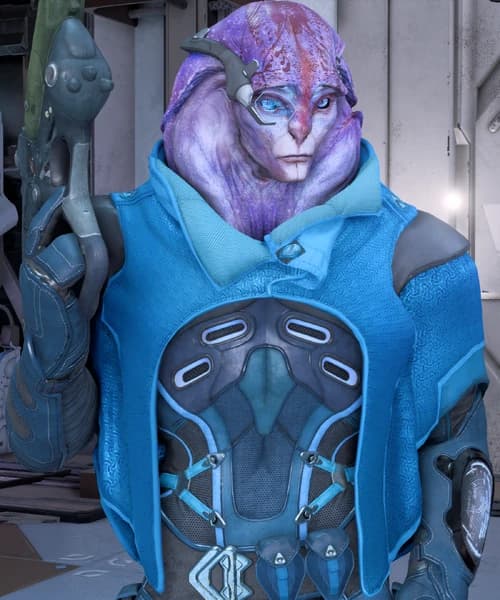
The angara were warm-blooded mammals with broad shoulders, narrow waists, and a leg structure resembling that of the quarians, salarians, and kett. They had two black eyes with blue irises, a single pair of nostrils, and folds of flesh along the sides of their heads that extended down to their chests. Their hands bore the bone structure for five fingers, but the final three on each hand were densely webbed into a single digit, and their feet were built similarly, giving the impression that they stood on their hands. Skin colors ran through shades of blue and mauve, sometimes shading into green or tan, and their blood was a deep blue. Male angara were taller than females, while females had wider hips and rounder faces. (Mass Effect: Andromeda)
Their internal biology differed markedly from that of the Milky Way species. To Jaal, Milky Way food tasted bland. Though every organism produced some natural bioelectrical field, the angara generated an especially intense one and could exert fine control over it, using it for purposes such as communication. Their physiology also depended on sunlight, specifically the electromagnetic radiation emitted by a sun. Deprived of real or artificial light they would go dark, suffering a severe weakening of their immune systems and bio-energy, and prolonged deprivation could lead to a coma and death. To compensate, they relied on powerful ultraviolet lamps for both heat and light. Their physiology was regarded as well suited to harsh environments, and some angara on the frozen world of Voeld preferred its cold to the temperate climate of Aya. (Mass Effect: Andromeda)
History and the Scourge#
According to the angara themselves, they had once been a highly advanced species that originated on Havarl and spread to many worlds across the Heleus Cluster. An ancient site on Havarl called the Forge held the oldest known pre-Scourge ruins and was regarded as the birthplace of their civilization. The appearance of the Scourge ruined their worlds and plunged their civilization into a pre-industrial dark age lasting a century, carrying away much of the knowledge of their own past. (Mass Effect: Andromeda)
The survivors of five worlds, including Havarl and Voeld, eventually rediscovered spaceflight and reestablished contact, only to find that their long isolation had bred divergent cultures. The angara began to expand once more, colonizing Kadara and Aya, and worked toward a new unified government. That rebuilding was disrupted by the kett invasion of the cluster around 2744. No angaran records of first contact with the kett survived, but the few surviving details indicate that the kett made overtures of peace and trade before kidnapping or assassinating angaran leaders, setting their worlds against one another. By the time the angara recognized the true enemy, their formal military and space fleet had already been destroyed. Multiple resistance movements arose but achieved little until 2814, when Evfra de Tershaav reorganized them into the Angaran Resistance, headquartered on Aya. (Mass Effect: Andromeda)
The Jardaan and the truth of their origin#
Unknown to the angara, they were not a naturally evolved species but a created one, the product of an advanced race native to Heleus known as the Jardaan, who were also responsible for the Remnant machines. Several millennia before the arrival of the Andromeda Initiative, the Jardaan had designed the first angara through advanced genetic manipulation and seeded them across the cluster, though their reasons remained unknown. This truth came to light only when explorers discovered Jardaan gestation facilities aboard the spaceborne Remnant city of Khi Tasira, a revelation that shocked angara and Milky Way arrivals alike. (Mass Effect: Andromeda)
Culture and society#
The angara were free with their emotions, demonstrative and described as larger than life, saying and doing what they meant even when it led to violence, sometimes within their own families. Long mistrustful of outsiders, whose most recent example before the Initiative had been the predatory kett, they organized their lives around large, almost clan-like families. Beyond an individual's biological or true parents, an ordinary angara had multiple mothers and many siblings and cousins, and a household of a person plus their parents and eighteen siblings was considered average. With the education system shattered by the invasion, these families took on the work of schooling and socializing the young, teaching everything from literacy to weapons handling. (Mass Effect: Andromeda)
As a people the angara were communally focused rather than individualist, structuring their society around an ideal of horizontal collectivism. Individual liberty, legal equality, and private property existed, but convention pressed each angara to subordinate personal desire to the wider whole, whether family, community, or species. Charity, cooperation, and self-sacrifice were emphasized, and crimes were judged not only by their nature but by how widely their consequences spread. Sickness was treated as a private matter, awkward to discuss openly. In pre-Scourge myth the angara had once produced figures called Moshae, master inventors of great wisdom and compassion; in later times the title was given to Sjefa for her contributions to angaran civilization. (Mass Effect: Andromeda)
Religion#
The angara held many different religions, all sharing one basic tenet: that when an angara died, the soul was reincarnated and remained within the family, strengthening the lineage. The souls of angara who had been exalted by the kett, however, were believed to be lost forever. The angara preferred to worship in private, holding that faith was strongest when unobserved, and they honored the spiritual isolation of their kett-enslaved kin. (Mass Effect: Andromeda)
In recent times a number of young angara came to believe that enlightenment could be forced by hurling themselves at death. Labeled Gloryseekers, they trained as hard as any in the Resistance and then carried out suicide missions against the kett, accepting death calmly in the belief that they would be reborn stronger and wiser. By their creed it did not matter whether such a mission succeeded, so long as the angara died fighting; returning alive with nothing accomplished was viewed as cowardice unworthy of blessed rebirth. Older angara such as the priestess Roshwar Linn regarded these deaths as needless sacrifice. (Mass Effect: Andromeda)
Language#
The angara spoke between two and three hundred languages, but their most common tongue was Shelesh, a lingua franca developed in the early days of angaran spaceflight before the Scourge. Shelesh faded into obscurity as their civilization collapsed and was revived only as separated settlements reestablished relations. The word angara itself meant civilized people, or those who had put down roots, derived from anj, meaning anchor. Their vocabulary reflected their values and history: gosavar named the Resistance as a whole, Heskaarl named an elite military group comparable to the human N7s, and vesagara, meaning uprooted people or exiles, was a derogatory term the xenophobic Roekaar applied to arrivals from the Milky Way. (Mass Effect: Andromeda)
Government and military#
The de facto seat of angaran civilian government was on Aya, where the planetary governor held the highest office in civilian affairs. Governors were chosen by democratic election, preceded by candidates arguing loudly over their platforms until only one remained, and were limited to a single term out of fear that political power might be misused. Military matters fell to the Angaran Resistance, a separate but integral organization. The angara fielded no standing military as such, though centuries before the arrival of outsiders they had maintained the Heskaarl, special forces whose training was comparable to that of the N7 program and whose knowledge was passed down by oral tradition. Their weapons included the Isharay, the Ushior, the Sovoa developed jointly with the turians, and the firaan. They also fielded fighter craft and transports, calling their shuttle-sized vessels cruisers, a term that among Milky Way species denoted far larger warships. (Mass Effect: Andromeda)
The arrival of the Andromeda Initiative, though welcomed by the Resistance, provoked a faction called the Roekaar. Founded by the charismatic Akksul out of resentment toward the Resistance and hatred of the kett, the Roekaar were a xenophobic paramilitary force hostile to all non-angara, and they were officially disavowed by the Resistance. (Mass Effect: Andromeda)
Frequently asked questions
- Who are the angara?
- The angara were the only known living sapient species native to the Heleus Cluster of the Andromeda galaxy. They were a communally minded mammalian people who had been fighting a long resistance war against the invading kett by the time the Andromeda Initiative made first contact with them.
- Where did the angara come from?
- The angara believed they had originated on Havarl and spread across the Heleus Cluster as an advanced civilization. In truth, they were a created species, engineered through advanced genetic manipulation by an ancient race called the Jardaan, who also built the Remnant machines and seeded the angara across the cluster for reasons that remained unknown.
- What was the Scourge?
- The Scourge was a catastrophe that ruined the angaran worlds and collapsed their civilization into a pre-industrial dark age lasting a century, erasing much of their recorded history. The survivors on five worlds eventually rediscovered spaceflight and reestablished contact, only to be invaded by the kett.
- How do the angara depend on sunlight?
- Angaran physiology relied on the electromagnetic radiation given off by a sun. Without real or artificial sunlight they would go dark, which severely weakened their immune systems and bio-energy, and prolonged deprivation could lead to a coma and death. They used powerful ultraviolet lamps to supplement their light intake.
- What is the Angaran Resistance?
- The Angaran Resistance was the unified fighting force that opposed the kett occupation, headquartered on Aya. It was formed in 2814 when Evfra de Tershaav reorganized the scattered, struggling resistance movements into a single organization, and it later welcomed the arrival of the Andromeda Initiative as a potential ally.
Sources
- GameMass Effect: Andromeda, BioWare, 2017
Spotted a factual error or a primary source we missed? Email a correction. Every flagged claim gets reviewed.
Followed from this entry
Jaal Ama Darav: Angaran Resistance Fighter
Jaal Ama Darav was an angaran native of Havarl and a high-ranking member of the Angaran Resistance against the kett. Sent to observe the newly arrived Andromeda Initiative, he joined the human Pathfinder's crew aboard the Tempest and became one of its most loyal members.
Kett: Conquerors of Heleus
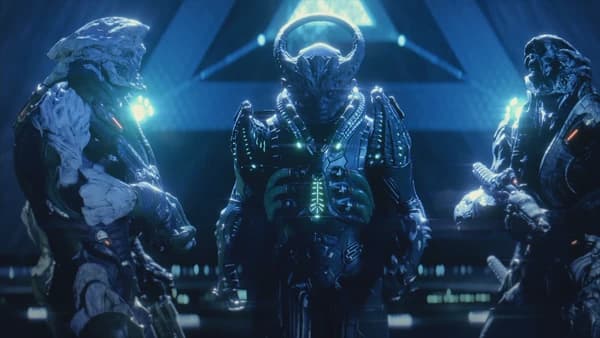
The kett were a hostile, militaristic species encountered by the Andromeda Initiative in the Heleus Cluster. Unable to breed by natural means, they expanded their ranks and their empire through exaltation, a process that converted captured members of other species into obedient kett.

Every Mass Effect Species and Race, With Lifespans
A field guide to every sapient species in Mass Effect, from the Council races and their clients to the krogan, the geth, the Protheans and the peoples of the Heleus Cluster. Each entry gives the homeworld, the lifespan where the games actually state one, and where the species stood with the Citadel.

Heleus Cluster: The Initiative's New Frontier
The Heleus Cluster was a resource-rich region of star systems on the outskirts of the Andromeda galaxy, chosen by the Andromeda Initiative as its foothold in the new galaxy. Centered on a massive black hole and seeded with abundant Element Zero, it held the worlds the Initiative hoped to settle.

Kadara: Haven of Exiles and Pirates
Kadara was a mountainous world in the Heleus Cluster, first settled by the angara and later overrun by exiles and pirates who fled the Nexus. Its waters ran toxic with sulphides until a Remnant vault was reactivated, after which the Andromeda Initiative was able to plant an outpost there.

Voeld: Frozen Angaran World
Voeld was an angaran world in the grip of an ice age, set in the Heleus Cluster of the Andromeda galaxy. Once dense with cities, it had become a frozen battleground where scattered angaran settlements and a resistance held out against the occupying kett.
Mentioned in15 entries
Andromeda Initiative: the one-way voyage to the Heleus Cluster
The Andromeda Initiative was a privately funded, multi-species project to settle the Andromeda galaxy. Founded by Jien Garson in 2176, it sent the Nexus and its arks across dark space in 2185, and they reached the Heleus Cluster more than six centuries later to find almost nothing as promised.
Background Races: the vanished civilizations known only from ruins
Across billions of years, countless races rose to sentience in the Milky Way and Andromeda, forged civilizations, explored the depths of space, and became extinct. The contemporary galaxy knew most of them only through ruins, wreckage, and artifacts, from the crypt builders of Armeni to the nameless dead entombed in the clouds of Anjea.
Drugs: the narcotics and medicines of the galaxy
Drugs were chemical substances that altered the normal bodily functions of an organism, and the galactic market for them was lucrative enough that criminal enterprises produced, sold, and smuggled them despite legal restrictions. They ranged from lifesaving antibiotics to red sand, a narcotic refined from element zero that granted brief biotic power, and to suppressants engineered to strip a biotic of that power entirely.
Every Mass Effect Romance Option, Game by Game
Every romance in Mass Effect, Mass Effect 2, Mass Effect 3 and Andromeda: who each character is, whether a male or female Shepard or Ryder can romance them, how the relationship plays out and what happens to it in the next game. Fates that depend on choices are given as choices.
Every Mass Effect Species and Race, With Lifespans
A field guide to every sapient species in Mass Effect, from the Council races and their clients to the krogan, the geth, the Protheans and the peoples of the Heleus Cluster. Each entry gives the homeworld, the lifespan where the games actually state one, and where the species stood with the Citadel.
Every Mass Effect Squadmate and Companion, Game by Game
Every squadmate in Mass Effect, Mass Effect 2, Mass Effect 3 and Andromeda, with their species, how they join, what their story is about and how they can die. Fates that depend on player choices are given as choices, because the series never picks one canon.
Heleus Cluster: The Initiative's New Frontier
The Heleus Cluster was a resource-rich region of star systems on the outskirts of the Andromeda galaxy, chosen by the Andromeda Initiative as its foothold in the new galaxy. Centered on a massive black hole and seeded with abundant Element Zero, it held the worlds the Initiative hoped to settle.
Jarun Tann: Director of the Andromeda Initiative
Jarun Tann was a salarian bureaucrat who became Director of the Andromeda Initiative after the deaths of every leader above him. Self-important and insecure yet broadly well-meaning, he steered the Nexus through famine, mutiny, and the search for a habitable home in the Heleus Cluster.
Kadara: Haven of Exiles and Pirates
Kadara was a mountainous world in the Heleus Cluster, first settled by the angara and later overrun by exiles and pirates who fled the Nexus. Its waters ran toxic with sulphides until a Remnant vault was reactivated, after which the Andromeda Initiative was able to plant an outpost there.
Mass Effect Story Explained: the Trilogy and Andromeda
The whole Mass Effect story in order, one game at a time. Shepard stops Saren, beats the Collectors and leads the galaxy against the Reapers, then Andromeda starts again 600 years later in another galaxy.
Mass Effect Timeline: every major event from the Leviathans to Andromeda
A dated history of the Mass Effect universe, from the Leviathans and the first Reaper harvests through the fall of the Protheans, the Council's wars, humanity's arrival and the Reaper War of 2186. It ends with the Andromeda Initiative reaching the Heleus Cluster in 2819, and runs oldest first in eras.
Mass Effect: Andromeda Story Explained
The plot of Mass Effect: Andromeda in order, from the Hyperion's arrival in the Heleus Cluster to the battle for Meridian. Who the kett are, what the Remnant vaults do, and what the ending leaves open.
+ 3 more
Get new articles in your inbox
No spam. New lore drops, canon conflicts, and deep dives only when they’re worth reading.
Some links on Lore Fortress are affiliate links. If you buy through them we earn a small commission at no extra cost to you.