Viper Mark VIIa
the networked Colonial fighter
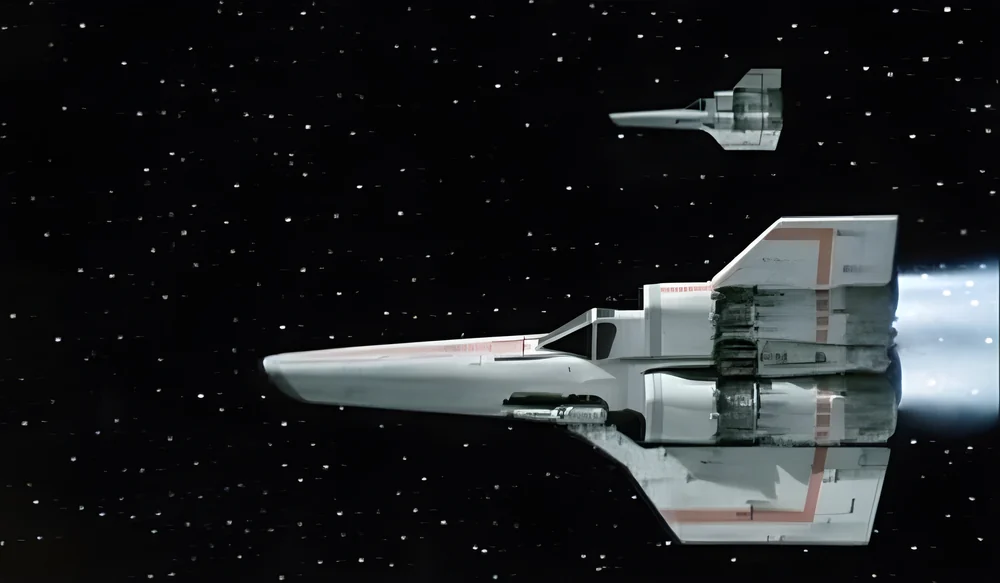
The Viper Mark VIIa was the seventh generation of the Colonial Fleet's space-superiority fighter, fielded in the years before the Fall of the Twelve Colonies. Its networked computers and Command Navigation Program left almost all of its kind vulnerable to a Cylon remote shutdown during the Fall.
The Viper Mark VIIa was a space-superiority fighter used by the Colonial Fleet in the years prior to the Fall of the Twelve Colonies. It was the seventh generation of Viper, a name the Colonies had given to fighting aircraft since before the Cylon War. On screen it is simply the Mark VII; "Mark VIIa" is a fan label for the original exterior design, as distinct from the reworked look seen from "Maelstrom" onwards. (Battlestar Galactica miniseries; Caprica, "Things We Lock Away")
Design and the Command Navigation Program#
The Mark VII was designed at a time when the Colonial Fleet had become increasingly generous with the computer technology that could be used aboard its craft. The Mark VII's cockpit is almost fully computerised, and its systems were networked and ran the Command Navigation Program written by Gaius Baltar. (Battlestar Galactica miniseries)
This reliance on networked systems proved catastrophic. During the Fall of the Twelve Colonies, Cylon forces were able to remotely shut down Mark VIIs through wireless access to their CNPs, with the result that almost all of the type were destroyed without firing a shot at the Cylons. (Battlestar Galactica miniseries)
Survivors aboard Galactica and Pegasus#
Galactica and Pegasus each possessed a number of Mark VIIs that were unnetworked and whose CNP had been erased to prevent further hackings. These ships survived the Fall. (Battlestar Galactica miniseries; Battlestar Galactica, "Pegasus")
Galactica retained its Mark VIIs in more limited numbers, and they were flown mostly by its most experienced pilots, such as Lee Adama and Kara Thrace, while the rest of its flight group used the older yet still formidable Viper Mark IIs. Pegasus, by contrast, was a Mercury-class battlestar with an onboard foundry capable of manufacturing new Mark VIIs from resources gathered from asteroids. (Battlestar Galactica miniseries; Battlestar Galactica, "Scattered"; Battlestar Galactica, "Scar")
Frequently asked questions
- What is the Viper Mark VIIa?
- It's the fan name for the original version of the Viper Mark VII, the Colonial Fleet's front-line fighter at the Fall of the Twelve Colonies. On screen it's simply the Mark VII.
- What was the Command Navigation Program in the Viper Mark VII?
- The Mark VII's systems were networked and ran the Command Navigation Program, software written by Gaius Baltar. A Cylon agent had compromised it, leaving back doors the Cylons used during the attack.
- What happened to the Viper Mark VII during the Fall of the Twelve Colonies?
- During the Fall, Cylon forces were able to remotely shut down Mark VIIs through wireless access to their CNPs. Almost all of the type were destroyed without firing a shot at the Cylons.
- Why did some Viper Mark VIIs survive the Fall?
- Galactica and Pegasus each had a number of Mark VIIs whose systems were unnetworked and whose CNP had been erased to prevent further hacking.
- How did Galactica and Pegasus use their Viper Mark VIIs?
- Galactica's were flown mostly by its most experienced pilots, while the rest of its flight group flew older Mark IIs. Pegasus, a Mercury-class battlestar, could build new Vipers from materials mined from asteroids.
Sources
- EpisodeBattlestar Galactica miniseries, Two-part miniseries, Sci Fi Channel (2003)
- EpisodeThings We Lock Away, Caprica, Season 1, Episode 12 (2010)
- EpisodePegasus, Season 2, Episode 10 (2005)
- EpisodeScattered, Season 2, Episode 1 (2005)
- EpisodeScar, Season 2, Episode 15 (2006)
Spotted a factual error or a primary source we missed? Email a correction. Every flagged claim gets reviewed.
Followed from this entry
Colonial Viper
The Viper was the primary fighter of the Colonial Fleet, a name that went back to colonial air forces before the Cylon War. The Mark II and Mark VII bookended its service from the first war to the Fall of the Twelve Colonies.

Colonial Fleet: 120 battlestars
The navy of the Twelve Colonies, which fought the Cylon War. One software exploit cut it to two surviving battlestars on the day of the Fall.

Cylon War: the machines revolt
The Cylons rose against the people who built them on Caprica. Twelve years of fighting ended in a sudden Armistice that held for forty years.

Cylon
The Cylons were a race of sentient machines created as military robots by Graystone Industries on Caprica. Built from research into artificial consciousness, they rebelled against their human masters, fought a long war, and forty years later returned to annihilate humanity.

Fall of the Twelve Colonies
A single day of Cylon attack killed billions of people across Colonial space. Barely fifty thousand escaped in a refugee fleet.

Gaius Baltar
Dr. Gaius Baltar was a celebrated computer scientist whose vanity and manipulation by a Cylon agent handed the enemy the keys to the Colonial defenses, enabling the near-extermination of humanity. He survived to become Vice President, President, prophet, and finally a reluctant penitent.
Get new articles in your inbox
No spam. New lore drops, canon conflicts, and deep dives only when they’re worth reading.
Some links on Lore Fortress are affiliate links. If you buy through them we earn a small commission at no extra cost to you.