Mercury-class
the Colonial Fleet flagship battlestar
The Mercury-class was the most advanced battlestar fielded by the Colonial Fleet, developed in the years after the first Cylon War to succeed the aging Jupiter-class. Its heavy networking proved its undoing when the Cylons attacked.
The Mercury-class was a class of battlestar developed by the Colonial Fleet in the years after the first Cylon War and in service at the Fall of the Twelve Colonies. A successor to the aging Jupiter-class, it offered upgrades in most categories, from an enlarged fighter complement to heavier firepower. Its reliance on advanced networked computers made it vulnerable to Cylon infiltration. The only known ship of the class to survive the Cylon attack was the Pegasus. (Battlestar Galactica (miniseries); Battlestar Galactica, "Pegasus"; Battlestar Galactica: Razor)
Role and development#
The Mercury-class was conceived to supplement and in time supersede the older Jupiter-class battlestar. In nearly every measure of capability, from fighter capacity to armament, it represented a marked advance over its predecessor. The class was the newest line of battlestars the Colonial Fleet produced before the Cylon attack. (Battlestar Galactica, "Pegasus", "The Captain's Hand"; Battlestar Galactica: Razor)
Armament and armor#
Mercury-class ships carried heavy armament and were sheathed in metal armor plating across the entire hull. Turrets were mounted around the vessel, concentrated on the bow section and along the port and starboard sides. Compared with the older Jupiter-class, the class appeared somewhat lacking in dorsal and ventral turrets. (Battlestar Galactica, "The Captain's Hand"; Battlestar Galactica: Razor)
Fighter complement#
The class carried a large complement of Viper space superiority fighters alongside Raptor multipurpose craft. The exact number is never given on screen, but the size of the flight pods suggests several squadrons. These pods were fixed rather than retractable, letting the ship jump away from a battle faster than older battlestars, and were dual-layered, allowing pilots to launch and recover on two sides. The Mercury-class also incorporated fighter production facilities, enabling it to manufacture spare parts or even entire new fighters while detached from support ships, provided suitable materials were available. (Battlestar Galactica, "Pegasus", "Scar", "The Captain's Hand")
Computer systems and vulnerability#
Like most Colonial military assets of the era, the Mercury-class relied heavily on advanced computer systems and networks, including Gaius Baltar's Command Navigation Program, which the Cylons used as a backdoor to shut down Colonial ships during the attack. This proved the class's downfall: its other ships are presumed lost, and the sole known survivor, the Pegasus, escaped only because it was in the Scorpion Fleet Shipyards for a systems overhaul with parts of the program taken offline, and jumped away blind. (Battlestar Galactica (miniseries); Battlestar Galactica, "Pegasus"; Battlestar Galactica: Razor)
Crew and propulsion#
Despite being larger than the Jupiter-class, the more automated Mercury-class needed a comparatively smaller crew, with automated gun batteries replacing positions that were manned on older ships. Each ship was driven by eight main rearward-facing sublight engines mounted on the outer hull at the stern, arranged four to the dorsal and four to the ventral surface, and was capable of faster-than-light travel with its FTL drive. Numerous smaller maneuvering thrusters were distributed across the hull for combat agility, including two large bow-mounted forward-facing thrusters. (Battlestar Galactica, "Pegasus", "The Captain's Hand"; Battlestar Galactica: Razor)
Known ship#
The only named ship of the class on record is the Battlestar Pegasus, BS-62, which survived the Fall and was later destroyed over New Caprica. (Battlestar Galactica, "Pegasus", "Exodus, Part II")
Frequently asked questions
- What is the Mercury-class battlestar?
- The Mercury-class was a class of battlestar developed by the Colonial Fleet in the years after the first Cylon War. It was the newest and most capable battlestar in Colonial service, a successor to the aging Jupiter-class.
- How was the Mercury-class an improvement over the Jupiter-class?
- The Mercury-class offered upgrades in most categories, from an enlarged fighter complement to heavier firepower. Despite being larger than the Jupiter-class, its automation meant it needed a comparatively smaller crew.
- Why was the Mercury-class vulnerable to the Cylons?
- The class relied heavily on advanced computer systems and networks, including the Command Navigation Program, which contained a Cylon backdoor. When the Cylons attacked, that networking left the ships open to infiltration.
- Which Mercury-class ship survived the Cylon attack?
- The only known ship of the class to survive the attack was the Battlestar Pegasus, BS-62. Pegasus survived because it was in the Scorpion Fleet Shipyards for a systems overhaul, with parts of the Command Navigation Program offline, and jumped away blind. It was later destroyed over New Caprica.
- What was the fighter complement of the Mercury-class?
- The class carried a large complement of Viper space superiority fighters alongside Raptor multipurpose craft, likely several squadrons. Its flight pods were fixed and dual-layered, and the ships included fighter production facilities that could manufacture spare parts or entire new fighters while detached from support ships.
Sources
- EpisodeBattlestar Galactica (miniseries), Miniseries, Sci Fi Channel (2003)
- EpisodeBattlestar Galactica, "Pegasus", Season 2, Episode 10 (2005)
- EpisodeBattlestar Galactica, "Scar", Season 2, Episode 15 (2006)
- EpisodeBattlestar Galactica, "The Captain's Hand", Season 2, Episode 17 (2006)
- EpisodeBattlestar Galactica, "Exodus, Part II", Season 3, Episode 4 (2006)
- FilmBattlestar Galactica: Razor, Television film (2007)
Spotted a factual error or a primary source we missed? Email a correction. Every flagged claim gets reviewed.
Followed from this entry
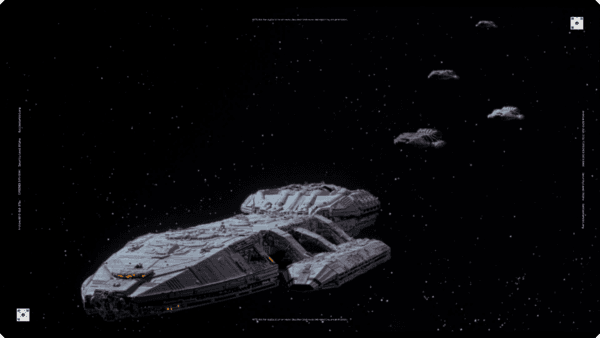
Battlestar
The battlestar was the Colonial Fleet's capital ship, an armoured battleship and carrier hybrid. The wartime battlestars relied on unnetworked computers, carried squadrons of fighters, and were armoured to survive nuclear blasts.

Jupiter-class
The Jupiter-class is the name licensed works give to the line of the original twelve battlestars built for the Cylon War. Built around un-networked computers, the class resisted Cylon infiltration, and Galactica, the last of the line still in service, survived the Fall of the Twelve Colonies.
Pegasus: Helena Cain's battlestar
Pegasus survived the Fall because an overhaul had taken parts of its Command Navigation Program offline. It was lost ramming a basestar to cover Galactica's escape from New Caprica.

Colonial Fleet: 120 battlestars
The navy of the Twelve Colonies, which fought the Cylon War. One software exploit cut it to two surviving battlestars on the day of the Fall.
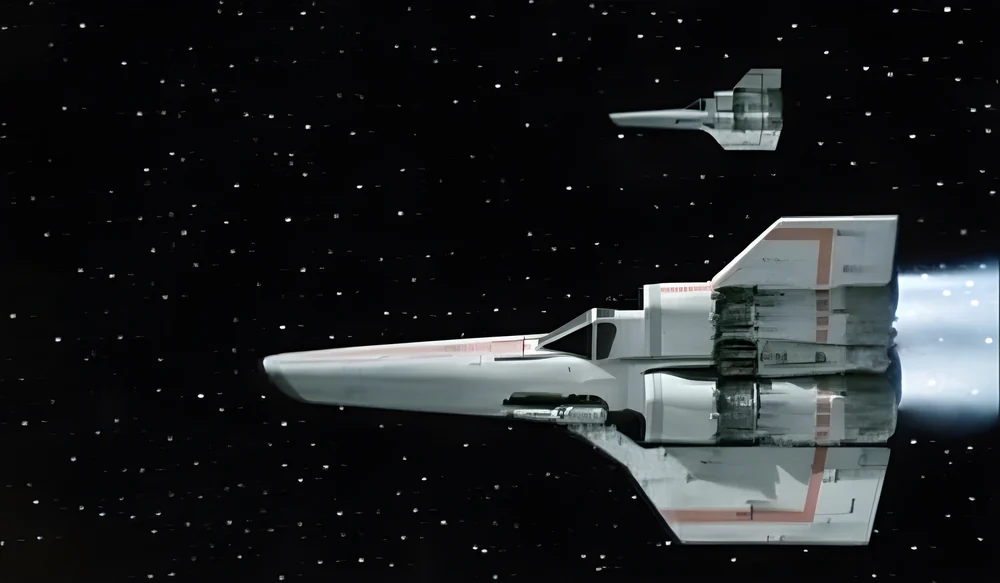
Colonial Viper
The Viper was the primary fighter of the Colonial Fleet, a name that went back to colonial air forces before the Cylon War. The Mark II and Mark VII bookended its service from the first war to the Fall of the Twelve Colonies.

Cylon War: the machines revolt
The Cylons rose against the people who built them on Caprica. Twelve years of fighting ended in a sudden Armistice that held for forty years.
Mentioned in12 entries
"Pegasus": Battlestar Galactica season 2 episode 10 explained
A second battlestar turns up alive, and its admiral outranks Adama. Here's what happens in "Pegasus", what it shows about Helena Cain and her crew, and how the standoff it ends on plays out.
Battlestar
The battlestar was the Colonial Fleet's capital ship, an armoured battleship and carrier hybrid. The wartime battlestars relied on unnetworked computers, carried squadrons of fighters, and were armoured to survive nuclear blasts.
Battlestar Atlantia
The Atlantia was a Colonial battlestar that became the flagship of the Fleet during the Cylon surprise attack, when Admiral Nagala took personal command aboard her after the loss of Picon Fleet Headquarters. She was destroyed over Virgon, a victim of the Cylon backdoors in the Command Navigation Program.
Colonial Fleet: 120 battlestars
The navy of the Twelve Colonies, which fought the Cylon War. One software exploit cut it to two surviving battlestars on the day of the Fall.
Gina Inviere
Gina Inviere was the alias of a Number Six copy who infiltrated the battlestar Pegasus as a systems analyst, sabotaged it during the Fall, and after months of captivity assassinated Admiral Cain before destroying the liner Cloud Nine.
Helena Cain
Rear Admiral Helena Cain commanded the battlestar Pegasus, one of only two Colonial capital ships to survive the Fall of the Twelve Colonies. Ruthless and uncompromising, she waged a relentless campaign against the Cylons before her assassination.
Jack Fisk
Commander Jack Fisk was a Pegasus officer who survived the Fall, rose to command the battlestar after Admiral Cain's death, and was garroted for his grip on the fleet's black market.
Kendra Shaw: Cain's executive officer aboard Pegasus
Kendra Shaw arrived aboard Pegasus as a freshly commissioned lieutenant days before the Fall of the Twelve Colonies, exposed the Cylon backdoor in the Command Navigation Program, and carried out the killings that made Helena Cain's war possible. She rose to executive officer of the battlestar and died in the assault on the Guardian basestar.
Pegasus: Helena Cain's battlestar
Pegasus survived the Fall because an overhaul had taken parts of its Command Navigation Program offline. It was lost ramming a basestar to cover Galactica's escape from New Caprica.
Pegasus: the lost battlestar
Pegasus was a battlestar of the Fifth Fleet, long believed destroyed but kept alive by the brilliance of its commander, Cain. After the Fall of the Twelve Colonies it met the refugee fleet led by Galactica before vanishing in an attack on two Cylon basestars.
Scorpion Fleet Shipyards
The Scorpion Fleet Shipyards were a vast orbital shipbuilding installation above Scorpia, a principal builder of Colonial warships from the First Cylon War until they were destroyed in the Fall of the Twelve Colonies.
Viper Mark VIIa
The Viper Mark VIIa was the seventh generation of the Colonial Fleet's space-superiority fighter, fielded in the years before the Fall of the Twelve Colonies. Its networked computers and Command Navigation Program left almost all of its kind vulnerable to a Cylon remote shutdown during the Fall.
Get new articles in your inbox
No spam. New lore drops, canon conflicts, and deep dives only when they’re worth reading.
Some links on Lore Fortress are affiliate links. If you buy through them we earn a small commission at no extra cost to you.