Contact Beam
The Supercollider Mining Tool
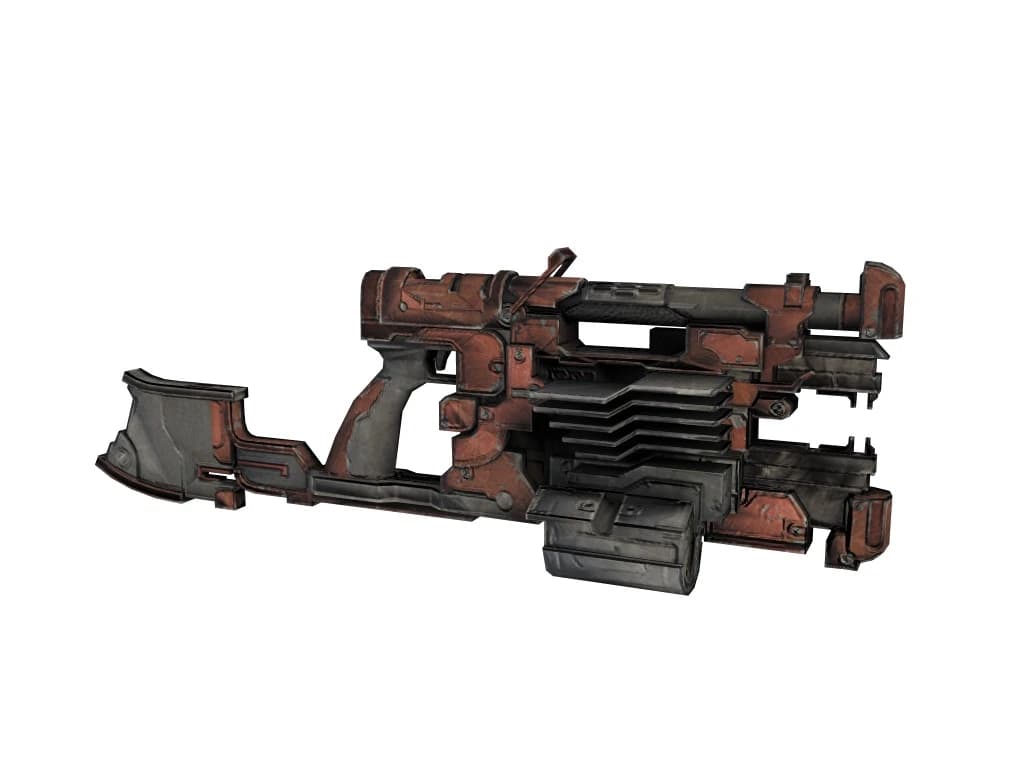
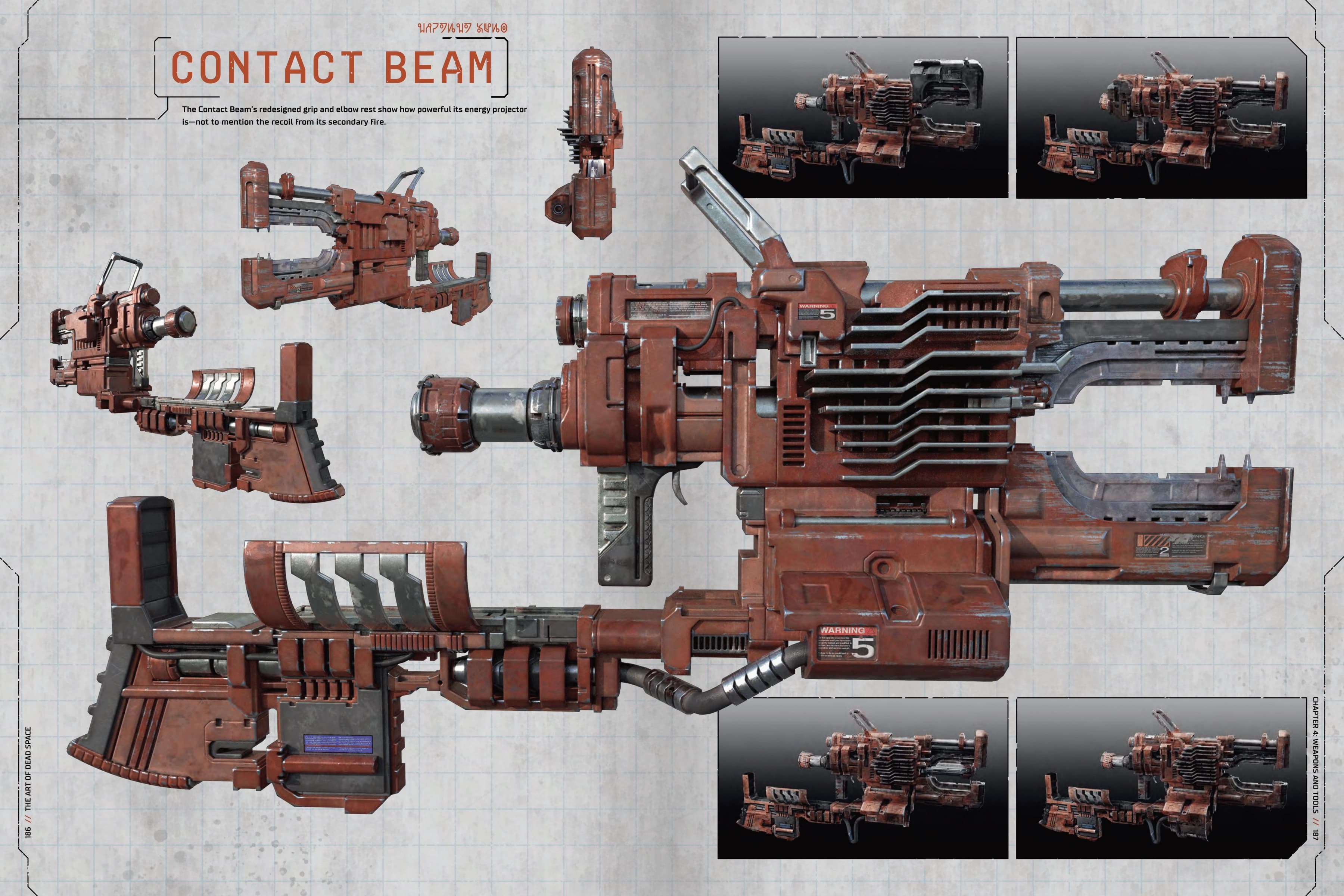
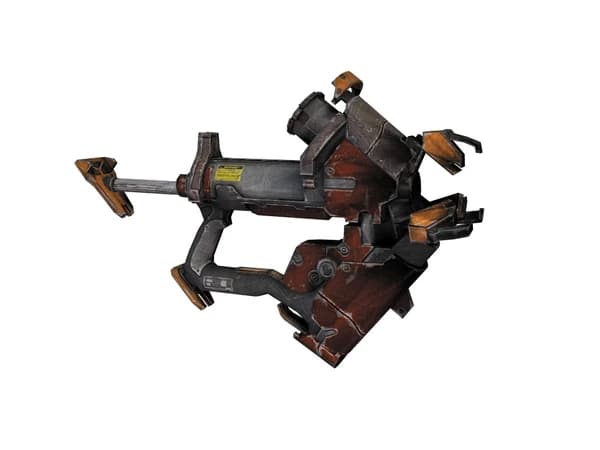
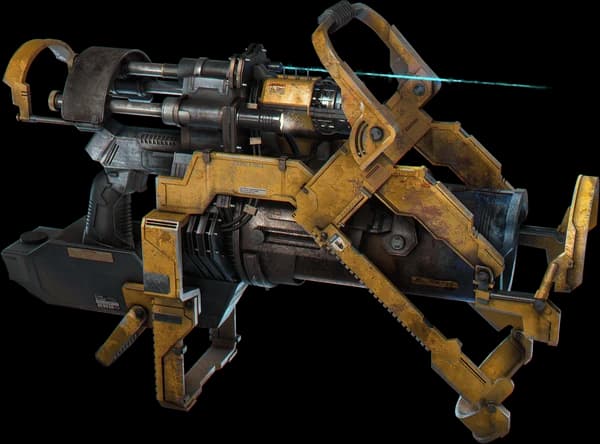
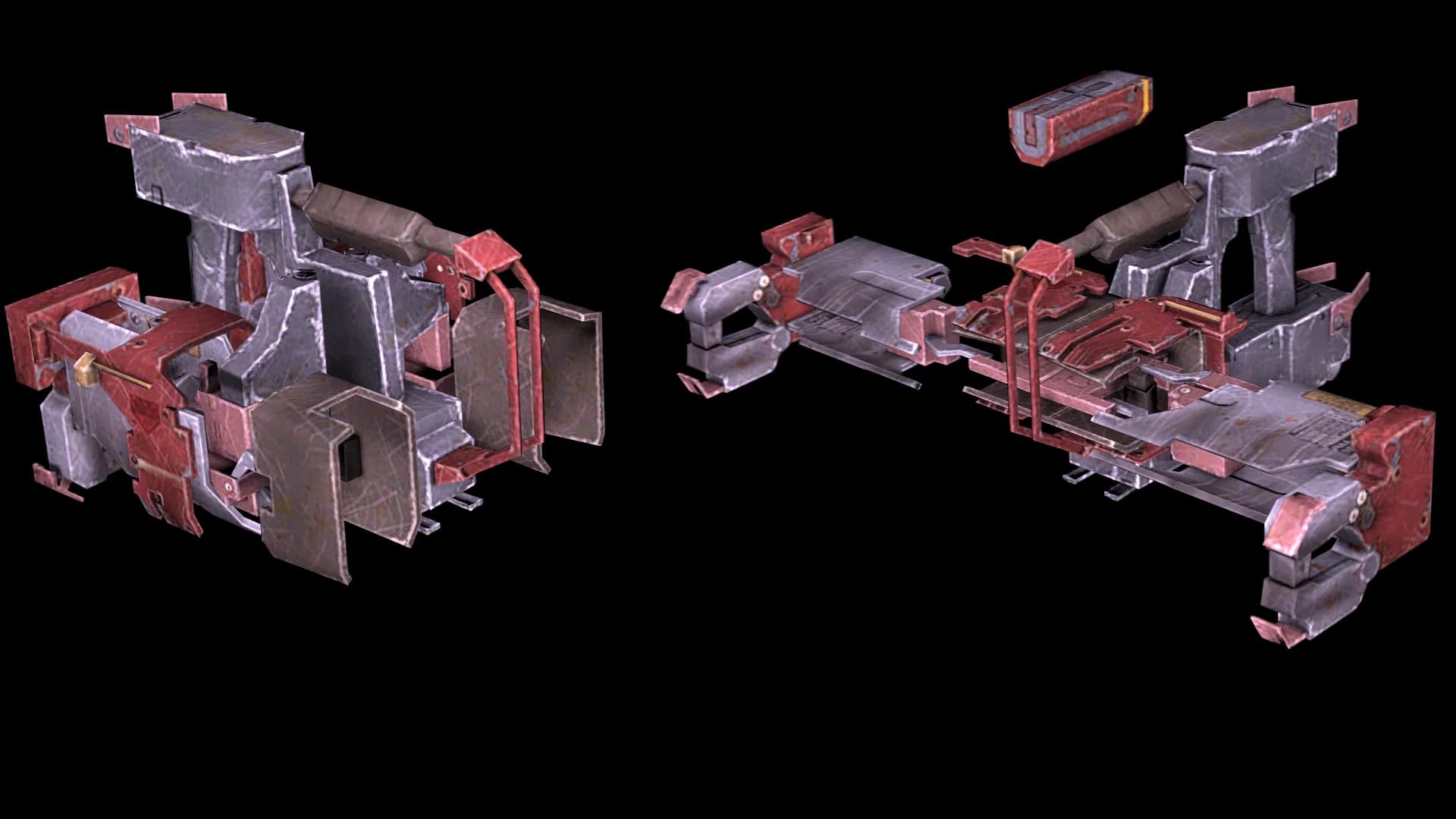
The C99 Supercollider Contact Beam was a heavy mining tool, a miniaturized particle accelerator built to pound and shatter the toughest ore and meteors so the minerals inside could be extracted. Survivors used its charged kinetic discharge against the strongest Necromorphs.
The C99 Supercollider Contact Beam, known simply as the Contact Beam, was a heavy engineering tool built to pound and soften hard, raw minerals into smaller pieces. A miniaturized particle accelerator, it was made for splitting the toughest rock and meteors, and survivors such as Isaac Clarke repurposed its charged kinetic discharge against the strongest of the Necromorphs. (Dead Space; Dead Space 2; Dead Space 3)
Function and design#
The Contact Beam was built for the heaviest extraction work. Precious ores and minerals are sometimes locked inside large, toughened rocks that defeat smaller mining equipment, and the C99 was made specifically to split and obliterate such tough materials and meteors so the ore inside could be reached. As its name indicates, it was a miniaturized particle accelerator. Like the Force Gun, it was an energy projector that worked through kinetic energy rather than heat. (Dead Space; Dead Space 2)
To do its work the tool had to be charged for a brief period. When fully charged and fired, it delivered a huge kinetic discharge that obliterated anything it came into contact with; uncharged, it served only as a weak short-range tool. Its secondary function released a small radial, ground-based shock wave that knocked objects and creatures away from the wielder in every direction. In the 2023 remake the focused charged blast was moved to the secondary function while the primary projected a continuous beam of energy, drawing on its charge over time. Accounts disagreed on its weight: it was heavy enough that a user leaned under it, yet Nathan McNeill once wielded it one-handed after losing his other arm. (Dead Space; Dead Space 2; Dead Space (2023); Dead Space: Extraction)
Use in the outbreaks#
Carried as a weapon, the Contact Beam was prized against the toughest Necromorphs. Its charged discharge was powerful enough to bring down nearly any creature with a single hit, which made it the tool of choice against heavily built foes and the large tentacled beasts encountered along the way. It came with real drawbacks: it had to be charged before each shot, its capacity was small, and ammunition for it was scarce, so a missed shot was costly and a survivor had to make every charge count. The secondary shock wave was less a weapon than a means of buying room, clearing the space around a cornered user so he could escape, though it reliably destroyed the smallest swarming Necromorphs outright. (Dead Space; Dead Space 2)
The wider canon recorded its industrial nature plainly. In the novel Catalyst an engineer used a Contact Beam to dig slowly through rock and complained that the tool was meant to clear piles of rubble, not solid stone; it managed to reduce several feet of rock to rubble before burning out. An audio log on the Ishimura's Mining Deck records a miner taking his own life with a heavy tool, first blowing off his legs and then destroying his upper torso. The tool is never named, but the charging sound heard before each blast is the Contact Beam's. (Dead Space: Catalyst; Dead Space)
Frequently asked questions
- What is the Contact Beam in Dead Space?
- The C99 Supercollider Contact Beam, known simply as the Contact Beam, was a heavy engineering tool built to pound and soften hard, raw minerals into smaller pieces. A miniaturized particle accelerator, it was made for splitting the toughest rock and meteors so the ore inside could be extracted.
- How does the Contact Beam work?
- The tool had to be charged for a brief period, and when fully charged and fired it delivered a huge kinetic discharge that obliterated anything it touched, while uncharged it served only as a weak short-range tool. Like the Force Gun, it was an energy projector that worked through kinetic energy rather than heat. Its secondary function released a small radial, ground-based shock wave that knocked objects and creatures away from the wielder.
- Why was the Contact Beam effective against Necromorphs?
- Survivors such as Isaac Clarke repurposed its charged kinetic discharge against the strongest of the Necromorphs, as a single charged shot was powerful enough to bring down nearly any creature. This made it the tool of choice against heavily built foes and the large tentacled beasts encountered along the way.
- What were the drawbacks of the Contact Beam?
- It had to be charged before each shot, its capacity was small, and ammunition for it was scarce, so a missed shot was costly and a survivor had to make every charge count. The secondary shock wave was less a weapon than a means of buying room, though it reliably destroyed the smallest swarming Necromorphs outright.
- What was the Contact Beam originally designed to do?
- The Contact Beam was built for the heaviest extraction work, splitting and obliterating tough rocks and meteors that defeated smaller mining equipment so the ore locked inside could be reached. In one account an engineer used one to dig slowly through rock and complained that the tool was meant to clear piles of rubble rather than solid stone, reducing several feet of rock to rubble before it burned out.
Gallery
Images via Dead Space Wiki
Sources
- GameDead Space, EA Redwood Shores, 2008
- GameDead Space (2023), Motive Studio, 2023 (remake)
- GameDead Space 2, Visceral Games, 2011
- GameDead Space 3, Visceral Games, 2013
- GameDead Space: Extraction, Visceral Games and Eurocom, 2009
- BookDead Space: Catalyst, B. K. Evenson, Titan Books, 2012
Spotted a factual error or a primary source we missed? Email a correction. Every flagged claim gets reviewed.
Also in Weapons
Weapon Parts: how Dead Space 3 builds a gun out of frames, tools and tips
Weapon parts are the crafting materials scattered around Dead Space 3. A frame, a tool part and a tool tip combine into a working weapon, and the same three slots rebuild almost every gun from the earlier games.
Arc Welder: The Schofield Tools Welding Gun
The Arc Welding Gun was an engineering tool designed by Schofield Tools to repair structural damage by welding metal with a concentrated electrical arc. During the Second Aegis VII Incident, survivors of the Necromorph outbreak turned its arcing discharge on the dead and found it strong enough to dismember them.
Detonator
The Detonator was a seismic survey tool that deployed laser tripmines onto almost any surface. Built for drilling prospection, it was reworked by survivors of the Necromorph outbreaks into a trap that detonated when its laser beams were broken.
Handheld Graviton Accelerator
The Handheld Graviton Accelerator, better known as the Force Gun, was a short range kinetic mining tool that blasted rock apart and shifted debris in zero gravity. Survivors of the Necromorph outbreaks used its concussive blast to hurl the creatures back and tear off their limbs.
Line Gun
The IM-822 Handheld Ore Cutter Line Gun was a wide-beamed mining tool built to shear apart heavy ore that lighter equipment could not cut. Survivors of the Necromorph outbreaks repurposed its broad horizontal beam and its laser mines as a weapon.
Mentioned in5 entries
Divider
Dividers were tall, thin Necromorphs that strangled their prey with a long tongue and, when badly hurt, fell apart into a swarm of independent crawling components. The head itself was the true creature, able to seize a fresh corpse and turn it into a Shambler.
Every Dead Space Weapon and Tool, Explained
Isaac Clarke's weapons are mostly mining and engineering tools, and that is the point. This guide goes through every major Dead Space weapon and tool, what it was built for in the story, who made it and which games it appears in, from the Plasma Cutter to the military rifles of Dead Space 3.
Hans Leggio
Hans Leggio was a miner on Aegis VII who fell under the dementia spread by Marker 3A, murdered members of his own dig team, and was taken aboard the USG Ishimura, where he died during the outbreak and rose again as a Necromorph.
Nathan McNeill
Nathan McNeill was a P-Sec detective on the Aegis VII Colony and a veteran of the Resource Wars who survived the outbreak on the colony and aboard the USG Ishimura. He escaped toward the Sprawl only to succumb to his wounds and reanimate as a Necromorph.
Weapon Parts: how Dead Space 3 builds a gun out of frames, tools and tips
Weapon parts are the crafting materials scattered around Dead Space 3. A frame, a tool part and a tool tip combine into a working weapon, and the same three slots rebuild almost every gun from the earlier games.
Get new articles in your inbox
No spam. New lore drops, canon conflicts, and deep dives only when they’re worth reading.
Some links on Lore Fortress are affiliate links. If you buy through them we earn a small commission at no extra cost to you.