Saudir I: the Great, fourth Emperor of the Known Universe
Saudir I ruled the Corrino Imperium from 12 BG to 70 AG and gave the empire the shape it would keep for ten thousand years. He negotiated the Spacing Guild into the imperial order, created CHOAM at the Financial Synod of Aerarium IV, and settled the accord that isolated Ix. He was remembered as Saudir the Great and Saudir Akbar.
In The Dune Encyclopedia, Emperor Saudir I was the fourth Emperor of the Known Universe, ruling the Corrino Imperium from 12 BG to 70 AG as head of the House of Saluso Corrino. He inherited the throne from his father, Corrin I Palaigo, at a moment when House Corrino held power by little more than the might of its Sardaukar, and he left behind an empire bound together by law, commerce, and mutual dependence. In his reign the essential elements of the Imperium came together in the forms they would keep for the next ten millennia, a process in which the emperor himself was intimately involved. The Spacing Guild took its place at the heart of interstellar civilization, CHOAM was chartered as the commercial arm of the Landsraad, and the accord that isolated Ix set the limits of permitted technology. For this work he was remembered as a wise and canny ruler, and honored with the names Saudir the Great and Saudir Akbar. (The Dune Encyclopedia)
Accession and the young empire#
Saudir I came to the throne in 12 BG on the death of his father, Corrin I Palaigo, who had reigned for only two years. By the time of Saudir's accession the Corrinos had ruled for 76 years, ever since the rise of their house in 88 BG, and they were eager to transform their empire into a "true Imperium" resting on a basis of rule more stable and long lasting than the might of their Sardaukar. (The Dune Encyclopedia)
The new emperor's position was formidable but not absolute. His military power was equal to the combined forces of the Landsraad in some respects, including atomics, and levy funds and other taxes made him an economic power equal to about half of the states in the Landsraad. Saudir quickly involved himself in touchy dealings with the assembled houses over the form of a government that could permit both parties to thrive. He succeeded in delicately balancing the feudal structure of the Imperium, though tensions continued to exist beneath the settlement. Among his most important aims was an agreement from the Houses Major that warfare be strictly regulated: once the decision of victory or defeat was proclaimed, hostilities had to cease immediately, and survivors would be free from the threat of extermination. (The Dune Encyclopedia)
The return of the Guild#
In 10 BG the Corpus Luminis Praenuntiantis, the organization that would become the Spacing Guild, began negotiations with the Imperium. The Guild offered safe and reliable interstellar travel, absent since the days of the Butlerian Jihad two centuries before, and revealed the geriatric properties of the spice melange. In return its emissaries asked for a total monopoly on hyperspace transport and a promise from the Imperium to respect their secrecy, while they themselves swore absolute abstention from politics. (The Dune Encyclopedia)
The Guild's approach was a masterstroke of purposeful misdirection. Its ambassadors presented melange only as a spice that would extend human longevity, and since they could honestly assert ignorance of its source, they allayed any suspicion that the spice had additional effects. The stratagem worked for centuries. The emissaries also warned against attempts to use the Guild for purposes other than those negotiated, referring obliquely to the possibility of finding and seizing Tupile. If any such action were seriously entertained, the Guild would retreat into secrecy; no political entity could match the Guild in space, a search for its hidden worlds would take years, and in that time the Guild would destroy its own hyperspace industry rather than submit. (The Dune Encyclopedia)
Saudir quickly realized that the only way to deal with the Guild was on a basis of mutual advantage. In the matter of Tupile he saw the value of a relief valve for the tensions boiling within the feudal structure he had so delicately balanced, a hidden refuge that made his rule of regulated warfare enforceable in practice. (The Dune Encyclopedia)
The Financial Synod of Aerarium IV#
To settle the Guild's position among the powers of the Imperium, Saudir convened the Financial Synod on Aerarium IV in 10 BG, gathering representatives of the Guild, the Imperial House, and the Landsraad. The emotions of those attending were an almost unbearable combination of fascination and fear. The feudal houses wanted the return of extensive trade and coveted the age controlling properties of the spice, yet they were aware of their vulnerability to the effects of trade and wished to control the Guild that carried it. (The Dune Encyclopedia)
The Synod lasted five years, in large part because of the ambitions of the Houses Major. Many of those houses predated the rise of House Corrino and still regarded the success of the "barbarian" Sardaukar as a "freak of history". Houses that hoped to raise themselves to the throne saw in the Guild an opportunity, if only they could seize control of the new means of trade, and the Guild refused to deal with them. For years neither the Guild nor the feudal powers could find a way to accomplish all their aims, though matters were never permitted to deteriorate so far that the gathering broke up. The Guild in particular knew that the outcome of the Synod would determine whether it survived. (The Dune Encyclopedia)
The charter of CHOAM#
The deadlock was broken by Saudir himself, working with his chief financial officer, the Dioicetes Asetirides, who devised the distribution of shares that became the foundation of the new corporation. The emperor did not depend on the unprepared reaction of the delegates. For months before the proposal was made to the whole Synod, a series of private meetings made clear to the feudal powers the advantages accruing to them; the most powerful of the Great Houses were approached first individually and then in concert, while the weaker powers, which would become agents for the nonfeudal states, were dealt with in regional groups. (The Dune Encyclopedia)
In the latter half of the third year, when it began to appear that the deadlock might destroy the Synod, Saudir called the delegates into full session and presented the plan for the formation of CHOAM, a development organization holding a monopoly on interstellar trade whose gross profits would be distributed to the noble houses through shares. The emperor took 20 percent of the shares, a portion deliberately calculated to leave him dependent on the support of many other houses. After several months of argument over matters of detail the charter was accepted, and because membership in the Synod and the Landsraad overlapped so heavily, the formal vote of the Landsraad was a foregone conclusion, accomplished within months of the Synod disbanding. The years that followed were spent in bargaining sessions between the newly created CHOAM directors and the Guild's agents, where commercial areas, product rights, monetary exchange, tariffs, schedules, and transport costs and priorities were haggled over until agreement was achieved. (The Dune Encyclopedia)
The creation of CHOAM marked the true beginning of the Imperium, and the corporation became inseparable from the empire as an institution. Together with the Guild monopoly it allowed the Imperium to expand rapidly. In 0 AG the Imperial House under Saudir, the Spacing Guild, and CHOAM as the arm of the Landsraad combined to establish the form of human society that would last for the next ten thousand years. (The Dune Encyclopedia)
The Ixian arrangement#
In 55 AG Saudir was approached by an ambassador from Ix. The Ixians specialized in complex machinery that came close to defying the strictures of the Butlerian Jihad, and the resumption of interstellar travel under the Spacing Guild presented a mortal threat to them, since their machines would eventually be discovered. Rather than wait for annihilation, the Ixians made the first move themselves and cautiously sent their ambassador to the emperor, a daring and risky act of the same kind the Guild had ventured decades earlier. (The Dune Encyclopedia)
Saudir was shocked by the revelation, but the possibilities soon became obvious to him. A controlled source of technology, available to House Corrino, the Spacing Guild, and the Houses Major, could bring considerable advantages. An arrangement was made: Ix would remain isolated, with the Guild ensuring that no unapproved visitors reached the planet, while the Ixians continued their work. Under the agreement struck in Saudir's reign, Ix and its neighbor Richese were left in isolation to supply what technology would be allowed for the next ten millennia, and the arrangement endured through the long ages of Corrino rule. (The Dune Encyclopedia)
Succession and legacy#
Saudir ruled until 70 AG, when he was succeeded on the throne by his son Henoor II Negara I, whose reign lasted only three years before another of Saudir's sons, Elrood I al-Aziz, took the throne. A daughter of Saudir married Alman bin Haig, who after Elrood's assassination replaced him as emperor and founded the House of Alman Corrino, while Elrood's nephew and rightful heir, Saudir II Negara II, fled into exile before eventually reigning as the eighth Emperor of the Known Universe. (The Dune Encyclopedia)
The dynasty Saudir left behind was troubled, but the order he built outlasted every quarrel within it. The balance of Imperial House, Landsraad, Guild, and CHOAM that he negotiated remained the constitution of human civilization for ten thousand years. Later generations remembered him as Saudir the Great and Saudir Akbar, and the regnal numbering of the much later emperor Akbar II Avelard XX counted him as Akbar I. (The Dune Encyclopedia)
Sources
- BookThe Dune Encyclopedia, Willis E. McNelly (ed.), Berkley Books, 1984
Spotted a factual error or a primary source we missed? Email a correction. Every flagged claim gets reviewed.
Followed from this entry

House Corrino: ten thousand years enthroned
The imperial House ruled from Kaitain and held Salusa Secundus as its fief. Paul Atreides forced Shaddam IV to give up the Golden Lion Throne.
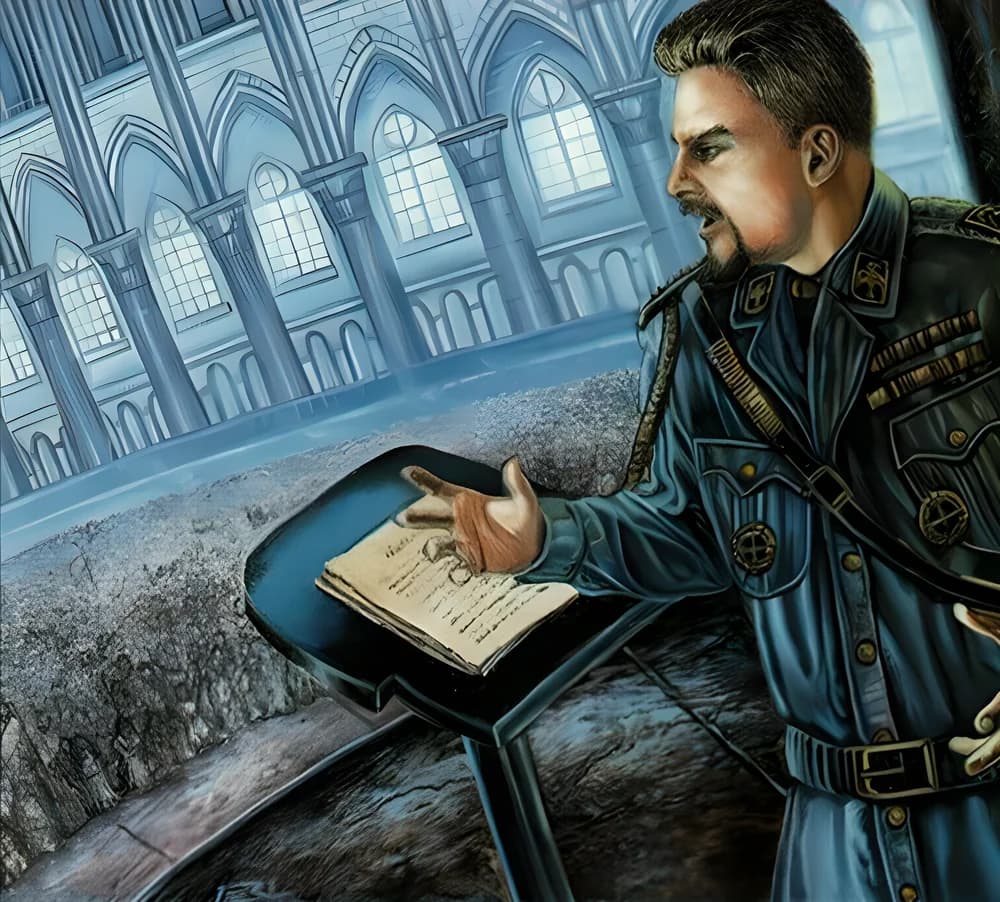
Landsraad: the council of the Great Houses
The High Council of the Great Houses, overseen by the Padishah Emperor. It gave them a forum for trade, alliance and the formal feud of kanly.
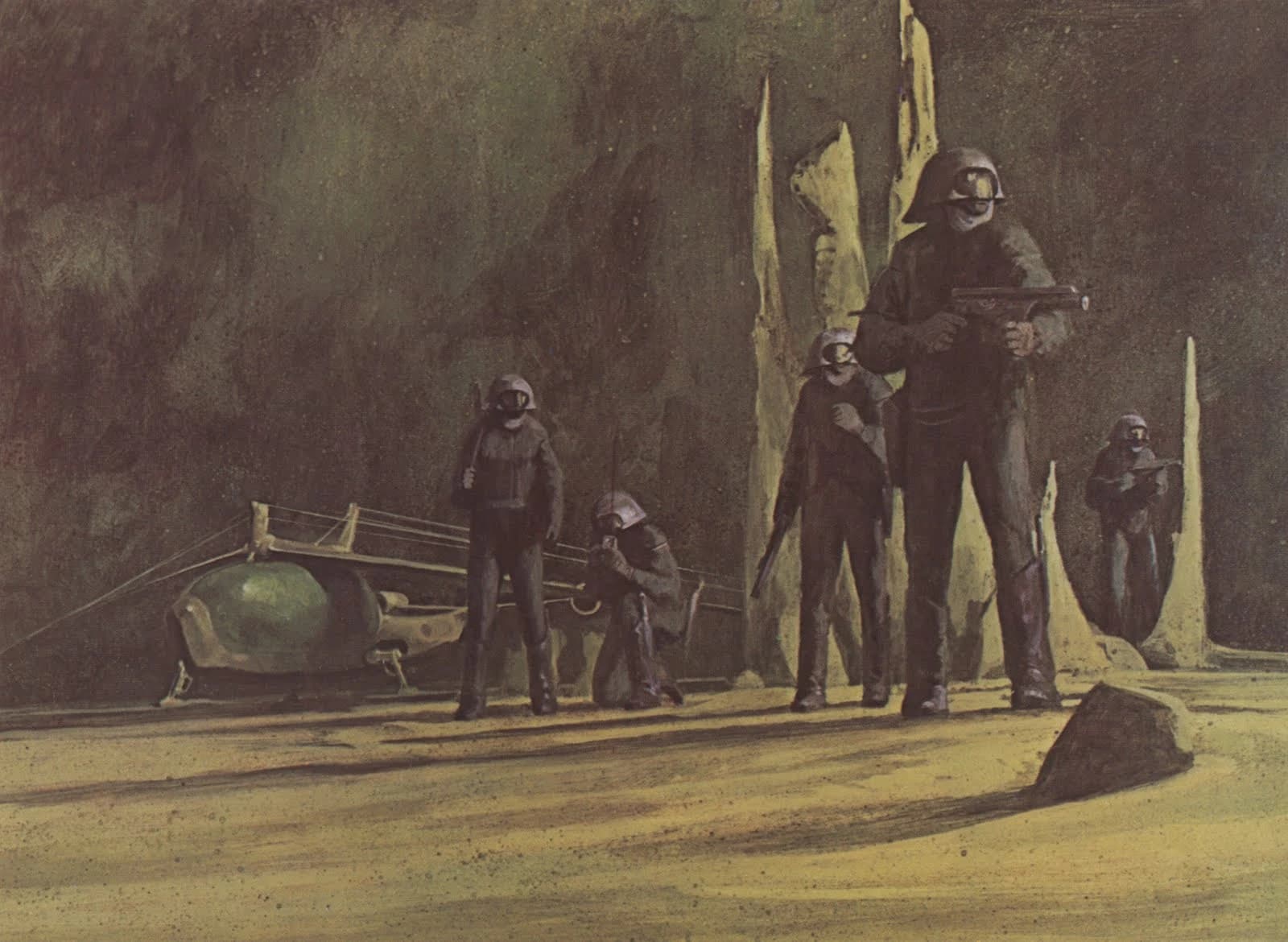
Sardaukar: the Emperor's prison-world troops
Raised on the penal planet Salusa Secundus and feared across the Known Universe. The Fremen beat them on Arrakis and put Paul Atreides on the throne.

Butlerian Jihad: the war on thinking machines
It began with a slave rebellion on Earth in 201 BG and ended at Corrin in 88 BG. Out of it came the ban on machines in the likeness of a mind.

CHOAM
CHOAM, the Combine Honnete Ober Advancer Mercantiles, was the vast commercial monopoly that governed nearly all trade across the Imperium. Its directorships were the true measure of political power, and its profits, many of them tied to the spice melange, sustained the Great Houses.

Financial Synod
The Financial Synod of Aerarium IV was convened by Emperor Saudir I to settle the Spacing Guild's place among the Landsraad. After years of deadlock, the emperor broke the impasse with a plan that created CHOAM and gave the Imperium its enduring commercial and political order.
Mentioned in1 entry
Get new articles in your inbox
No spam. New lore drops, canon conflicts, and deep dives only when they’re worth reading.
Some links on Lore Fortress are affiliate links. If you buy through them we earn a small commission at no extra cost to you.