C-14 Impaler: the Marine Corps' standard gauss rifle
standard terran marine weapon
The C-14 Impaler fires 8 mm armor-piercing spikes at thirty rounds per second, driven by a magnetic accelerator pack that gives the gauss rifle its name. Standard issue for Confederate and Dominion marines, in service by 2478, it still runs on gunpowder and fails when its ammunition gets wet.
The C-14 Impaler gauss rifle was the standard issue infantry weapon of the Confederate and later Terran Dominion Marine Corps, and the most common firearm in the Koprulu sector. It used gauss-assisted technology to accelerate ferromagnetic projectiles to hypersonic speed through magnetic induction, and was carried by the rank-and-file marines who formed the backbone of every terran ground force across the Guild Wars, the Great War, and the conflicts that followed. (StarCraft; StarCraft II unit profile: Marine; StarCraft: I, Mengsk)
Design and operation#
The C-14 was a gauss weapon, accelerating ferromagnetic projectiles to hypersonic velocity through a process of magnetic induction. The induction was produced by a magnetic accelerator pack built into the gun, which gave the rifle its class name. In use by 2478, the weapon typically fired hypersonic 8 mm armor-piercing metal spikes encased in steel, designed to penetrate two inches of steel plating. (StarCraft: I, Mengsk; StarCraft; StarCraft: Frontline Volume 1; StarCraft Compendium; StarCraft: Speed of Darkness)
Despite its gauss-assisted mechanism, the C-14 still relied on traditional propellant in the form of gunpowder, a holdover that caused the rifle to malfunction when its ammunition became wet. It was fully automatic, with a fire rate of thirty rounds per second, though fully automatic fire was discouraged in most circumstances. A capacitor system let the weapon fire in controlled short bursts, conserving ammunition and minimizing the power draw. The trade-off was severe recoil, which the CMC armor worn by marines was specifically designed to suppress. The armor could also supplement the rifle's own power supply. (StarCraft Field Manual; StarCraft: Speed of Darkness; StarCraft; StarCraft: I, Mengsk)
Ammunition#
The C-14 could chamber an unusually wide range of rounds, so one rifle could be tuned to many battlefield roles. Armor-piercing rounds were issued against heavily armored targets. Depleted-uranium rounds, built around U-238 shells, were the most popular variant among marines because they extended the rifle's effective range by up to a quarter. Hollow-point spread rounds flattened and expanded on impact for maximum wounding effect, a custom load attributed to the marine Ardo Melnikov. Incendiary rounds were turned against structures, and steel-tipped rounds were chosen to maim rather than kill. (StarCraft: Liberty's Crusade; StarCraft II unit profile: Marine; StarCraft: Frontline Volume 1; StarCraft: Speed of Darkness)
Variants#
The rifle was produced in more than one configuration over its long service life. The first variant was in use as far back as 2495 and remained the core version of the weapon. Its frame allowed a degree of customization, accepting a retractable bayonet, laser sights, or an underbarrel launcher, the last of which was forbidden under Dominion Marine Corps regulations. It carried a torch function and a scope with enemy-identification capability, could be paired with an M98 ballistic alloy combat shield, and held at least five hundred rounds per magazine. (StarCraft II: Heaven's Devils; StarCraft II unit profile: Marine; StarCraft: Frontline Volume 1; StarCraft II: Wings of Liberty; StarCraft Field Manual; StarCraft II: Shadow Wars)
A second variant saw service during the Great War. Although bulky, it was sleeker than later production models, and unlike most versions it did not require CMC armor to operate. This variant carried two grips: a smaller grip that an unarmored shooter had to brace with both hands to keep the barrel steady, and a larger grip that a CMC-armored soldier could fire one-handed, at some cost to accuracy. It featured an LED magazine-capacity indicator and could launch fragmentation grenades, accept a laser designator and rocket-propelled grenade components, and even fire grapples from the muzzle. (StarCraft: Speed of Darkness; StarCraft: Queen of Blades; StarCraft: Liberty's Crusade; StarCraft; StarCraft: Brood War)
The C-14 was sometimes confused with the AGR-14 rifle. Both were referred to as assault rifles, though the latter may have been a scaled-down version of the former. (StarCraft: Speed of Darkness; StarCraft II unit profile: Marine)
Frequently asked questions
- What is the C-14 Impaler gauss rifle?
- The C-14 Impaler gauss rifle was the standard issue infantry weapon of the Confederate and later Terran Dominion Marine Corps, and the most common firearm in the Koprulu sector. It used gauss-assisted technology to accelerate ferromagnetic projectiles to hypersonic speed through magnetic induction.
- How does the C-14 gauss rifle work?
- The C-14 accelerates ferromagnetic projectiles to hypersonic velocity through magnetic induction produced by a magnetic accelerator pack built into the gun. In use by 2478, it typically fired hypersonic 8 mm armor-piercing metal spikes encased in steel, designed to penetrate two inches of steel plating.
- Why does the C-14 malfunction when its ammunition gets wet?
- Despite its gauss-assisted mechanism, the C-14 still relied on traditional propellant in the form of gunpowder. That holdover caused the rifle to malfunction when its ammunition became wet.
- What ammunition can the C-14 fire?
- The C-14 could chamber a wide range of rounds, including armor-piercing rounds against heavily armored targets and depleted-uranium U-238 rounds, the most popular variant because they extended the rifle's range by up to a quarter. It also fired hollow-point spread rounds, incendiary rounds for structures, and steel-tipped rounds chosen to maim rather than kill.
- What variants of the C-14 exist?
- The first variant was in use as far back as 2495 and remained the core version, accepting a retractable bayonet, laser sights, or a regulation-forbidden underbarrel launcher. A second, bulkier variant saw service during the Great War and, unlike most versions, did not require CMC armor to operate, carrying two grips and able to launch fragmentation grenades.
Sources
- GameStarCraft, Blizzard Entertainment, 1998
- GameStarCraft: Brood War, Blizzard Entertainment, 1998
- GameStarCraft II: Wings of Liberty, Blizzard Entertainment, 2010
- BookStarCraft: Liberty's Crusade, Jeff Grubb, 2001
- BookStarCraft: Speed of Darkness, Tracy Hickman, 2002
- BookStarCraft: Queen of Blades, Aaron Rosenberg, 2006
- BookStarCraft: I, Mengsk, Graham McNeill, 2008
- BookStarCraft II: Heaven's Devils, William C. Dietz, 2010
- ComicStarCraft: Frontline Volume 1, Tokyopop anthology, 2008
- BookStarCraft Field Manual, Rick Barba, Blizzard Entertainment and Insight Editions, 2015
- ComicStarCraft II: Shadow Wars, Blizzard Entertainment, War Chest comic series, 2019
- WebStarCraft II unit profile: Marine, Blizzard Entertainment, StarCraft II website, 2010 to 2014
- WebStarCraft Compendium, Blizzard Entertainment, official StarCraft website
Spotted a factual error or a primary source we missed? Email a correction. Every flagged claim gets reviewed.
Followed from this entry

CMC Powered Combat Suit
The CMC Powered Combat Suit was the standard armored exoskeleton of terran infantry across the Koprulu sector, an enclosed hardskin worn by marines and firebats of the Confederacy, the Terran Dominion, and the Kel-Morian Combine. Its successive models defined the appearance and survivability of the human foot soldier from the Guild Wars through the End War.
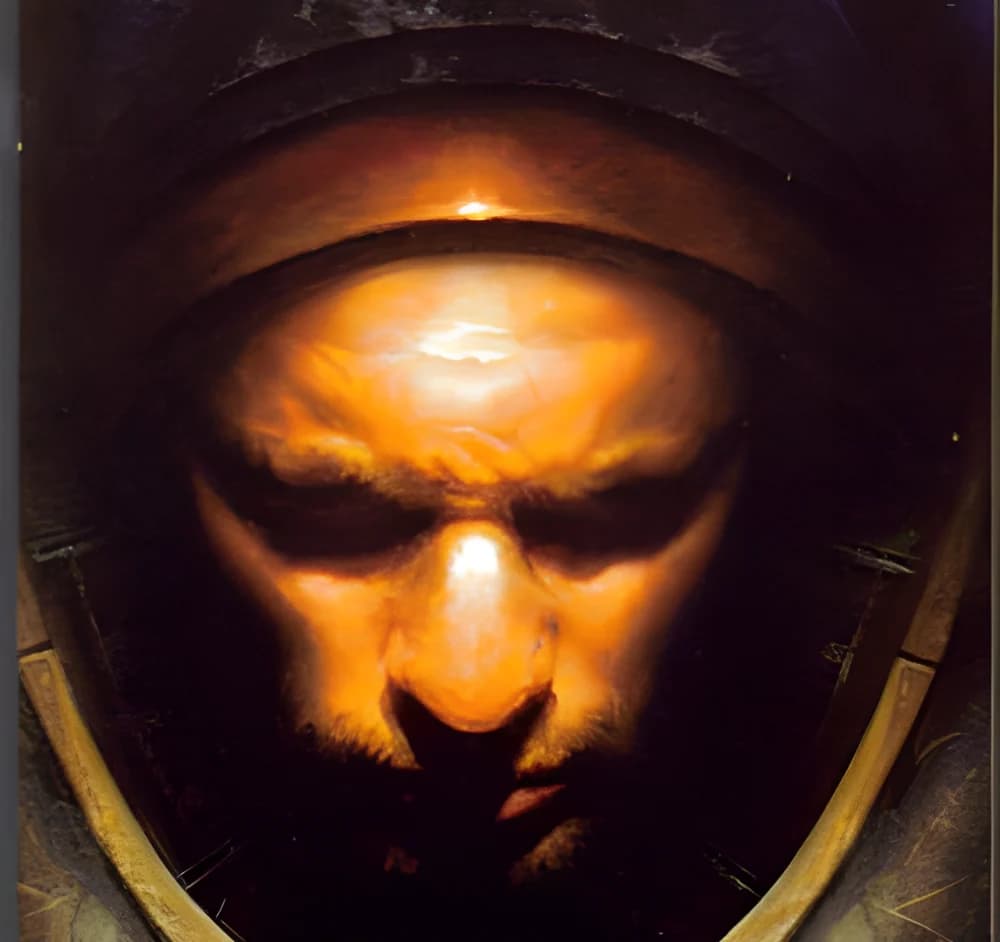
Ardo Melnikov
Ardo Melnikov was a young Confederate Marine Corps private whose memories of his home on Bountiful were rewritten by neural resocialization. Discovering that the Confederacy, not the zerg, had stolen his past, he died on Mar Sara buying time for civilian transports to escape.
Dominion Marine Corps
The Dominion Marine Corps was the ground combat branch of the Terran Dominion's armed forces and the backbone of nearly every Dominion deployment. Drawn from volunteers, conscripts, and the resocialized, it fought in every major war of its era.
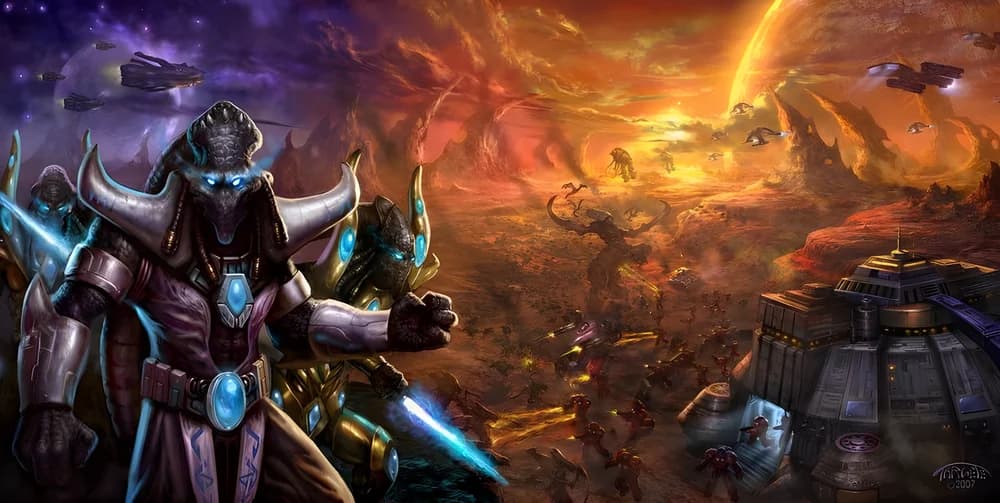
Great War: protoss against zerg over Aiur
The Great War was the first open fight between protoss and zerg, with the terrans caught between them. It ended over Aiur with the Overmind destroyed.

Guild Wars: Confederacy against the Combine
Fought across the late 2480s over the mineral wealth of the Koprulu sector. The Confederacy won, seized the mining guilds and ruled the next decade.

Terran Confederacy
The Terran Confederacy, also called the Confederacy of Man, was the dominant human government of the Koprulu sector before the Great War, ruled by the Old Families of Tarsonis and brought down by the zerg invasion and the Sons of Korhal rebellion.
Mentioned in4 entries
Confederate Marine Corps: infantry backbone of the Terran Confederacy
The Confederate Marine Corps was the best known military arm of the Terran Confederacy, an infantry service older than the Confederacy itself that filled its ranks with resocialized criminals and reluctant volunteers. It fought the Kel-Morian Combine through the Guild Wars and was destroyed alongside its government when the zerg overran Tarsonis.
Elms: mercenary marine and hidden psychic
Elms was a terran mercenary marine with a cybernetic arm and a psionic gift she kept hidden from those around her. Hired for a crooked salvage operation on Adena, she fought her way through a zerg ambush, exposed the officers who abandoned her, and killed them all rather than accept a leash from anyone.
Engineering Bay: infantry research center of the terran military
The engineering bay was a terran research structure devoted to improving the quality of the weapons and armor fielded by infantry. In use by the Terran Confederacy as early as 2488, it remained one of the first two research facilities raised in any Dominion field base, and its work followed terran soldiers to every battlefield in the Koprulu sector.
Every Terran Unit in StarCraft and StarCraft II, Explained
Every terran unit from StarCraft, Brood War and the three StarCraft II campaigns, sorted into infantry, vehicles and starships. Each entry covers who built it, what it was for and which games it appears in.
Get new articles in your inbox
No spam. New lore drops, canon conflicts, and deep dives only when they’re worth reading.
Some links on Lore Fortress are affiliate links. If you buy through them we earn a small commission at no extra cost to you.