Larva
the seed of every zerg strain
The larva was the base zerg unit from which all other strains and structures were born. Carrying the genetic code of the entire Swarm in its DNA, a single larva could pupate into any breed the hive required, and the first zerg the terrans ever encountered.
The larva was the base unit of the zerg, the form from which all other strains and, ultimately, the Swarm's structures were created. Closest of all zerg to the original insectoids that the xel'naga had first uplifted, the larva retained the two traits that had drawn the attention of those ancient masters: an extraordinary genetic versatility and a sensitivity to psionic command. (StarCraft)
Physiology#
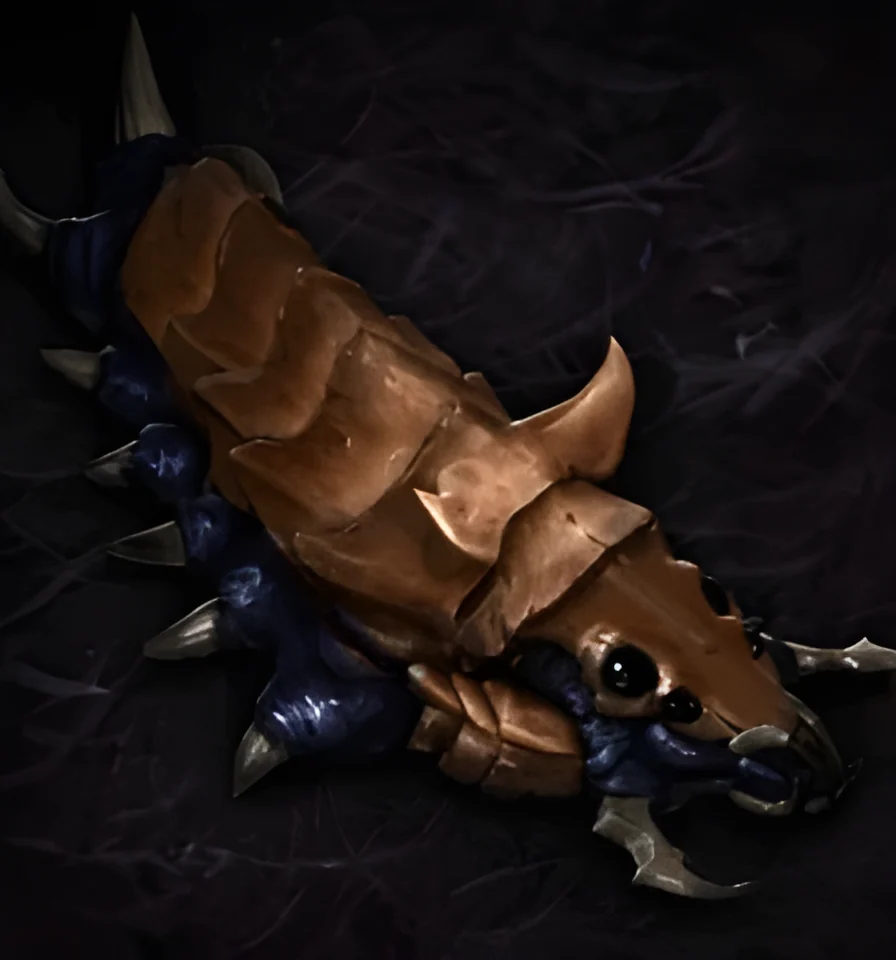
The larva was a small, maggot-like creature that often made a wet sucking sound from its tail section, likened to a boot pulled from mud. It had a segmented, many-legged body that trailed a mucous-like substance behind it, twin antennae that probed the air, and a complex array of internal organs. (StarCraft; StarCraft: Uprising)
A larva used its tendrils both to absorb nutrients from creep and to move, and it depended utterly on creep to live, surviving only hours to days if cut off from it. It also carried a number of extra organs that kept it compatible with the Swarm's vast genetic library. (StarCraft Field Manual; In the Blood)
Reproduction and metamorphosis#
Within a larva's DNA lay countless sequences carrying billions of patterns and nearly infinite genetic combinations, holding the complete code for every other zerg breed. When the Swarm needed a new strain, an individual larva entered a pupal state and began replicating the DNA of one specific breed at an astounding rate, hatching as a mature zerg after a short gestation. A young hive held only the code for the most basic breeds, such as the drone, but as it grew and developed new structures its library of strains expanded. (StarCraft; StarCraft: Uprising)
On a command from the Overmind or a cerebrate, the larva would begin its metamorphosis into whatever breed the hive required, sealing itself in an egg-like cocoon for a brief pupation whose length depended on the breed being grown. This metamorphic power was the source of the Swarm's terrible resilience: a single surviving larva could mutate into a drone, which could mutate into a hatchery, which could give birth to an entire reborn colony. For that reason the Terran Dominion stressed that its marines be obsessively thorough in zerg eradication. (StarCraft; StarCraft: Brood War; In the Blood; StarCraft Field Manual)
First contact#
Larvae were the first zerg strain ever encountered by the terrans of the Koprulu Sector. Around 2487, specimens were discovered on a number of fringe worlds that had been depopulated by what was reported as "cholera." The larvae were shipped to a Confederate science facility on Vyctor 5, where they remained until they were discovered by the Sons of Korhal nearly five years later. By the Battle of Adena, larvae could also be generated, or at least regurgitated, by the infestors of the Niadra Brood. (StarCraft: Uprising; StarCraft II: Shadow Wars)
Frequently asked questions
- What is a zerg larva?
- The larva was the base unit of the zerg, the form from which all other strains and the Swarm's structures were created. It was the closest of all zerg to the original insectoids the xel'naga had first uplifted, retaining their extraordinary genetic versatility and sensitivity to psionic command.
- How does a larva turn into other zerg?
- On a command from the Overmind or a cerebrate, a larva entered a pupal state and began replicating the DNA of one specific breed, sealed in an egg-like cocoon for a brief pupation whose length depended on the breed being grown.
- Why did the Terran Dominion treat a single larva as a threat?
- Because a single surviving larva could mutate into a drone, which could mutate into a hatchery, which could give birth to an entire reborn colony. For that reason the Dominion stressed that its marines be obsessively thorough in zerg eradication.
- When did terrans first encounter larvae?
- Larvae were the first zerg strain ever encountered by the terrans of the Koprulu sector. Around 2487, specimens were discovered on fringe worlds depopulated by what was reported as cholera, then shipped to a Confederate science facility on Vyctor 5, where they remained until the Sons of Korhal discovered them nearly five years later.
- Why did the Dominion fear a single surviving larva?
- One larva could mutate into a drone, which could mutate into a hatchery and give birth to a whole new colony, so the Dominion told its marines to be obsessively thorough when wiping out the zerg. A larva cut off from creep, though, survived only hours to days.
Gallery
Images via StarCraft Wiki
Sources
- GameStarCraft, Blizzard Entertainment, 1998 (including the manual)
- GameStarCraft: Brood War, Blizzard Entertainment, 1998
- BookStarCraft: Uprising, Micky Neilson, 2000
- BookIn the Blood, Matt Burns, short story, Blizzard Entertainment, 2013
- BookStarCraft Field Manual, Rick Barba, Insight Editions, 2015
- ComicStarCraft II: Shadow Wars, Valerie Watrous (w), Miguel Sepulveda (a), Blizzard Entertainment, 2018
Spotted a factual error or a primary source we missed? Email a correction. Every flagged claim gets reviewed.
Followed from this entry

Drone
The drone was the zerg worker strain, gathering resources and morphing its own body into the living structures of the Swarm. A single drone, descended from one surviving larva, could seed an entire reborn zerg colony.

Zerg
The zerg are a ravenous collective of biologically advanced aliens who evolve by assimilating the essence of other species in pursuit of genetic perfection. Created by Amon's xel'naga on Zerus and bound to the Overmind, they grew into one of the three dominant powers of the galaxy.

Kerrigan's Swarm: the Zerg Swarm under the Queen of Blades
Kerrigan's Swarm was the faction of the Zerg Swarm led by Sarah Kerrigan, the Queen of Blades, formed when the death of the Overmind split the leaderless zerg and Kerrigan seized control of the broods she would command through the Brood War, the Second Great War, and the war against Amon.
Overmind: the zerg mind that betrayed Amon
Amon built the Overmind on Zerus to drive the zerg at the protoss. It worked in secret against him instead, and died above Aiur to Tassadar's sacrifice.
Terran
The terrans are the descendants of a failed 23rd century colony mission from Earth, a young and highly factionalized species with latent psionic potential. Despite endless wars among themselves and with their alien neighbors, they stand as one of the three dominant species of the galaxy.
Xel'Naga
The xel'naga were a god-like race from the Void who seeded life across the universe and sought to perpetuate themselves through the Infinite Cycle. They created both the protoss and the zerg, and the rogue xel'naga Amon's bid to end the cycle drove the central conflicts of the Koprulu Sector.
Mentioned in6 entries
Drone
The drone was the zerg worker strain, gathering resources and morphing its own body into the living structures of the Swarm. A single drone, descended from one surviving larva, could seed an entire reborn zerg colony.
Elms: mercenary marine and hidden psychic
Elms was a terran mercenary marine with a cybernetic arm and a psionic gift she kept hidden from those around her. Hired for a crooked salvage operation on Adena, she fought her way through a zerg ambush, exposed the officers who abandoned her, and killed them all rather than accept a leash from anyone.
Every Zerg Unit in StarCraft and StarCraft II, Explained
Every zerg strain from StarCraft, Brood War and the three StarCraft II campaigns, from the zergling to the leviathan. Each entry covers the species it came from, what it does for the Swarm and where it turns up in the story.
Hatchery: foundational structure of every zerg colony
The hatchery was the living heart of every zerg colony, spreading creep, birthing larvae, and digesting minerals and vespene gas into nutrients for the Swarm. Grown from a single metamorphosed drone, it could mature into a lair and finally a hive, and the zerg defended it with fanatical zeal.
Hive: apex structure of the Zerg Swarm
The hive was the primary structure of the zerg and the final evolution of the hatchery, unlocking the last stages of the Swarm's development. Shielded by a dense exoskeleton and joined to the Overmind's full pool of knowledge, it gave the being that commanded it the power to loose the full fury of the zerg.
Swarm Host
The swarm host was a zerg siege strain that burrowed into the ground and birthed an endless supply of short-lived locusts from an incubator on its back. Adapted by Abathur from the primal hosts of Zerus, it gave the Swarm a living artillery piece.
Get new articles in your inbox
No spam. New lore drops, canon conflicts, and deep dives only when they’re worth reading.
Some links on Lore Fortress are affiliate links. If you buy through them we earn a small commission at no extra cost to you.