Ultralisk
Siegebreaker Strain of the Swarm
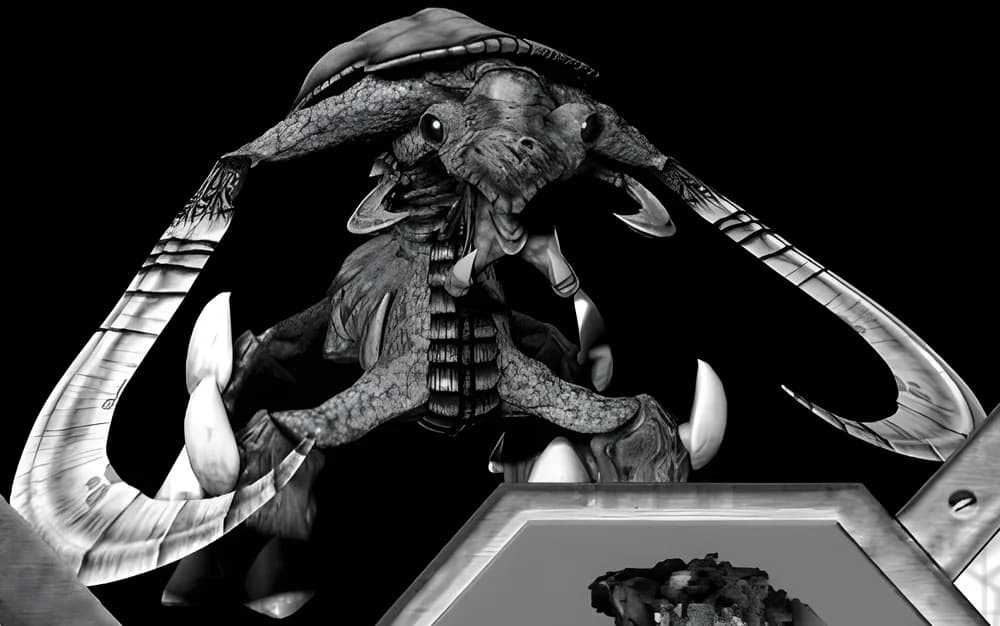
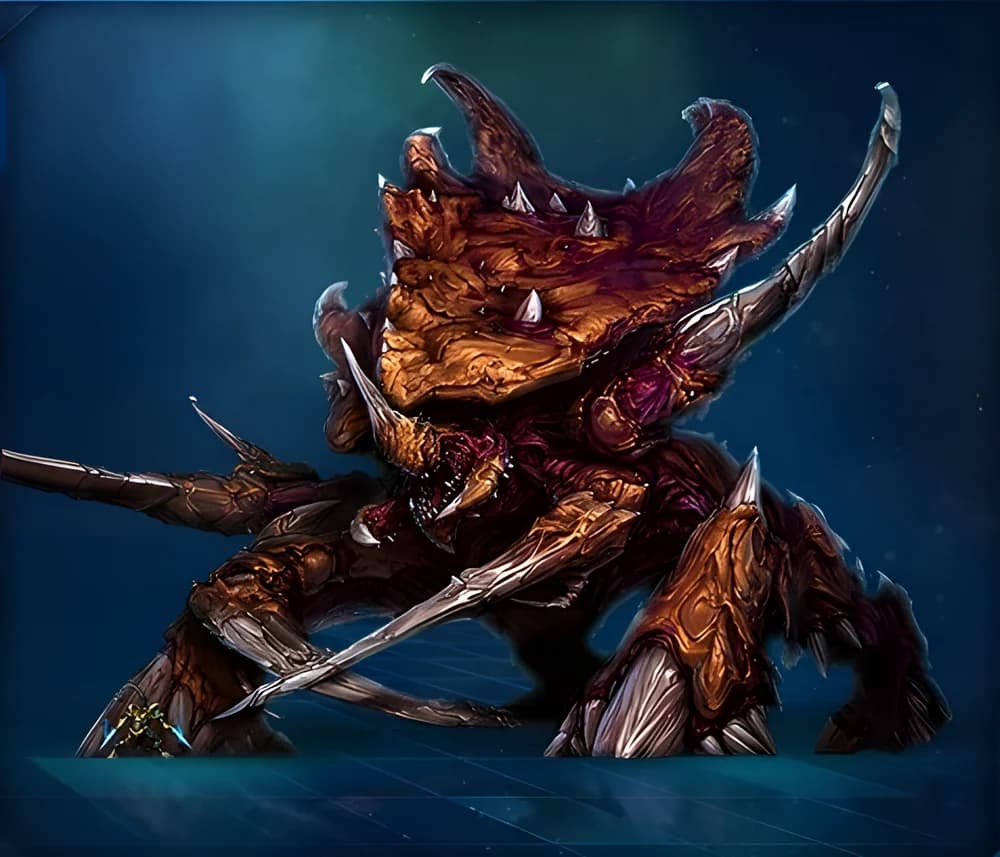
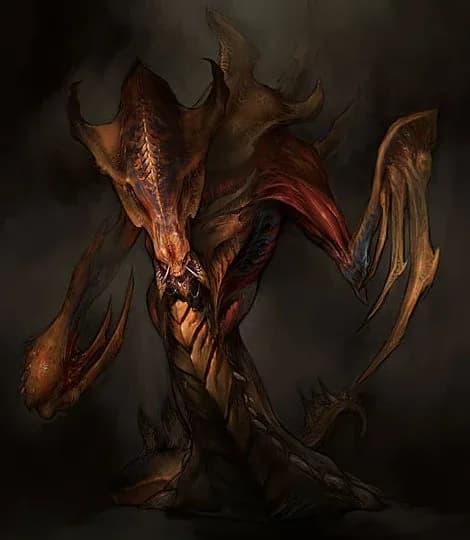
The ultralisk was the most powerful ground strain the zerg possessed, a massive living battering ram evolved from the docile brontolith and armed with near-indestructible kaiser blades. Heavily armored and able to charge through protoss force fields, the ultralisk served as the Swarm's siegebreaker.
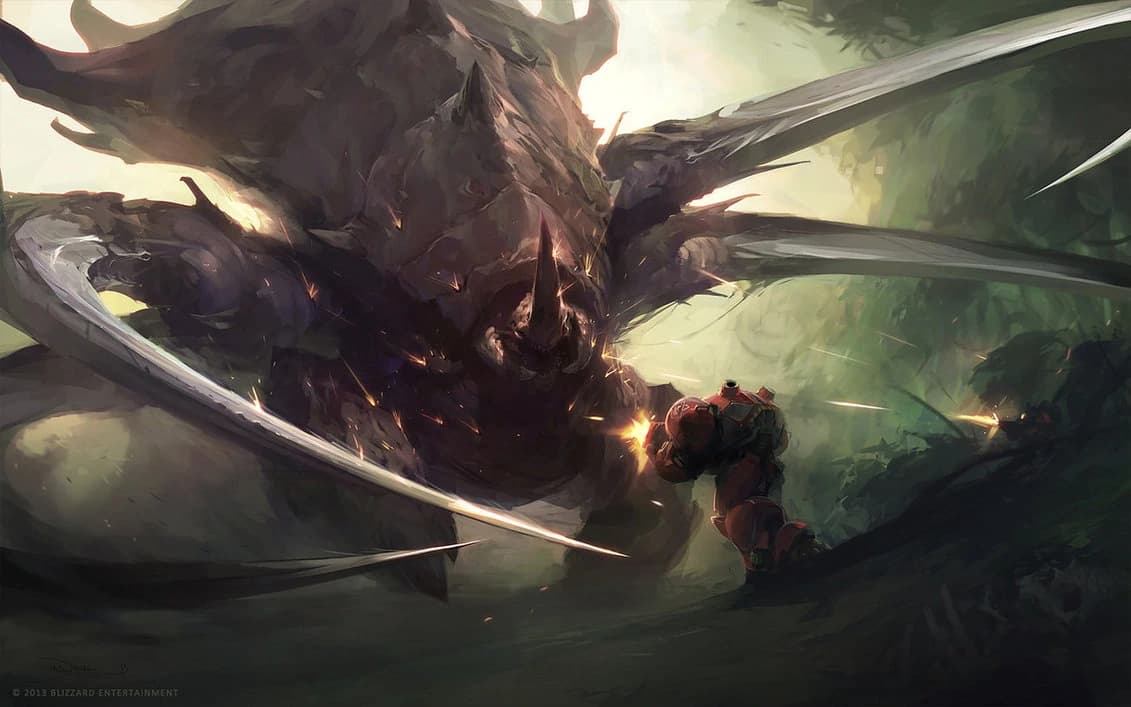
The ultralisk was the most powerful ground strain the zerg Swarm possessed, a massive living battering ram that served as its siegebreaker. Evolved from the docile brontolith, the ultralisk was armored in an exceptionally thick carapace and armed with bone scythes called kaiser blades. When ultralisks were deployed against terran forces in the Koprulu Sector, Terran Dominion marines were advised to maintain a wide perimeter and call in air support. (StarCraft II unit profile: Ultralisk; StarCraft; StarCraft: Brood War; StarCraft Field Manual)
Origin and physiology#
Ultralisks evolved from the docile brontolith, a creature the ultralisk came to bear little resemblance to. The brontolith's genetic code was dissected, rebuilt, and repurposed multiple times, each phase eliminating less desirable traits while augmenting the creature's ability to withstand severe punishment, including the brontolith's superb immune system. As a finishing touch, the Swarm added a gene that would replace the creature's organs. The ultralisk's genetic material was subject to countless tests and experiments, and only the final viable code was used by the larvae that produced it. By the end of its development the ultralisk stood as a living battering ram, fast for its size despite its bulk. (StarCraft; StarCraft II unit profile: Ultralisk; StarCraft Field Manual)
Weapons and defenses#
The ultralisk attacked using large bone-like scythes that protruded from its back, known as kaiser blades. These scythes were nearly indestructible, their density, bevel, and edges honed at the genetic level, and their monomolecular edges could tear through most substances with ease, slicing through armored vehicles and eviscerating entire squads of light infantry in a few swipes. By 2500 at least some ultralisks sported four kaiser blades rather than the usual two, and by the Second Great War four blades had become the standard. The creature's size was itself a weapon, allowing it to charge with enough ferocity to destroy protoss force fields. Ultralisks enslaved by the Cerberus Program were further enhanced with heat-treated titanium blade implants. Set beside the rest of the zerg strains, nothing else on the ground came close to its mass. (StarCraft; StarCraft Field Manual; StarCraft II unit profile: Ultralisk; StarCraft (WildStorm comic); StarCraft II: Legacy of the Void)
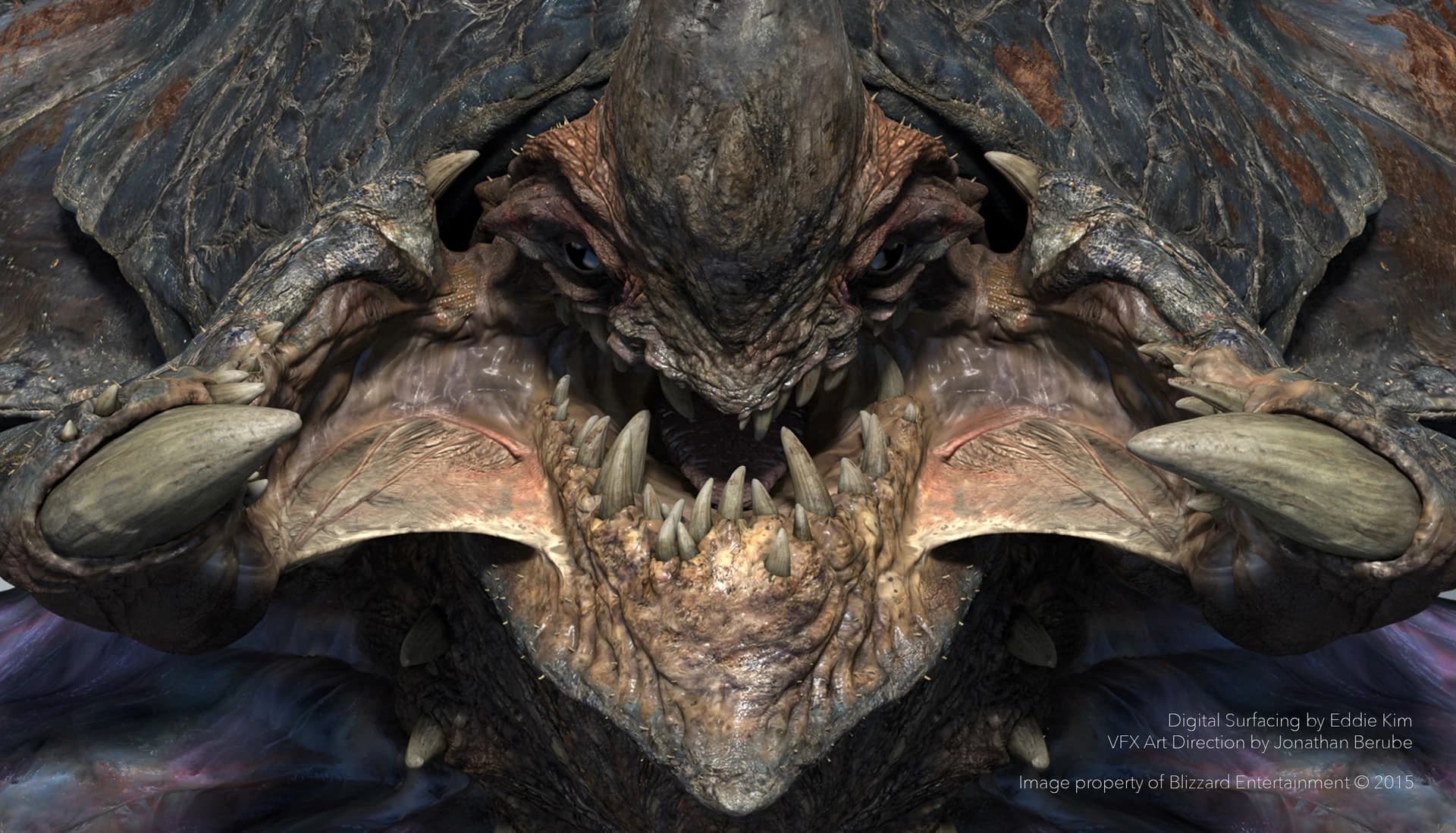
The strain's defense rested on an exceptionally thick carapace. Dominion scientists believed the larva's highly resistant carapace had served as the template for the ultralisk's armor; tests showed the diamond-shaped chitinous scales were combined with foreign compounds and organic tissue multiple times, producing very light plates with an unmatched level of hardness. A gene within the ultralisk's code existed for the sole purpose of growing heavily armored copies of the beast's primary organs in random locations across its body, while the brontolith's immune system, improved upon for the strain, let it thrive in the most toxic and inhospitable environments. Its weak spots lay in its head, particularly the mouth and eyes, its underbelly, and around the neck, where the plating was thinner. (StarCraft: Brood War; StarCraft II unit profile: Ultralisk; StarCraft Field Manual; Symmetry)
Evolution across the wars#
Ultralisks during the First Great War and Brood War were slimmer and more agile than later evolutions, built with durable muscle and sinew rather than heavy armor. By a later point, prolonged exposure to vespene gas had enhanced the strain's physical capabilities, hardening its exoskeletal shell and granting it the ability to carry out anabolic synthesis through altered glands that produced endorphins and adrenal fluids. By the Second Great War the strain received substantial additions to its internal structure, including a complex sensory system, an auxiliary nervous system, and specialized muscle fibers that expanded or contracted in reaction to stimuli, allowing an ultralisk to maintain speed even with its hind legs severed. (StarCraft II: Legacy of the Void; StarCraft: Brood War; StarCraft II unit profile: Ultralisk)
When terrans first encountered ultralisks, they observed that the creatures suffered balance issues and were easily toppled by artillery fire or loss of limbs. By the Second Great War, "unstoppable" ultralisks had appeared, sporting more kaiser blades and heavier carapace armor; though terran intelligence revealed the additions to their internal structure, the data offered little toward a counter. During that conflict some ultralisks were combined with the essence of the primal zerg of Zerus, making them truly relentless killing machines, while ultralisks birthed by the Leviathan Brood were terrifying figures of spines and blades. (StarCraft II unit profile: Ultralisk; StarCraft Field Manual; StarCraft II: Legacy of the Void)
Study and reconstitution#
Ultralisks were submitted to countless genetic experiments and studied by terrans to a significant extent, with Avernus Station and the Castanar space platform serving as examples. During the final stages of the Second Great War, Sarah Kerrigan was able to reconstitute the ultralisk strain from test subjects held at the Skygeirr Platform laboratory. Research stations on Korhal later allowed her to assimilate the noxious strain of ultralisk and to reconstitute the torrasque strain. (StarCraft II unit profile: Ultralisk; StarCraft II: Wings of Liberty; StarCraft II: Heart of the Swarm)
Frequently asked questions
- What is an ultralisk in StarCraft?
- The ultralisk was the most powerful ground strain the zerg Swarm possessed, a massive living battering ram that functioned as its siegebreaker. It was armored in an exceptionally thick carapace and armed with bone scythes called kaiser blades.
- What did the ultralisk evolve from?
- The ultralisk evolved from the docile brontolith, a creature it came to bear little resemblance to. The brontolith's genetic code was dissected, rebuilt, and repurposed multiple times to eliminate undesirable traits and augment the creature's ability to withstand punishment, and the Swarm added a gene to replace its organs.
- What are kaiser blades?
- Kaiser blades were the large bone-like scythes that protruded from the ultralisk's back. They were nearly indestructible, with monomolecular edges that could tear through most substances, slicing through armored vehicles and eviscerating entire squads of light infantry in a few swipes. By the Second Great War four blades had become the standard rather than the usual two.
- How did the ultralisk break through protoss force fields?
- The ultralisk's sheer size was itself a weapon, allowing it to charge with enough ferocity to destroy protoss force fields.
- How did Sarah Kerrigan reconstitute the ultralisk strain?
- During the final stages of the Second Great War, Sarah Kerrigan reconstituted the ultralisk strain from test subjects held at the Skygeirr Platform laboratory. Research stations on Korhal later allowed her to assimilate the noxious strain and to reconstitute the torrasque strain.
Gallery
Images via StarCraft Wiki
Sources
- GameStarCraft, Blizzard Entertainment, 1998 (including the manual and the Loomings bonus campaign)
- GameStarCraft: Brood War, Blizzard Entertainment, 1998
- ComicStarCraft (WildStorm comic), Simon Furman (w), Federico Dallocchio (a), WildStorm, 2009 to 2010
- GameStarCraft II: Wings of Liberty, Blizzard Entertainment, 2010
- WebSymmetry, Cameron Dayton, Blizzard Entertainment short story, 2010
- WebStarCraft II unit profile: Ultralisk, Blizzard Entertainment, StarCraft II website, 2010 to 2015 (including Ultralisk Science and Larva Science)
- GameStarCraft II: Heart of the Swarm, Blizzard Entertainment, 2013
- BookStarCraft Field Manual, Rick Barba, Insight Editions, 2015
- GameStarCraft II: Legacy of the Void, Blizzard Entertainment, 2015 (including Collections skin descriptions)
Spotted a factual error or a primary source we missed? Email a correction. Every flagged claim gets reviewed.
Followed from this entry

Zerg
The zerg are a ravenous collective of biologically advanced aliens who evolve by assimilating the essence of other species in pursuit of genetic perfection. Created by Amon's xel'naga on Zerus and bound to the Overmind, they grew into one of the three dominant powers of the galaxy.
Every Zerg Unit in StarCraft and StarCraft II, Explained
Every zerg strain from StarCraft, Brood War and the three StarCraft II campaigns, from the zergling to the leviathan. Each entry covers the species it came from, what it does for the Swarm and where it turns up in the story.

Brood War: Kerrigan's war for the Swarm
The Brood War was a zerg civil war between Kerrigan and the cerebrate Daggoth over who would succeed the Overmind. The UED invaded from Earth at the same time.
Great War: protoss against zerg over Aiur
The Great War was the first open fight between protoss and zerg, with the terrans caught between them. It ended over Aiur with the Overmind destroyed.
Leviathan
The leviathan was a massive airborne zerg breed that served as the Swarm's equivalent of a capital ship. Measured at around eleven kilometers long and capable of deep-space and warp travel, it became Sarah Kerrigan's mobile base of operations after her return to the zerg.

Sarah Kerrigan, the Queen of Blades
Sarah Kerrigan was a psychic terran who began as a Confederate ghost, rose to be second-in-command of the Sons of Korhal, and after Arcturus Mengsk abandoned her on Tarsonis was captured and infested by the Zerg Swarm to become the Queen of Blades.
Mentioned in7 entries
Battle of Korhal
The Battle of Korhal was the final battle of the Second Great War, a joint assault by Sarah Kerrigan's Zerg Swarm and Jim Raynor's Raiders on the Dominion capital. It ended with the death of Emperor Arcturus Mengsk and the destruction of much of Augustgrad.
Bunker: fortified strongpoint of the terrans
The bunker was a low domed terran defensive structure, plated in paristeel or neosteel and pierced by weapon ports on every side. Soldiers called them battlefield coffins for their ubiquity and lack of amenities, yet the squat shelters anchored terran lines from the Confederacy through the wars of the Dominion.
Essence
Essence was the genetic information carried by all life and the key to zerg evolution. By consuming or assimilating their prey, the zerg took the essence of other creatures and folded their desired strengths into the Swarm, an ability that first drew the fallen xel'naga Amon to enslave them.
Every Zerg Unit in StarCraft and StarCraft II, Explained
Every zerg strain from StarCraft, Brood War and the three StarCraft II campaigns, from the zergling to the leviathan. Each entry covers the species it came from, what it does for the Swarm and where it turns up in the story.
Hydralisk
The hydralisk was a versatile zerg combat strain evolved from the peaceful slothien, armored in carapace plates and able to launch volleys of armor-piercing spines from its upper body. Forming the backbone of the Swarm's onslaughts, the hydralisk symbolized zerg power to terrans more than any other strain.
Mind control: psionic domination in the Koprulu Sector
Mind control was a psionic power that let one mind seize command of another. Judicators and dark archons wielded it among the protoss, gifted ghosts practiced it for the Terran Dominion, and it reached its most terrible scale when Amon turned the Khala itself into a leash for an entire species.
Vespene gas
Vespene gas was a hydrocarbon compound and the most plentiful high-performance fuel in the galaxy, one of the foundational resources of the Koprulu sector. Prized by terrans for its energy rating, consumed raw by the zerg, and used by the protoss to power their psi-driven machines, it fueled the wars and economies of three races.
Get new articles in your inbox
No spam. New lore drops, canon conflicts, and deep dives only when they’re worth reading.
Some links on Lore Fortress are affiliate links. If you buy through them we earn a small commission at no extra cost to you.