Siege Tank
Terran Dual-Mode Armored Artillery
The siege tank was a terran armored vehicle that could switch between a mobile combat mode and a static long-range artillery emplacement, developed by the Confederacy and carried forward by the Dominion.
The siege tank was a terran armored vehicle that could be configured to fulfill both the mobile combined-arms support role and the long-range artillery support role. Developed by the Terran Confederacy and carried forward through the Terran Dominion and the wider sector, the siege tank's defining feature was its ability to switch on the battlefield between a conventional tank and a static emplacement deploying a far more powerful cannon. (StarCraft (manual))
Concept and modes#
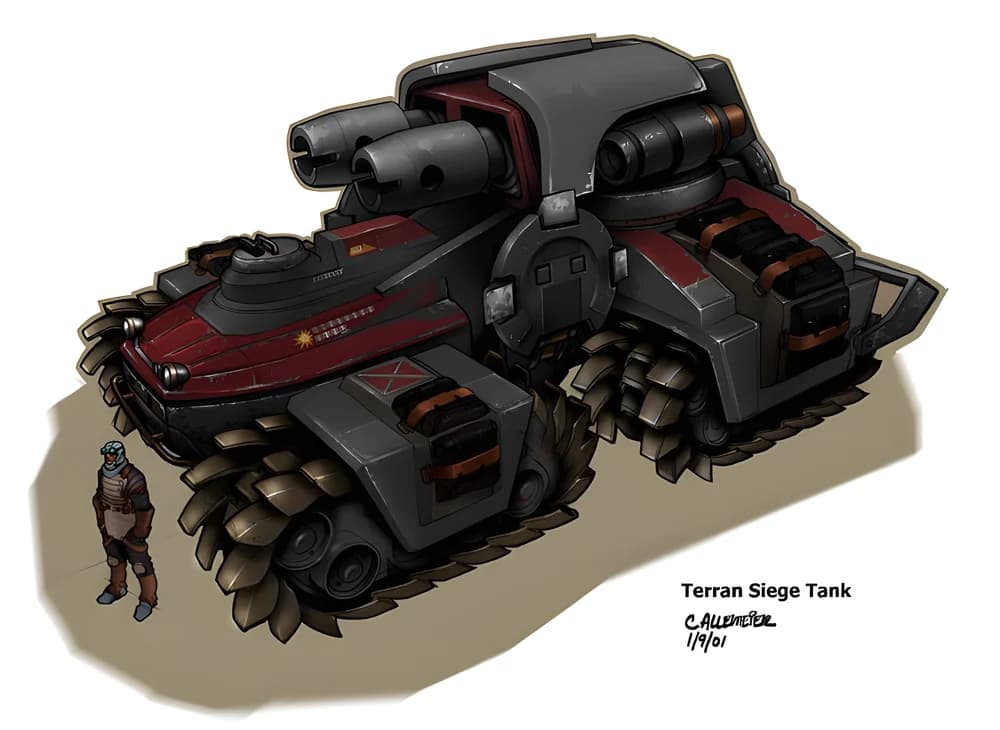
The dual-mode siege tank concept was a Confederate response to the flexibility of the goliath walker. Before the Guild Wars, work had progressed on a static "final defense" cannon, but the conflict demonstrated the need for mobility, and an effort was made to render the cannon mobile. The solution modified an existing tank design so that it could operate as a conventional tank and also deploy the cannon to become a static artillery emplacement at will. Mobile siege tanks existed by 2480, several years before the official start of the Guild Wars, and an artillery version was in Confederate use during that conflict. (StarCraft (manual); StarCraft: I, Mengsk; StarCraft II: Heaven's Devils)
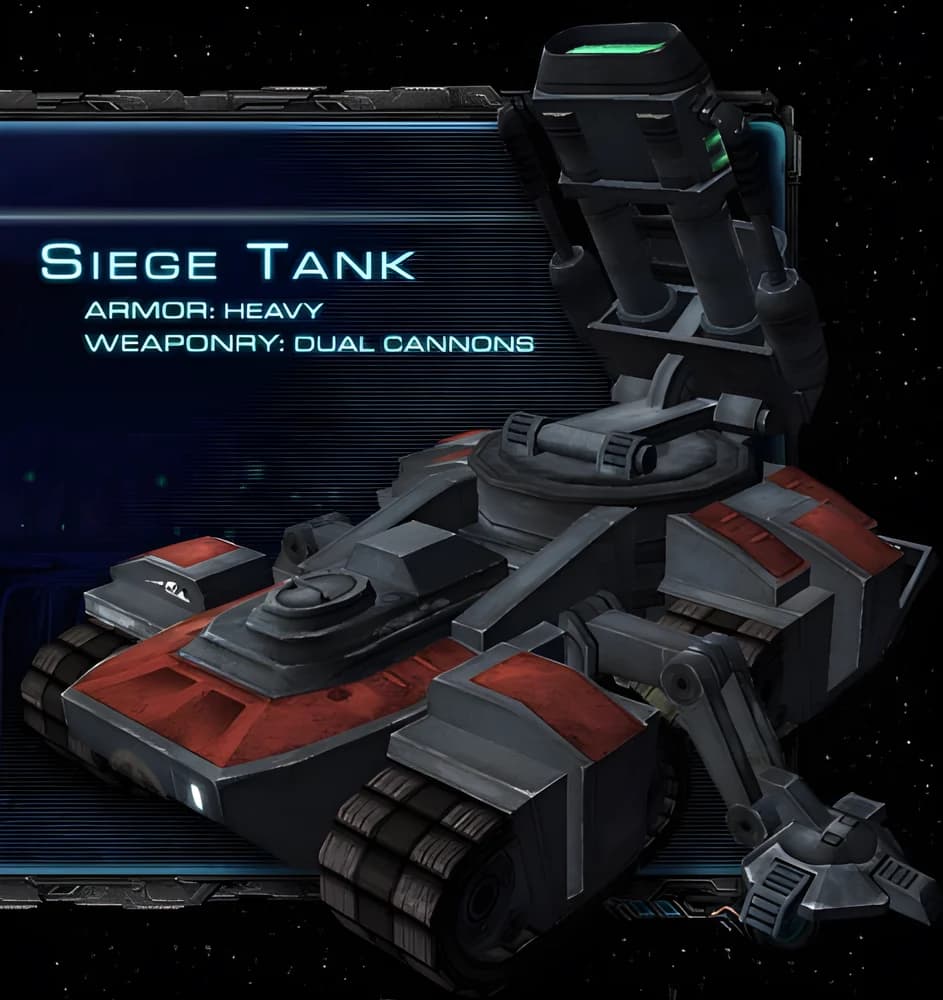
In its "tank" or "assault" mode, the vehicle served in the familiar armored support role using relatively light weapons. In the more radical "siege" mode it became a static emplacement deploying a much more powerful and longer-ranged weapon. (StarCraft (manual))
The AAV-5 Arclite#
The AAV-5 Arclite was in service by 2491 and was renowned throughout the Confederacy for its heavy firepower and its stalwart emplacement-and-advance tactics. It carried a crew of three, a gunner, a driver and a commander, though a single operator could still run it. The Arclite could double as a sort of armored personnel carrier, ferrying troops into a hot zone and deploying them through side and rear hatches. A gravity accelerator kept it stable in low or zero gravity, hydraulic actuators steadied it even under explosive fire, and its gyros let it climb inclines of up to sixty-five degrees. A targeting computer keyed on heat sources, identified their range, and could render the surrounding topography in three dimensions on an interior viewscreen. (StarCraft Compendium: Siege Tank; StarCraft: Uprising; StarCraft (manual); StarCraft: Frontline Volume 1; Momentum)
In siege mode the Arclite deployed a 120mm Shock Cannon. By the aftermath of the Great War the AAV-5's tank mode left much to be desired: its armament and armor were too light to advance or hold a firebase against a close assault without significant support. The Crucio was developed to address those shortcomings. (StarCraft (manual); Units: Crucio Siege Tank)
The Crucio#
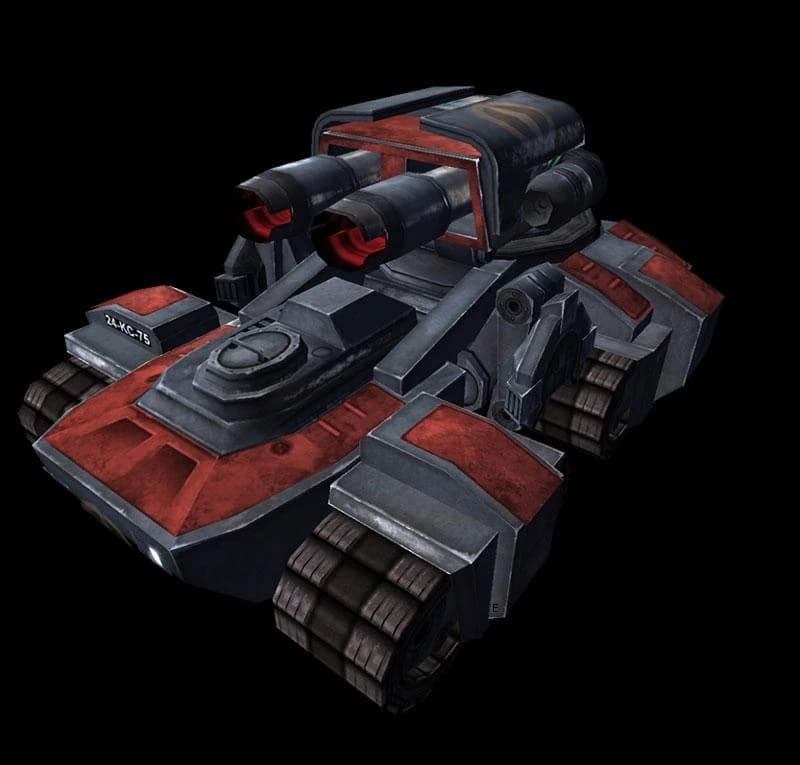
The Crucio was designed as the AAV-5's replacement and had entered Dominion service by 2502. It featured superior protection and armament, with an enlarged, reinforced turret and hull built for survivability, and an upgraded tank-mode weapon package that let it defend itself in open battle. Its treads were modular heavy-duty neosteel plates in a multi-track configuration, with extra tracks for stability and a system of tubes that pumped fast-drying gel onto damaged segments so the tank could keep moving after damage that would immobilize a conventional vehicle. In siege mode the main tracks turned outward, the secondary tracks slid into the hull, and thick hydraulic outriggers deployed from the sides to brace the roughly sixty-ton vehicle against the ground. (Units: Crucio Siege Tank; StarCraft: Frontline Volume 1; StarCraft II: Heaven's Devils; StarCraft Field Manual)
The Crucio's turret mounted twin 90mm cannons in assault mode, effective against enemy armor. Its true strength lay in siege mode, when those cannons became the 180mm Shock Cannon, a weapon whose roar alone was said to send enemies of the Dominion into full retreat. The Shock Cannon fired superheated tungsten across an area larger than the older 120mm version and could load a range of munitions, including armor-piercing Maelstrom shells. Dominion infantry were nonetheless universally convinced that Crucio operators inflicted more damage on friendly forces than on the enemy, and LarsCorp developed a "smart shell" that scanned for allies on impact and adjusted its detonation, reducing friendly-fire fatalities by seventy-five percent in field tests. During the reign of Valerian Mengsk, the Dominion improved the Crucio with reinforced plating and heftier cannons for the Special Forces. (Units: Crucio Siege Tank; StarCraft II: Wings of Liberty; StarCraft II: Legacy of the Void)
Other models and service#
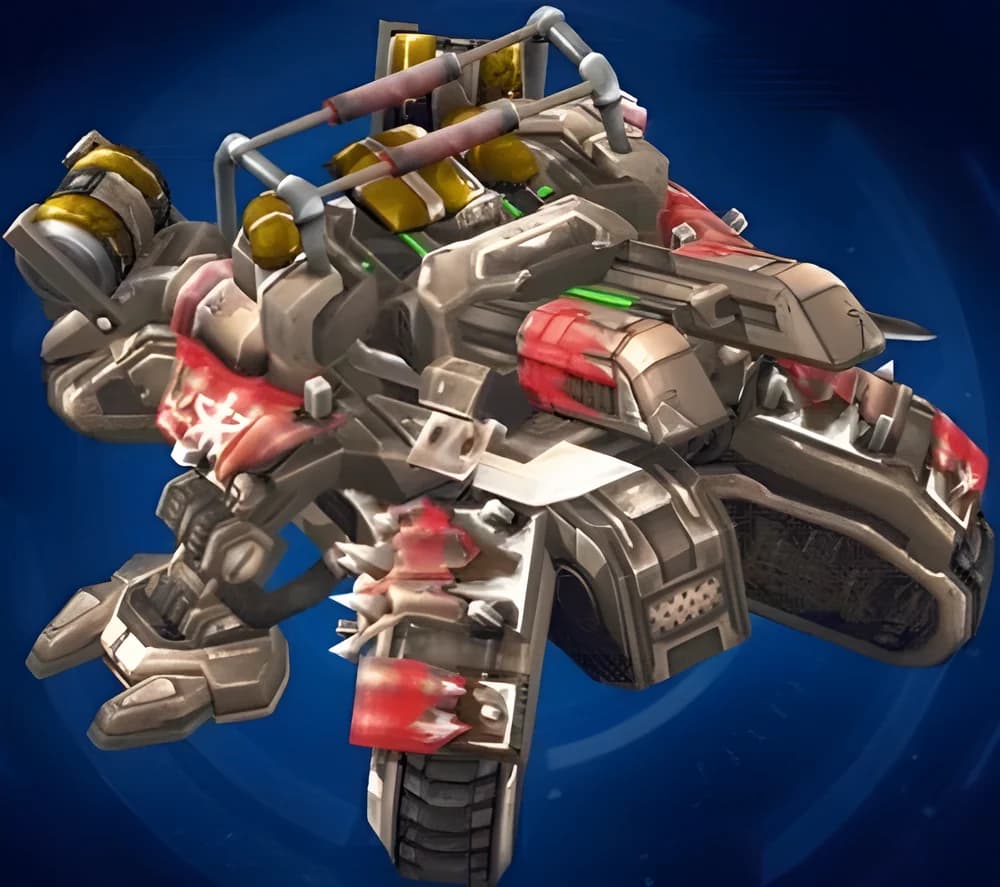
The Umojan Protectorate developed its own siege tank, the Imperio, a recent invention that already rivaled its Dominion counterparts in early combat tests, which had been precisely the design goal. By the Defenders of Man Insurgency the Protectorate was also operating Crucios, a number of which were infested by the zerg on Jarban Minor. Mercenary groups were known for heavily modifying their siege tanks to increase functionality and to make them more visually intimidating, while Tyrador IX maintained platinum-alloy siege tanks to fire ten-round salutes for visiting dignitaries of sufficient rank. In Co-op Missions, Nova Terra deploys advanced heavy siege tanks against Amon's forces during the End War. (StarCraft II: Legacy of the Void; StarCraft II: Nova Covert Ops; StarCraft II: Co-op Missions)
Frequently asked questions
- What is the siege tank in StarCraft?
- The siege tank was a terran armored vehicle that could be configured for both the mobile combined-arms support role and the long-range artillery support role. Its defining feature was the ability to switch on the battlefield between a conventional tank and a static emplacement deploying a far more powerful cannon.
- Why was the siege tank developed?
- The dual-mode siege tank concept was a Confederate response to the flexibility of the goliath walker. Before the Guild Wars, work had progressed on a static "final defense" cannon, but the conflict demonstrated the need for mobility, and an effort was made to render the cannon mobile. Mobile siege tanks existed by 2480.
- What is the AAV-5 Arclite?
- The AAV-5 Arclite was the original siege tank, in service by 2491 and renowned throughout the Confederacy for its heavy firepower. In siege mode it deployed a 120mm Shock Cannon.
- What replaced the Arclite siege tank?
- The Crucio was developed to address the Arclite's light tank-mode armament and armor, and it had entered Dominion service by 2502. It featured superior protection and armament, with twin 90mm cannons in assault mode that became the 180mm Shock Cannon in siege mode.
- Which other groups fielded siege tanks?
- The Umojan Protectorate developed its own model, the Imperio, and later operated Crucios as well. Mercenary groups heavily modified their siege tanks, Tyrador IX maintained platinum-alloy tanks for ceremonial salutes, and during the End War Nova Terra deployed advanced heavy siege tanks against Amon's forces.
Gallery
Images via StarCraft Wiki
Sources
- GameStarCraft II: Wings of Liberty, Blizzard Entertainment, 2010
- GameStarCraft II: Legacy of the Void, Blizzard Entertainment, 2015
- GameStarCraft II: Nova Covert Ops, Blizzard Entertainment, 2016
- GameStarCraft II: Co-op Missions, Blizzard Entertainment, 2015 onward
- BookStarCraft (manual), Peter Underwood, Bill Roper, Chris Metzen and Jeffrey Vaughn, Blizzard Entertainment, 1998
- BookStarCraft Field Manual, Rick Barba, Insight Editions, 2015
- BookStarCraft: Uprising, Micky Neilson, Pocket Books, 2000
- BookStarCraft II: Heaven's Devils, William C. Dietz, Gallery Books, 2010
- BookStarCraft: I, Mengsk, Graham McNeill, Pocket Star, 2008
- ComicStarCraft: Frontline Volume 1, Tokyopop, 2008
- WebUnits: Crucio Siege Tank, Blizzard Entertainment, StarCraft II website, 2010
- WebStarCraft Compendium: Siege Tank, Blizzard Entertainment, classic.battle.net, 1998
- WebMomentum, Danny McAleese, Blizzard Entertainment short story, 2013
Spotted a factual error or a primary source we missed? Email a correction. Every flagged claim gets reviewed.
Followed from this entry
2502: the year of quiet atrocities
2502 fell in the uneasy years between the Brood War and the Second Great War. The Terran Dominion hid a colonial massacre behind parade broadcasts, Emperor Mengsk buried the mother of his heir, a squad of outlaw commandos was sent to kill Jim Raynor, and secret programs built on stolen ghosts and captive protoss advanced in the dark.

Defenders of Man Insurgency
The Defenders of Man Insurgency was a conflict fought after the End War between the Terran Dominion and the separatist Defenders of Man, who lured feral zerg onto Dominion worlds to discredit Emperor Valerian Mengsk. It was exposed and crushed through the efforts of the ghost Nova Terra.
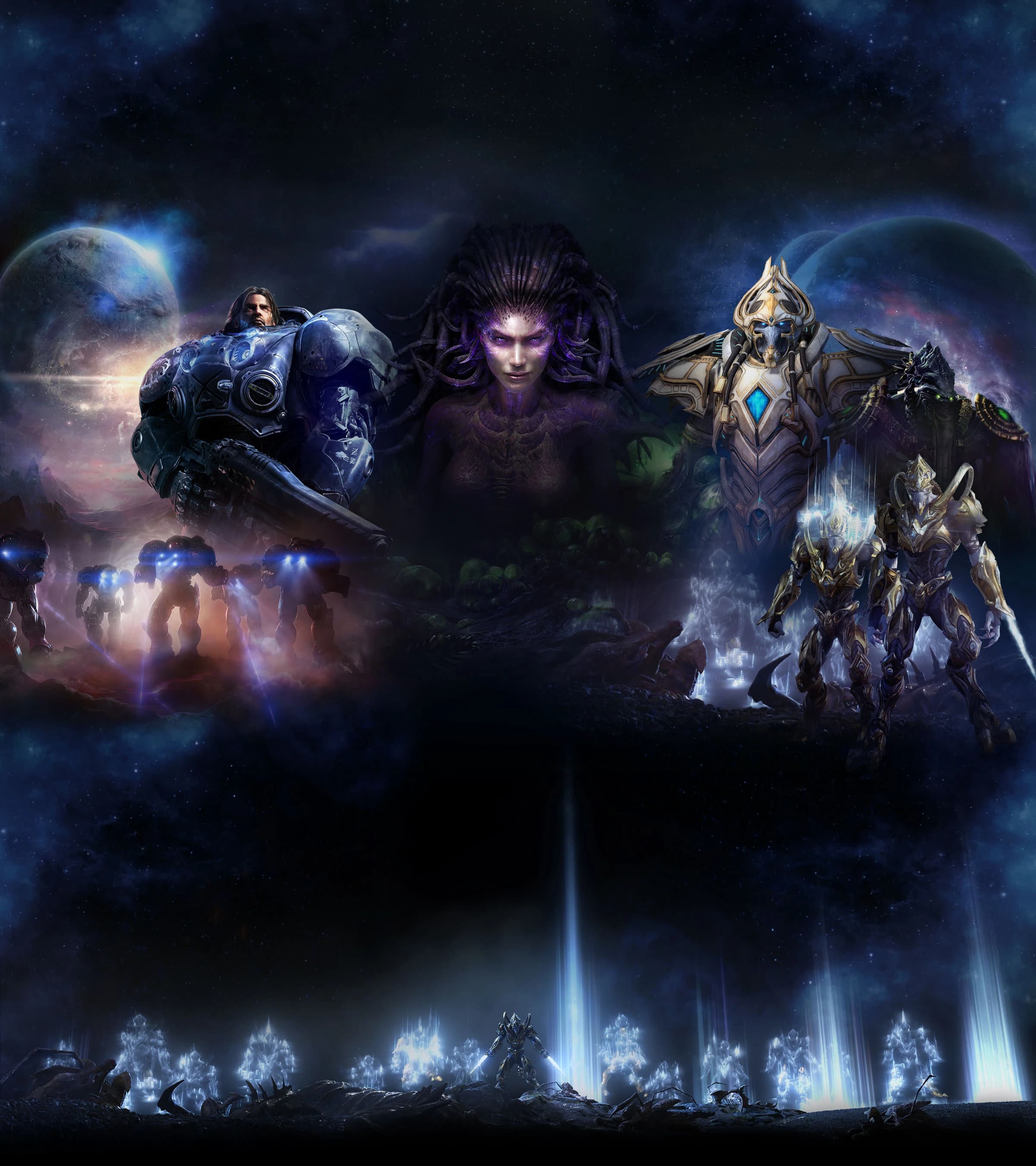
End War: Amon's crusade on the galaxy
The resurrected xel'naga Amon corrupted the Khala and cost the protoss both Aiur and Shakuras. Kerrigan, remade as a xel'naga, killed him in the Void.
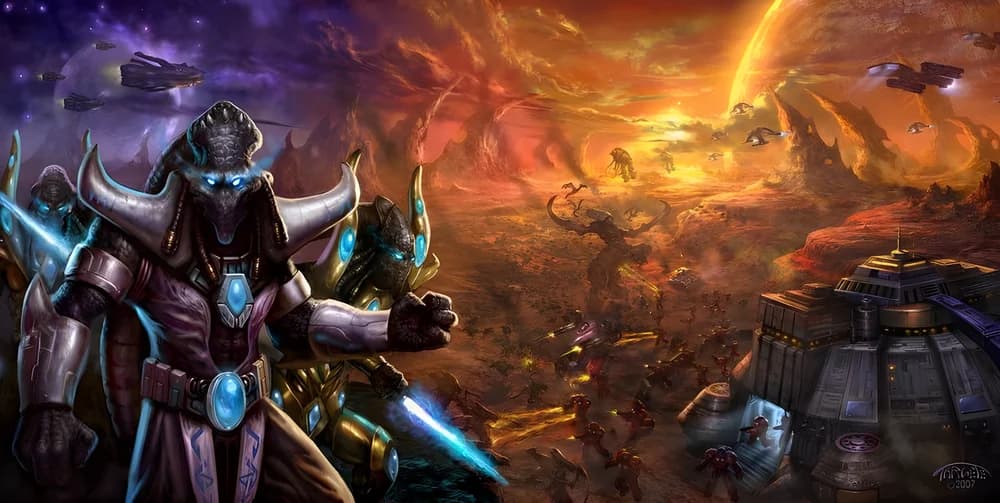
Great War: protoss against zerg over Aiur
The Great War was the first open fight between protoss and zerg, with the terrans caught between them. It ended over Aiur with the Overmind destroyed.
Guild Wars: Confederacy against the Combine
Fought across the late 2480s over the mineral wealth of the Koprulu sector. The Confederacy won, seized the mining guilds and ruled the next decade.
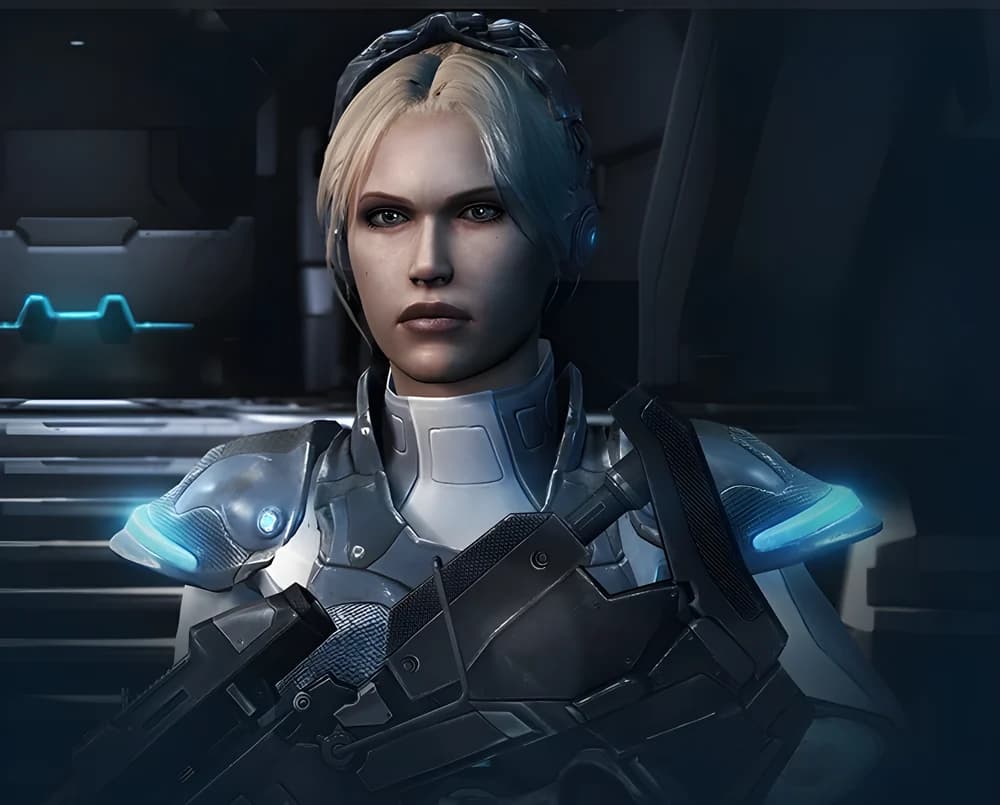
Nova Terra: Dominion ghost, Agent X41822N
Nova Terra was born to one of the Confederacy's Old Families. Rebels murdered them, her telepathy erupted, and the Ghost Program made her Agent X41822N.
Mentioned in8 entries
Armory: research forge of the terran war machine
The armory was a terran research structure where scientists and test groups developed improved materials for the weapons and armor of vehicles and starships. Built around a core of cooling turbines and raised among the first buildings of any Dominion field base, it kept terran armor and airpower ahead of the enemies arrayed against them.
Confederate Armed Forces: military arm of the Terran Confederacy
The Confederate Armed Forces was the military of the Terran Confederacy, headquartered on Tarsonis and organized into squadrons of conscripts and resocialized criminals. It fought the Kel-Morian Combine in the Guild Wars, razed Korhal with nuclear weapons, and collapsed when the zerg overran Tarsonis.
Dropship
The dropship was a heavily armored terran aerospace transport built to ferry troops and vehicles into combat. Designed by the Confederacy and in use by 2480, it was carried forward by the Dominion before the medivac dropship took over most of its work.
Engineering Bay: infantry research center of the terran military
The engineering bay was a terran research structure devoted to improving the quality of the weapons and armor fielded by infantry. In use by the Terran Confederacy as early as 2488, it remained one of the first two research facilities raised in any Dominion field base, and its work followed terran soldiers to every battlefield in the Koprulu sector.
Every Terran Unit in StarCraft and StarCraft II, Explained
Every terran unit from StarCraft, Brood War and the three StarCraft II campaigns, sorted into infantry, vehicles and starships. Each entry covers who built it, what it was for and which games it appears in.
Factory: armored heart of terran vehicle production
The factory was the automated terran structure that served as the primary production center for ground vehicles, structures, and ammunition. Behind walls of reinforced neosteel it housed elite vehicle crews in first class quarters, assembled war machines with interior cranes, and could lift off on ventral thrusters to follow the front wherever it moved.
Guild Wars: Confederacy against the Combine
Fought across the late 2480s over the mineral wealth of the Koprulu sector. The Confederacy won, seized the mining guilds and ruled the next decade.
Viking
The A2 Viking Armored Mechanical Hybrid was a terran combat vehicle that could transform between a ground assault walker and an air-superiority fighter, developed by the Terran Dominion to close gaps in terran anti-air defense after the Brood War.
Get new articles in your inbox
No spam. New lore drops, canon conflicts, and deep dives only when they’re worth reading.
Some links on Lore Fortress are affiliate links. If you buy through them we earn a small commission at no extra cost to you.