Humanoid Cylon
the skin-jobs
Humanoid Cylons were a form of biological Cylon engineered to look and behave exactly like human beings. Created by the Final Five after the Cylon War, these synthetic humans were both wholly organic and wholly artificial, and their infiltration of the colonies made the Fall possible.
Humanoid Cylons, known pejoratively as skin-jobs, were a form of biological Cylon that took the appearance and mannerisms of human beings. They were anatomically indistinguishable from humans, and unless recognised by face a Humanoid Cylon could be exposed only by a test such as the Cylon detector Gaius Baltar built. Engineered by the Final Five with the help of the original Number One, the line ultimately comprised a small set of models, together replicated into millions of individuals. (Battlestar Galactica, "Litmus"; "Six of One"; "No Exit")
Origins and creation#
During the Cylon War, the rebellious Cylons set out to create synthetic cybernetic organisms, believing that bridging the gap between man and machine would bring them closer to the One True God. Late in the war, human captives were taken to a secret Cylon research station and experimented on, work that produced the prototype Hybrid, a human fused with computer components. The Final Five, arriving from the thirteenth colony's Earth, offered the Centurions resurrection technology in exchange for ending the war, and agreed to help them build their new bodies. (Battlestar Galactica: Razor; Battlestar Galactica, "No Exit")
With the war at an end, the Cylons left the Cyrannus system to begin a new existence and constructed a vast mobile space station known as the Colony. There two projects advanced: the creation of replicable synthetic organisms and the integration of that biology with the Final Five's resurrection technology. (Battlestar Galactica, "No Exit")
The first successful Humanoid Cylon was the prototype Number One, called John, whose physical appearance was modeled on the father of Ellen, one of the Five. This prototype helped the Five produce the remaining models: Two, Three, Four, Five, Six, Seven, and Eight. John harbored violent tendencies, and in a fit of jealousy he killed the Sevens while their bodies were still growing by poisoning their amniotic fluid, then corrupted the data so that no new Sevens could be grown. The other models were reprogrammed so that they would neither recognize the Five nor understand their significance. (Battlestar Galactica, "No Exit")
Infiltration of the colonies#
Later the Ones unboxed the Five and placed them in Colonial society with false memories that led them to believe they were human. Saul Tigh arrived with memories of having fought in the Cylon War, and the others were slotted in at different times before the Fall of the Twelve Colonies. Meanwhile the Humanoid Cylons chose to renew the war with humanity and began infiltrating Colonial society themselves. The penetration ran deep: Number Ones served as priests on both Caprica and Galactica, and a Number Four, Simon, posed as a doctor on occupied Caprica. (Battlestar Galactica, "No Exit"; "The Farm"; "Lay Down Your Burdens, Part I"; Battlestar Galactica: The Plan)
Physiology#
The Cylon brain shares the basic structure of a human one but draws on the silica pathway technology the Colonies first developed for the mechanical Centurions. As a consequence, a Humanoid Cylon's consciousness shared many characteristics of a computer program: it could be transmitted on death to a new body, and it could be reprogrammed. Despite these cybernetic abilities, Humanoid Cylons were otherwise organic beings, anatomically indistinguishable from humans. Their bodies were fortified to resist intense radiation that would kill a human after short exposure, though they were not immune to every disease, as the lymphocytic encephalitis that ravaged them showed. (Battlestar Galactica (2003 miniseries); Battlestar Galactica, "Flesh and Bone"; "Escape Velocity"; "Torn"; "The Passage")
A Humanoid Cylon body was engineered to interface with mechanical computer systems and networks. To access and control Cylon technology, a Humanoid Cylon placed a hand into a data-font or onto the glowing interface pads of a basestar, linking with the system through the skin. They could also interface with human computers, though the painful procedure required cutting into the wrist and inserting a fibre-optic cable. (Battlestar Galactica, "Flight of the Phoenix"; "Torn")
Psychology#
As essentially synthetic humans, Humanoid Cylons possessed genuine human emotions, behaviors, and personalities, and their minds reacted to stimulus in a manner identical to human minds. They were subject to the same emotional traumas and joys as their human counterparts; one copy of Number Six, known as Gina Inviere, was repeatedly assaulted by the crew of the Pegasus, abuse that left her near-catatonic by the time the ship rediscovered the fleet. (Battlestar Galactica, "Pegasus"; "Escape Velocity")
The software-like nature of their consciousness allowed Humanoid Cylons to create what they called projection, a controlled, self-induced hallucination through which they chose to perceive their surroundings, so that a corridor could be seen as a forest. They were capable of dreaming, though the Ones reprogrammed themselves to do without sleep and its nightmares. When a Cylon died, its memories were stored, and another copy of the same model could choose to download them, after which they felt as vivid as its own. (Battlestar Galactica, "Torn"; "Exodus, Part I"; "Rapture"; "The Hub"; "No Exit")
The models#
In all, eight Humanoid Cylon models were engineered by the Final Five, though the Number Seven line, called Daniel, was destroyed by Cavil early on, leaving seven. With their base consciousnesses copied into new bodies, the models together ran into the millions. (Battlestar Galactica, "Six of One"; "No Exit")
Because each model derived from a copied base consciousness and could download the experiences of its fellows, the lines tended to share traits. The Number Ones each identified as Cavil and tended to be priests. The Number Twos identified as Leoben and believed deeply that all of this had happened before and would happen again. The Number Threes identified as D'Anna. The Number Fours were known as Simon and tended toward medicine. The Number Fives called themselves Doral and turned up in public relations work. The Number Sixes had more varied personalities and names, and Caprica Six used seduction as a tool. The Number Eights called themselves Sharon and were the model most prone to forming attachments to humans. Because models so often went by name rather than number, many could be referred to either way. (Battlestar Galactica (2003 miniseries); Battlestar Galactica, "Flesh and Bone"; "Final Cut"; "The Farm"; "Lay Down Your Burdens, Part I"; "Six of One")
Frequently asked questions
- What is a Humanoid Cylon?
- Humanoid Cylons, known pejoratively as skin-jobs, were a form of biological Cylon that took the appearance and mannerisms of human beings. They were both purely organic and purely artificial, remarkably similar to humans and differing only by subtle chemical traits.
- Who created the Humanoid Cylons?
- Humanoid Cylons were engineered by the Final Five and the original Number One, after the Five offered the Centurions resurrection technology in exchange for ending the Cylon War. The work advanced aboard a vast mobile space station known as the Colony, built after the Cylon War.
- How can a Humanoid Cylon be detected?
- Humanoid Cylons are anatomically indistinguishable from humans. Unless recognised by face, they could be identified only by a test such as the Cylon detector Gaius Baltar built, which he rarely used honestly. Their bodies resisted intense radiation that would kill a human, but they were not immune to every disease.
- How many Humanoid Cylon models were there?
- Eight Humanoid Cylon models were engineered by the Final Five, though the Number Seven line, called Daniel, went extinct in the early years, leaving seven. Copied from base consciousnesses, the models together ran into the millions.
- Why did Number One kill the Number Sevens?
- The prototype Number One, called John, harbored violent tendencies, and in a fit of jealousy he killed the Sevens while their bodies were still growing by poisoning their amniotic fluid. He then corrupted the data so that no new Sevens could be grown and reprogrammed the other models so they would neither recognize the Five nor understand their significance.
Sources
- FilmBattlestar Galactica (2003 miniseries), Sci Fi Channel miniseries, 2003
- EpisodeBattlestar Galactica, "Flesh and Bone", Season 1, Episode 8 (2005)
- EpisodeBattlestar Galactica, "Litmus", Season 1, Episode 6 (2005)
- EpisodeBattlestar Galactica, "Final Cut", Season 2, Episode 8 (2005)
- EpisodeBattlestar Galactica, "Flight of the Phoenix", Season 2, Episode 9 (2005)
- EpisodeBattlestar Galactica, "Pegasus", Season 2, Episode 10 (2005)
- EpisodeBattlestar Galactica, "The Farm", Season 2, Episode 5 (2005)
- EpisodeBattlestar Galactica, "Lay Down Your Burdens, Part I", Season 2, Episode 19 (2006)
- EpisodeBattlestar Galactica, "Exodus, Part I", Season 3, Episode 3 (2006)
- EpisodeBattlestar Galactica, "Torn", Season 3, Episode 6 (2006)
- EpisodeBattlestar Galactica, "The Passage", Season 3, Episode 10 (2006)
- EpisodeBattlestar Galactica, "Rapture", Season 3, Episode 12 (2007)
- FilmBattlestar Galactica: Razor, Television film, 2007
- EpisodeBattlestar Galactica, "Six of One", Season 4, Episode 2 (2008)
- EpisodeBattlestar Galactica, "Escape Velocity", Season 4, Episode 4 (2008)
- EpisodeBattlestar Galactica, "The Hub", Season 4, Episode 9 (2008)
- EpisodeBattlestar Galactica, "No Exit", Season 4, Episode 15 (2009)
- FilmBattlestar Galactica: The Plan, Television film, 2009
Spotted a factual error or a primary source we missed? Email a correction. Every flagged claim gets reviewed.
Followed from this entry

Aaron Doral
Aaron Doral was a Number Five humanoid Cylon who infiltrated Colonial society as a public relations executive, running the press side of Galactica's decommissioning. Framed by Baltar, he was left behind at Ragnar Anchorage and collected by his fellow Cylons.
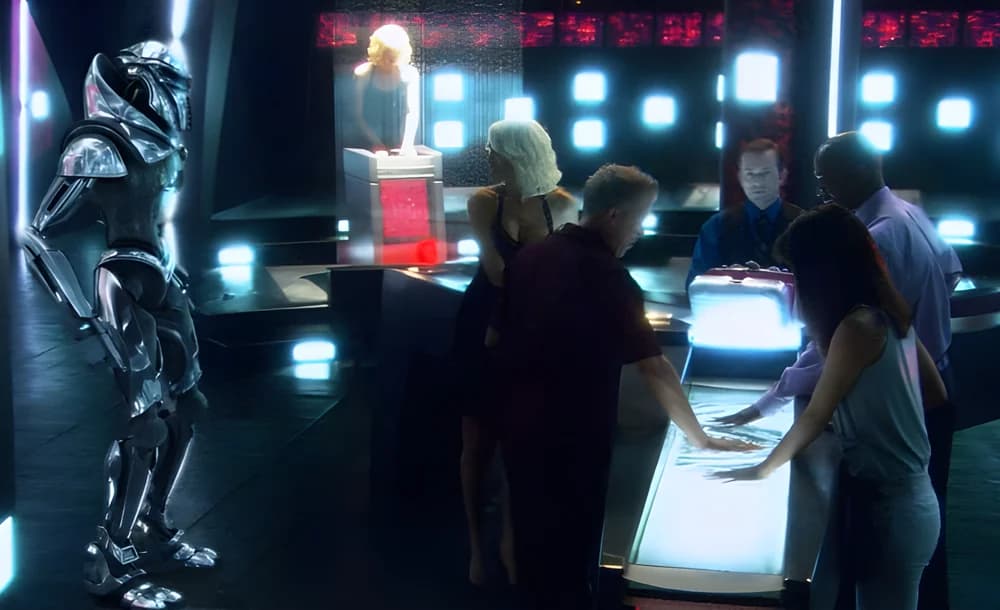
Cylon
The Cylons were a race of sentient machines created as military robots by Graystone Industries on Caprica. Built from research into artificial consciousness, they rebelled against their human masters, fought a long war, and forty years later returned to annihilate humanity.
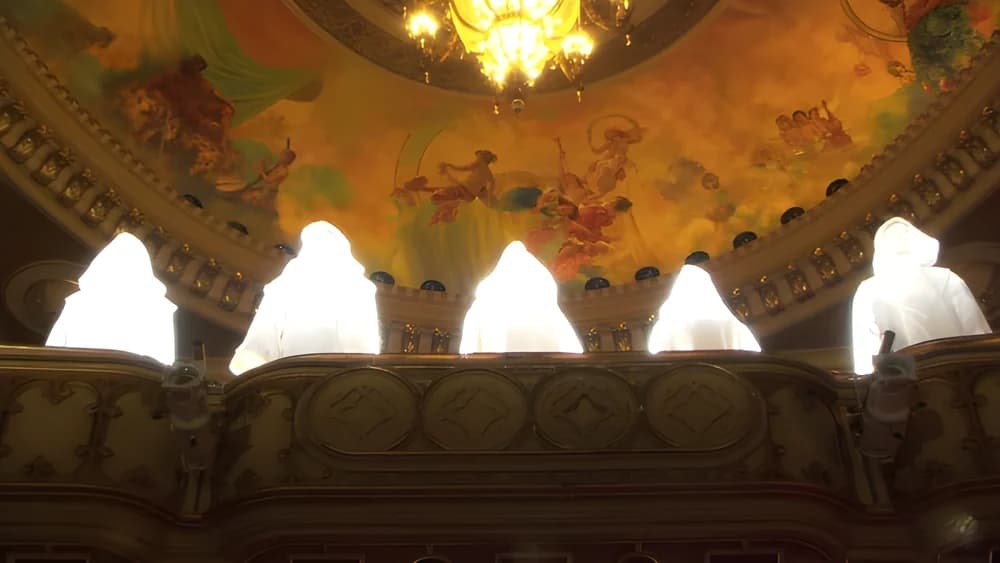
The Final Five
The Final Five were five humanoid Cylon models hidden from the rest of their kind, descendants of the Thirteenth Tribe and the creators of the Significant Seven.
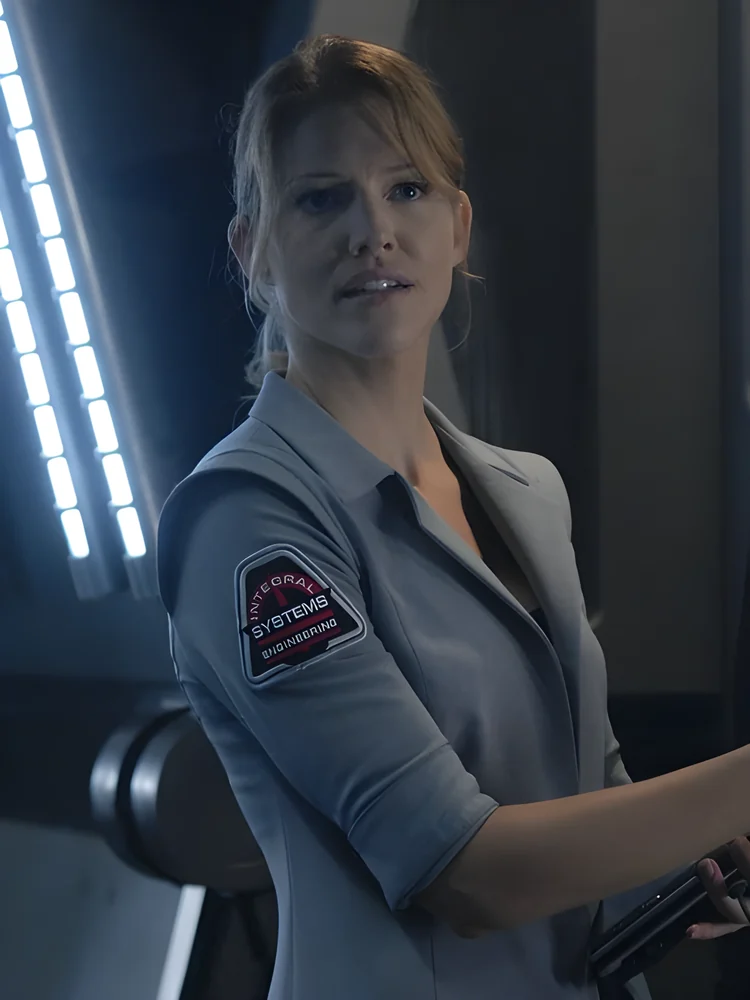
Gina Inviere
Gina Inviere was the alias of a Number Six copy who infiltrated the battlestar Pegasus as a systems analyst, sabotaged it during the Fall, and after months of captivity assassinated Admiral Cain before destroying the liner Cloud Nine.
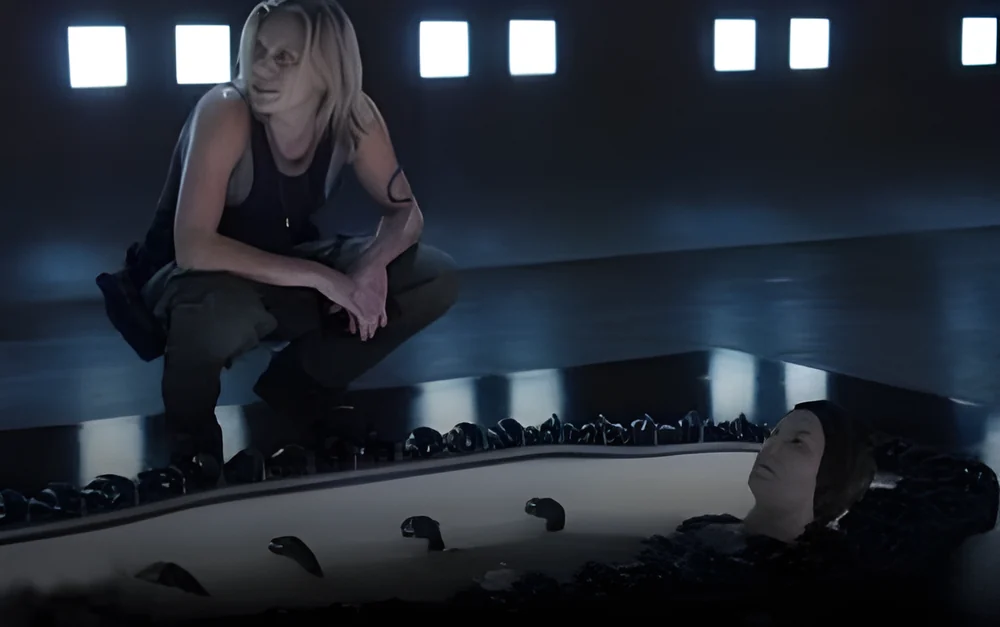
Hybrid
The Hybrid was a model of Cylon created in the final days of the Cylon War. A biological body fused into a computer, it served aboard Basestars in place of a conventional crew, often speaking in fragments of poetry that its makers could not agree how to interpret.

Number Eight
Number Eight was one of the seven surviving Humanoid Cylon models, replicated into many copies that typically went by the name Sharon. Marked by affection and a propensity for fickleness, the Eights produced both the sleeper agent Boomer and the loyal Athena.
Mentioned in20 entries
Basestar Type-D: the modern Cylon baseship
The Basestar Type-D, also called the Modern Basestar, was the primary Cylon capital ship at the Fall of the Twelve Colonies and through the war that followed. Partly organic and run by a Hybrid, it served as a fleet carrier and missile platform in the mould of a Colonial battlestar.
Battle of the Colony
The Battle of the Colony was the climactic engagement of the war between humanity and the Cylons, fought when Galactica assaulted the Cylon homeworld to rescue the child Hera. It ended with the destruction of the Colony and the end of the long pursuit.
Battle of the Resurrection Ship
The Battle of the Resurrection Ship was an engagement between Colonial and Cylon forces that destroyed a resurrection ship shadowing the Cylon pursuit fleet. Its destruction stripped the hunters of their ability to download the dead and left them wary of pressing the chase.
Battlestar Galactica Timeline: every major event from Kobol to the arrival on Earth
The Reimagined Series chronology in order, from the exodus from Kobol and the death of the first Earth to the Fall of the Twelve Colonies and the fleet's arrival 150,000 years ago. A shorter section at the end covers the separate 1978 series and Galactica 1980.
Centurion Model 0005
The Centurion Model 0005 was the line of mechanical Cylon soldiers that fought in the Cylon War. Descended from the Zoe Graystone U-87, they pursued a humanoid form and were later supplanted by their own humanoid creations.
Colonial Fleet: 120 battlestars
The navy of the Twelve Colonies, which fought the Cylon War. One software exploit cut it to two surviving battlestars on the day of the Fall.
Cylon Occupation of Caprica
The Cylon occupation of Caprica was a months-long presence of Centurions and Humanoid Cylons on the world after the Fall of the Twelve Colonies. It is remembered above all for the human resistance led by Samuel T. Anders and the Cylons' growing doubts over the genocide they had committed.
Every Cylon Model in Order, by Number: One to Eight and the Final Five
All twelve humanoid Cylon models from the reimagined Battlestar Galactica, in order by number, from Cavil and Leoben to Saul Tigh and Tory Foster. Who each one was, the copies that mattered, what they wanted and how their story ended.
Exodus from New Caprica
The Exodus from New Caprica was a combined ground, air, and space engagement in which the Colonial Fleet and the New Caprica Resistance broke the Cylon occupation of the colony and evacuated its settlers back into the fleet.
Hera Agathon
Hera Agathon was the first human-Cylon hybrid to exist, born to a Colonial officer and a Number Eight Cylon in the first month after the Fall of the Twelve Colonies. Held to be central to God's plan for both races, she was known before her birth as the Shape of Things to Come.
Karl Agathon
Karl "Helo" Agathon was a Colonial Fleet officer who, stranded on Caprica after the Fall of the Twelve Colonies, fell in love with a Number Eight Cylon he later married. He became the only successful father of a human-Cylon hybrid child, Hera.
Number Eight
Number Eight was one of the seven surviving Humanoid Cylon models, replicated into many copies that typically went by the name Sharon. Marked by affection and a propensity for fickleness, the Eights produced both the sleeper agent Boomer and the loyal Athena.
+ 8 more
Get new articles in your inbox
No spam. New lore drops, canon conflicts, and deep dives only when they’re worth reading.
Some links on Lore Fortress are affiliate links. If you buy through them we earn a small commission at no extra cost to you.