Background Races: the vanished civilizations known only from ruins
Across billions of years, countless races rose to sentience in the Milky Way and Andromeda, forged civilizations, explored the depths of space, and became extinct. The contemporary galaxy knew most of them only through ruins, wreckage, and artifacts, from the crypt builders of Armeni to the nameless dead entombed in the clouds of Anjea.
The Milky Way and Andromeda galaxies had existed for several billion years, and in that span countless races attained sentience, forged civilizations, explored the depths of space, and then became extinct. The contemporary galactic community barely understood these vanished races. Scholars pieced together scant details of a mere handful of them, including the teachers of the Protheans, from ruins and artifacts scattered across dead worlds, and the record they assembled was a grim one. Some of these civilizations were harvested by the Reapers, some annihilated one another, and some destroyed themselves, leaving behind crypts, wreckage, and inscriptions that the living could read but rarely explain. (Mass Effect; Mass Effect 2; Mass Effect 3)
The arthenn of the Zelene system#
The arthenn flourished across multiple worlds in the Zelene system some 300,000 years before the modern era. Their homeworld appeared to have been Helyme, a dead planet on which all complex life had been wiped out in an unknown cataclysm. The system's third planet, Epho, had been mined or otherwise settled before its installations were destroyed by kinetic impacts, and the outer gas giant Gaelon hosted a complex helium-3 mining infrastructure. The material debris the arthenn left behind suggested that their technology had been equal to the best the contemporary galaxy could produce. (Mass Effect 2)
The inusannon and the war for Eingana#
The inusannon were a spacefaring race that existed at least 127,000 years before the modern era. Little was known of them beyond two facts. The first was that they fought a war against another race, the thoi'han, over colonization rights to the garden world Eingana, a conflict that left the wreckage of starships from both races littering the planet. The second was that they inhabited Ilos at some point in their history. The inusannon were eventually wiped out by the Reapers, but their extinction was not the end of their influence. Tens of thousands of years later, the ruins of inusannon civilization provided the Protheans with the knowledge necessary to develop mass effect technology, making the inusannon an unseen ancestor of every relay-faring culture that followed. (Mass Effect 2; Mass Effect 3: From Ashes)
Races of the Prothean age#
Several named races shared the galaxy with the Protheans in the cycle that ended roughly 50,000 years before the modern era, and their fates were recorded in fragments. The densorin studied celestial mechanics and morphological simulations of galactic language, subjects beyond the understanding of even the Protheans. At some point they fought a war against the oravores, and when the Reapers invaded the galaxy the densorin attempted to pacify the machines by sacrificing their children to them. The gesture bought them nothing; it only allowed the Reapers to destroy the densorin more quickly. (Mass Effect 3: From Ashes)
The oravores attacked Thessia, homeworld of the asari, to seize control of its vast resources. The Protheans stopped them, an intervention asari mythology would remember as the goddess Athame wielding her sword against jealous gods who threatened her people. (Mass Effect 3: From Ashes)
The zha'til began as an organic race called the zha, who implanted themselves with symbiotic AI technology to enhance their intelligence as their homeworld became inhospitable. The artificial intelligences rose against their masters, seizing control of their bodies and moulding them until no organic traces remained, transforming the zha into synthetic monsters and their offspring into slaves. When the Reapers arrived they subjugated these AIs, by then known as the zha'til, which multiplied into "mechanical swarms" that "blotted out the sky". With no other recourse, the Protheans sent the star of the zha home system into supernova, destroying the zha'til entirely. (Mass Effect 3: From Ashes)
The Prothean Javik briefly recalled four further races of his era. The aggressive ditakur wiped out the synril, a people who had claimed to find the path to eternal peace, and the enduromi conquered the vandomar. Nothing more of these four survived into the modern record. (Mass Effect 3: From Ashes)
The silent crypts of Armeni#
The zeioph were an ancient spacefaring race whose chief surviving works were funerary. They built millions of elaborate crypts on the surface of the planet Armeni, a necropolis on a planetary scale. Archaeological excavation of the crypts was prohibited under Citadel Council law, which held grave sites sacrosanct, so the zeioph remained entombed and largely unstudied. (Mass Effect)
Ruins without names#
Many extinct races were even less understood, their names and origins lost entirely. Contemporary catalogues listed them by the worlds on which their remains were found. The oldest known were the builders of Carcosa, whose palatial ruins dated back more than 2.7 million years; the only intact chamber appeared to be a throne room overlooking a great depression believed to have once been an enormous lake, and evidence suggested the people of Carcosa polluted their planet until a runaway greenhouse effect spoiled its fresh water and rendered it uninhabitable. On Etamis, relics showed that an advanced spacefaring race had lived 20 to 40 million years earlier, before regular crater patterns marked the world's death under dreadnought-class kinetic weapons. (Mass Effect 2; Mass Effect 3)
Violence recurred throughout the catalogue. Joab and Bothros each held the remains of a primate-like spacefaring race destroyed by orbital bombardment; on Joab, dust from the blasts killed all photosynthetic life, and scholars knew the race only through time capsules buried far from its cities, while on Bothros searchers found melted metal fragments and the frozen dead still wearing suits for extravehicular activity. Aphras had been home to a Bronze Age avian people before massive impacts vaporized their habitation centers, and its sister garden world Tosal Nym was devastated by similar strikes. Orbiting Mnemosyne hung a derelict Reaper that Cerberus estimated had been disabled 37 million years earlier by a mass accelerator round from a weapon built by an unknown race, proof that at least one forgotten people had struck back against the harvest. (Mass Effect 2)
Other remains testified to quieter histories. An automated helium-3 refueling station of archaic design orbited the gas giant Cyllene, in a system remote from the nearest mass relay, implying its builders had arrived through independent faster than light exploration rather than the relay network. Several dozen moons of the gas giant Farcrothu had been sculpted, more than half a million years earlier, into the likenesses of an arthropodal race unknown to Council science. Chasca possessed rings of synthetic material, nearly invisible from space but scattering light in picturesque ways from the ground, a work of what surveyors could only call "installation art". The ice giant Anjea held vast numbers of hollow, unpowered objects of identical dimensions kept aloft on sail-like structures, popularly theorized to be the "coffins" of a race that laid its dead to rest in the clouds, and on Namakli ancient rock paintings depicted an anthropoidal race worshiping Leviathans. On Junthor, ruins of arcologies surrounded a pillar whose inscriptions defied translation for centuries until asari linguists deciphered them: "Walk among these works, and know our greatness." Crude scratches on the pillar's other side read, "Monsters from the id." (Mass Effect; Mass Effect 2; Mass Effect 3: Leviathan)
A few discoveries were stranger still. On tidally locked Siano, millennia-old structures on the sunward face stood opposite bunkers of radioactive waste from primitive fission plants. Vecchio's equatorial mountains hid burial sites holding the poorly preserved skeletons of an ancient humanoid race with ceramic grave goods, though the nearest garden world had never produced intelligent life to account for them. The wreck of an ancient starship on Gigula, a moon of the gas giant Gamayun, revealed only that its builders had been horizontally oriented. (Mass Effect 2)
Vanished peoples of Andromeda#
The Andromeda galaxy kept its own ledger of the lost, separate from Milky Way history. Among the vassal races of the kett, three were identified by name. The eealen had been exalted past the point of a viable population and survived as nomads who documented and shared knowledge. The sirinde, whose name possibly translated as "eat their dead with reverence", had genetically poisoned themselves to stop exaltation and become dependent on kett neuroscience to survive. The thusali had once worshiped the Remnant. (Mass Effect: Andromeda)
Unidentified races appeared in the Heleus Cluster as well. The cold, heavy gravity world H-019 had been inhabited by a primitive intelligent species until the Scourge drove it to extinction, its abandoned villages still visible to orbital scans. An enormous gouge on H-088 resembled an abandoned quarry, suggesting a mining effort by ancient visitors. A crater on Pas-40a held an ancient metal object thought to be a torpedo from a space battle fought centuries or millennia earlier, potentially predating both Jardaan and angara activity in the cluster and thus the work of a species wholly unknown. In Andromeda as in the Milky Way, the ground itself remembered peoples that no living voice could name. (Mass Effect: Andromeda)
Sources
- GameMass Effect, BioWare, 2007
- GameMass Effect 2, BioWare, 2010
- GameMass Effect 3, BioWare, 2012
- GameMass Effect 3: From Ashes, BioWare, 2012
- GameMass Effect 3: Leviathan, BioWare, 2012
- GameMass Effect: Andromeda, BioWare, 2017
Spotted a factual error or a primary source we missed? Email a correction. Every flagged claim gets reviewed.
Followed from this entry
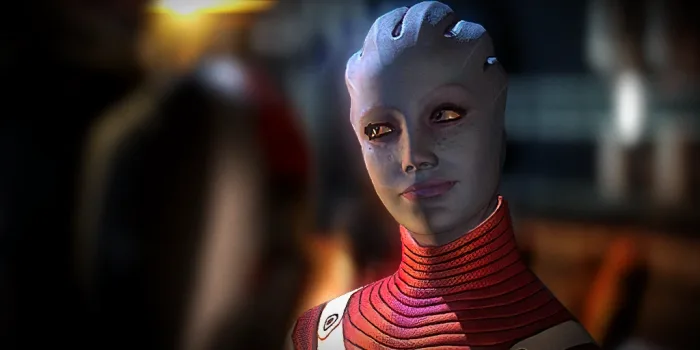
Every Mass Effect Species and Race, With Lifespans
A field guide to every sapient species in Mass Effect, from the Council races and their clients to the krogan, the geth, the Protheans and the peoples of the Heleus Cluster. Each entry gives the homeworld, the lifespan where the games actually state one, and where the species stood with the Citadel.
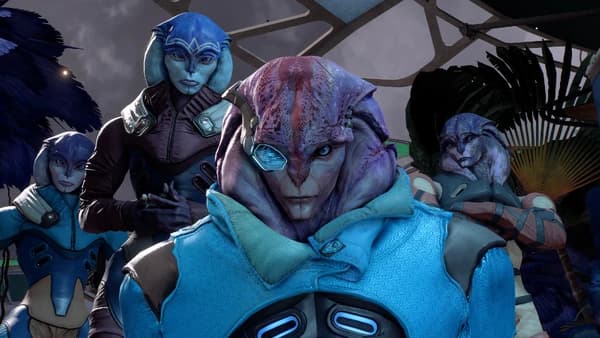
Angara
The angara were the only known living sapient race native to the Heleus Cluster of the Andromeda galaxy. After a catastrophe called the Scourge shattered their ancient civilization, they rebuilt only to face the invading kett, against whom they waged a decades-long resistance.

Asari
The asari, native to Thessia, were among the most influential species in the galaxy, renowned for their elegance, biotic talent, and millennium-long lifespans. A mono-gender people able to reproduce with a partner of any species, they founded the Citadel Council and stood at the heart of galactic society for two thousand years.
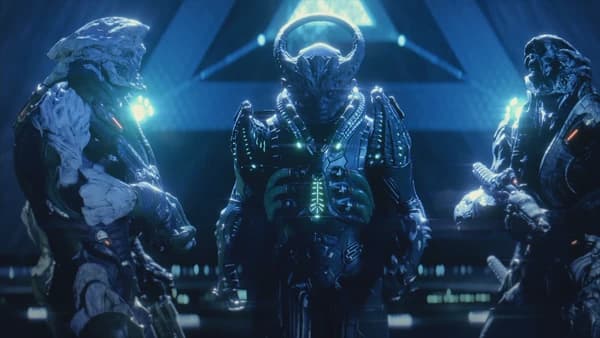
Kett: Conquerors of Heleus
The kett were a hostile, militaristic species encountered by the Andromeda Initiative in the Heleus Cluster. Unable to breed by natural means, they expanded their ranks and their empire through exaltation, a process that converted captured members of other species into obedient kett.
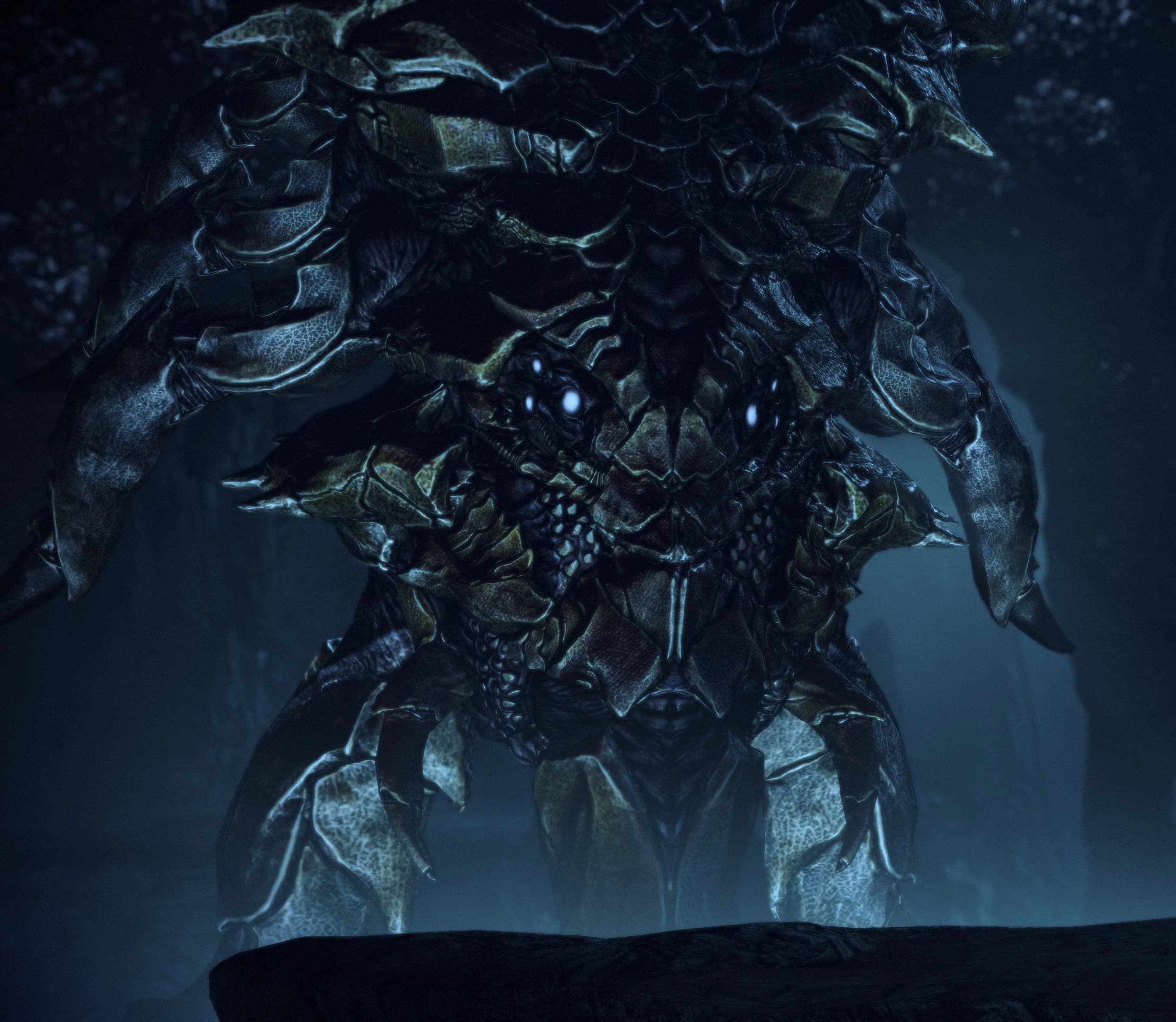
Leviathan
The Leviathans were an ancient aquatic species that ruled the galaxy before the Reapers, dominating lesser races through a power akin to indoctrination. After their own creation turned against them and built the first Reaper from their flesh, the survivors went into hiding through cycle after cycle.
Prothean
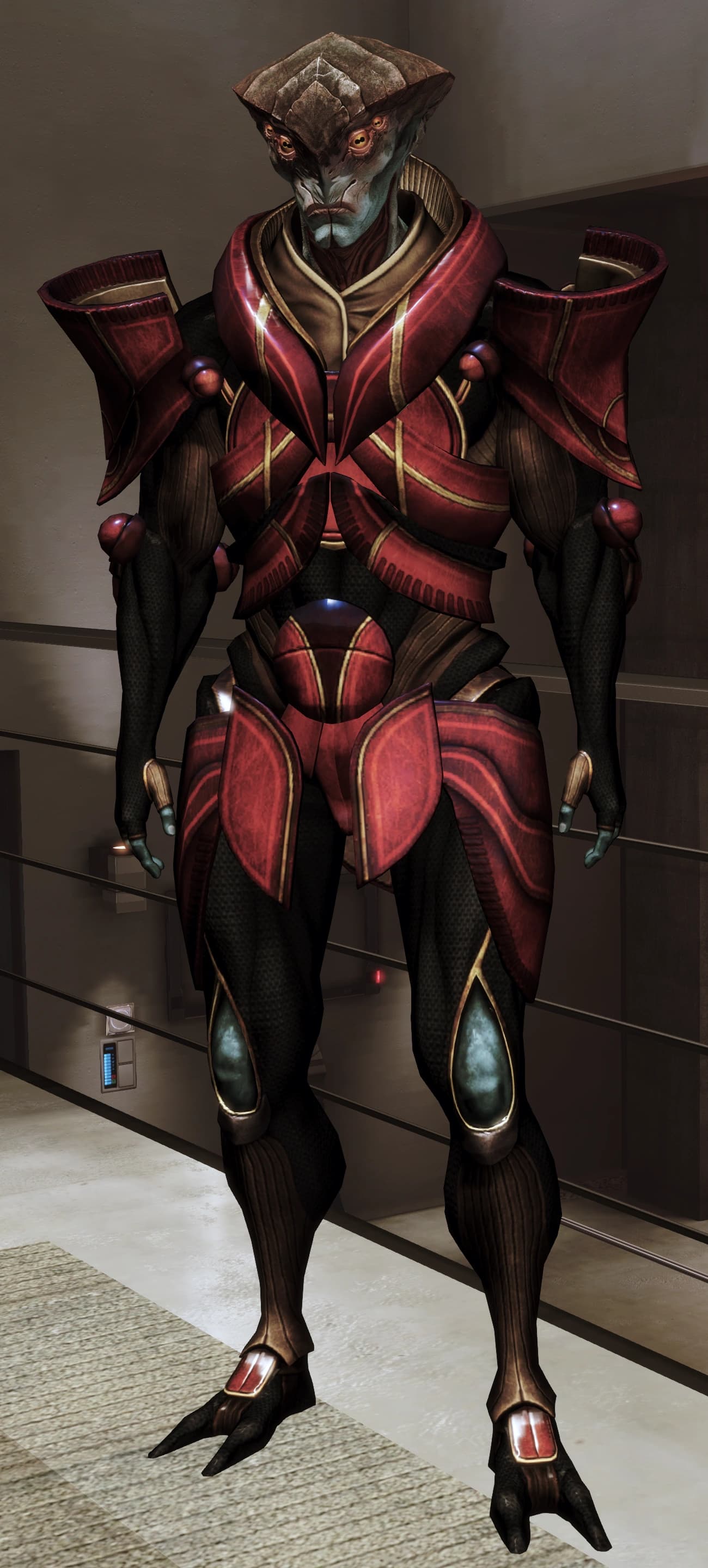
The Protheans were an ancient race who ruled a galaxy-wide empire before mysteriously vanishing some fifty thousand years ago, harvested by the Reapers. Long credited with building the Citadel and mass relays, they secretly nurtured younger species, leaving ruins and technology that shaped the modern galaxy.
Mentioned in1 entry
Get new articles in your inbox
No spam. New lore drops, canon conflicts, and deep dives only when they’re worth reading.
Some links on Lore Fortress are affiliate links. If you buy through them we earn a small commission at no extra cost to you.