Mass relay
The galactic transit network
Mass relays were colossal transit devices scattered across the Milky Way that flung starships across thousands of light years in moments. Long credited to the Protheans, they were in truth built by the Reapers as part of a trap meant to shape and harvest galactic civilization.
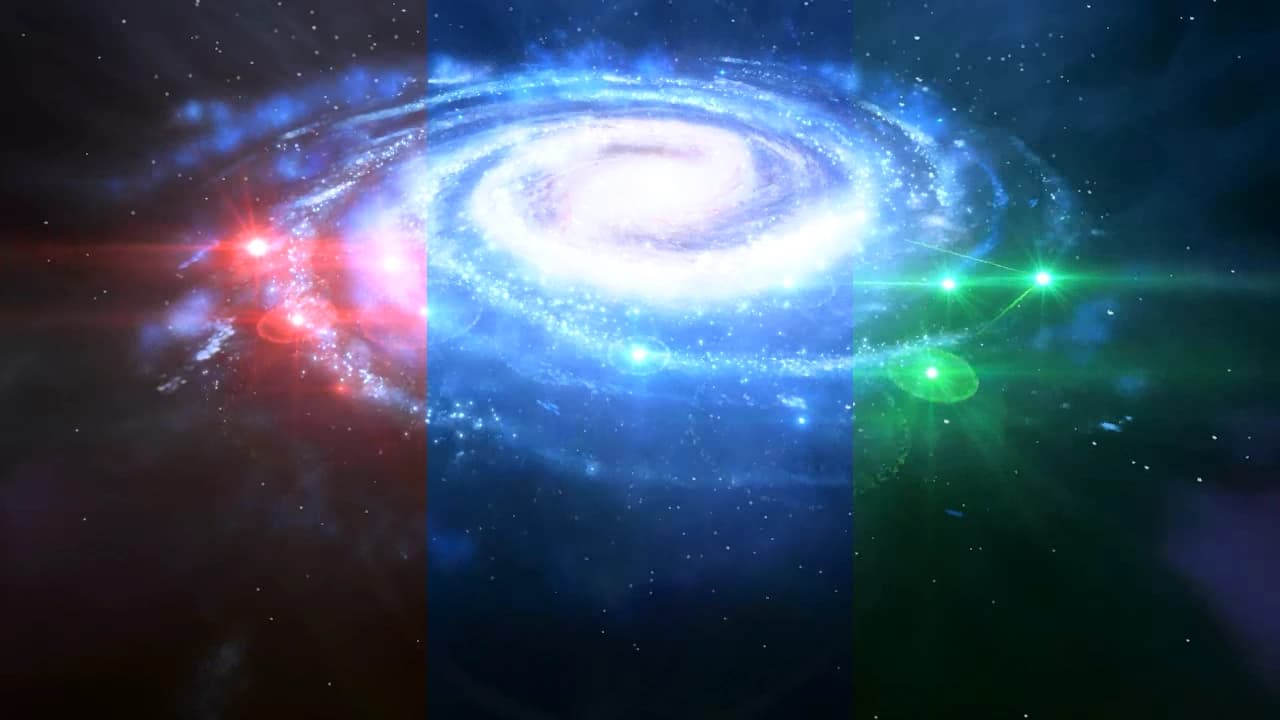
Mass relays were mass transit devices scattered across the Milky Way, usually positioned within particular star systems, that together formed a galaxy-wide network for rapid interstellar travel. A relay could hurl a starship instantaneously to another relay in the network, collapsing journeys that would otherwise have taken years or centuries with ordinary faster-than-light drives into a matter of days or hours. Long hailed as the greatest achievement of the extinct Protheans, the relays were the spine of galactic commerce and the chief reason the scattered species of the galaxy could function as a single community centered on the Citadel. (Mass Effect)
Structure and operation#
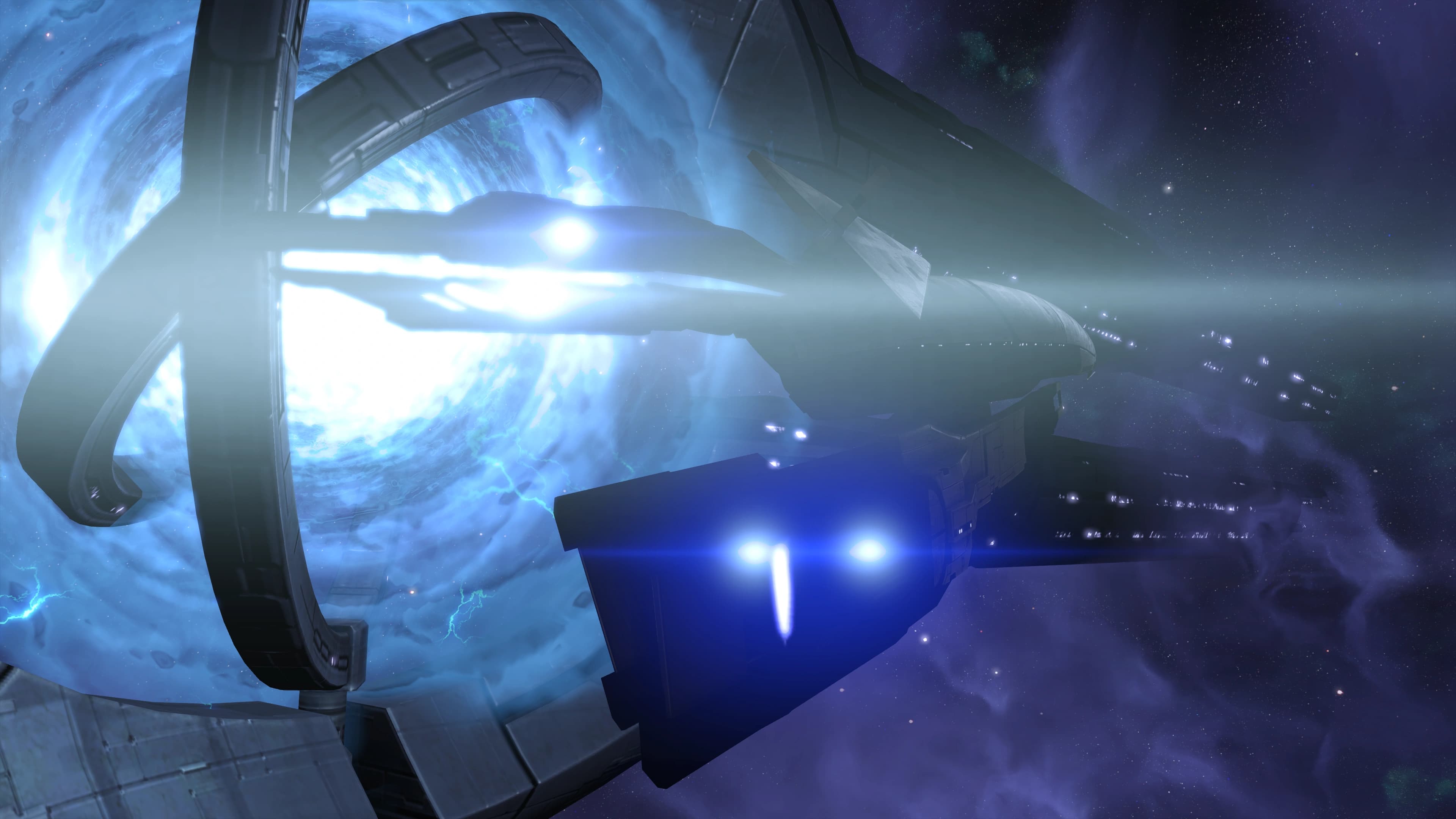
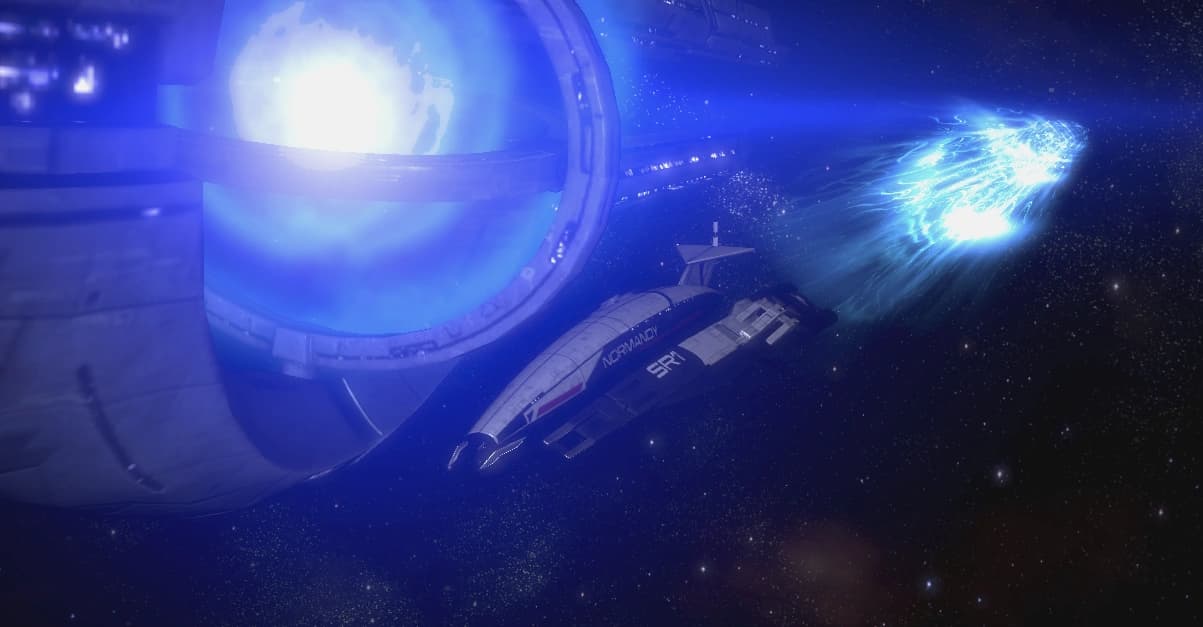
A mass relay consisted of two curved metal arms roughly fifteen kilometers long surrounding a set of revolving, gyroscopic rings about five kilometers across. At the heart of these rings sat a massive, blue-glowing core of element zero. The relays were fashioned from an unknown but extraordinarily resilient material, the same substance from which the Citadel was built, and were protected by a quantum shield that locked their structure at the subatomic level, rendering them nearly impervious to harm. A relay could survive the wake of a supernova without damage. They were cold objects, emitting neither heat nor radiation, which made them difficult to locate if their position had shifted over the ages. Some, like the Charon Relay, were gravitationally anchored to celestial bodies, while others drifted in open space and had to be carefully tracked. (Mass Effect; Mass Effect 2)
A relay functioned by creating a virtually mass-free corridor of space-time between itself and another relay, propelling a vessel across distances that would take centuries even at faster-than-light speeds. Before transit, a ship's pilot supplied the relay with the amount of mass to be moved, after which the vessel was guided into the approach corridor. The relay then aligned itself with its destination counterpart and flung the ship across the void. Vessels emerged with no fixed exit point, scattering around the destination relay with positional drift of many thousands of kilometers being common, which made mining or trapping a relay impractical. (Mass Effect)
Primary and secondary relays#
The network divided into two kinds of relay. Primary relays could propel a ship across thousands of light years but connected only to a single partner relay. Secondary relays could link to any other relay across shorter distances, generally only a few hundred light years. After the Rachni Wars, the spacefaring species of Council space refused to open a primary relay without first knowing where it led, fearing they might stumble upon another powerful and hostile species as they had the rachni. This caution caused friction when the turians encountered human pioneers who, ignorant of the Citadel Council's prohibition, were attempting to open any relay they could find. That clash eventually escalated into the First Contact War. (Mass Effect)
Many relays lay dormant for reasons that were never fully understood, though they could be reactivated with relative ease. A Prothean data cache discovered on Mars led humanity to a relay encased in ice and orbiting Pluto, long mistaken for a moon named Charon, which gave the Charon Relay its name. (Mass Effect)
True origin#
Despite common belief, the mass relays were not built by the Protheans. As the Reaper Sovereign revealed, the Protheans were merely one of many sentient species to discover the relays and the Citadel and exploit them. When the Reapers exterminated the Protheans, the asari were the next race to find the network thousands of years later. By drawing civilizations to use the relays and the Citadel, the Reapers ensured those civilizations evolved along predictable paths, accelerating their advancement, shortening the interval between harvests, and hastening the process of galactic extinction. (Mass Effect)
The Protheans nevertheless took a keen interest in the relays and managed to unravel the secret of their operation. This knowledge allowed them to construct the Conduit, a one-way prototype relay on Ilos, before they were destroyed. It was later discovered that the Citadel itself was an enormous, inactive mass relay leading directly to dark space, as well as the master control hub for the entire network, allowing the Reapers to sever travel between clusters the instant they re-entered the galaxy. (Mass Effect)
Destruction and the Reaper War#
The galactic community believed the relays to be indestructible, and no serious attempt had ever been made to damage one, since they were too vital to risk. The researcher Dr. Amanda Kenson and her team calculated that a sufficiently large mass hitting a relay with enough force could overwhelm it, and that the resulting release of energy from such a massive engine would rival a supernova. Following a rescue attempt for Kenson that became an effort to delay the Reaper invasion, an asteroid was deliberately steered into the Alpha Relay in the Bahak system. The impact tore the relay apart in an explosion that annihilated the Bahak system and killed more than three hundred thousand inhabitants. (Mass Effect 2: Arrival)
During the final battle to retake Earth from the Reapers, the relay network served as the conduit for the Crucible. When Commander Shepard reached the Catalyst and chose to destroy the Reapers, control them, or merge organic and synthetic life, the resulting energy was transmitted through the relay network from the Citadel, overloading the relays' element zero cores and affecting every point of space for hundreds of light years around them. In the aftermath the relays were rebuilt by the galaxy's survivors. (Mass Effect 3; Mass Effect 3: Extended Cut)
Frequently asked questions
- What is a mass relay?
- Mass relays were mass transit devices scattered across the Milky Way that together formed a galaxy-wide network for rapid interstellar travel. A relay could hurl a starship instantaneously to another relay, collapsing journeys that would otherwise take years or centuries into days or hours.
- Who really built the mass relays?
- Despite common belief that the Protheans built them, the mass relays were in fact creations of the Reapers. By drawing civilizations to use the relays and the Citadel, the Reapers ensured those civilizations evolved along predictable paths, shortening the interval between harvests.
- How does a mass relay work?
- A relay created a virtually mass-free corridor of space-time between itself and another relay, propelling a vessel across vast distances. Before transit a ship's pilot supplied the relay with the amount of mass to be moved, after which the relay aligned with its destination counterpart and flung the ship across the void.
- What is the difference between primary and secondary relays?
- Primary relays could propel a ship across thousands of light years but connected only to a single partner relay. Secondary relays could link to any other relay across shorter distances, generally only a few hundred light years.
- Can a mass relay be destroyed?
- The galactic community believed the relays to be indestructible, but Dr. Amanda Kenson and her team calculated that a sufficiently large mass hitting a relay with enough force could overwhelm it, releasing energy that would rival a supernova. An asteroid was steered into the Alpha Relay in the Bahak system, tearing it apart in an explosion that annihilated the system and killed more than three hundred thousand inhabitants.
Gallery
Images via Mass Effect Wiki
Sources
- GameMass Effect, BioWare, 2007
- GameMass Effect 2, BioWare, 2010
- GameMass Effect 2: Arrival, BioWare, 2011
- GameMass Effect 3, BioWare, 2012
- GameMass Effect 3: Extended Cut, BioWare, 2012
Spotted a factual error or a primary source we missed? Email a correction. Every flagged claim gets reviewed.
Followed from this entry
The Crucible
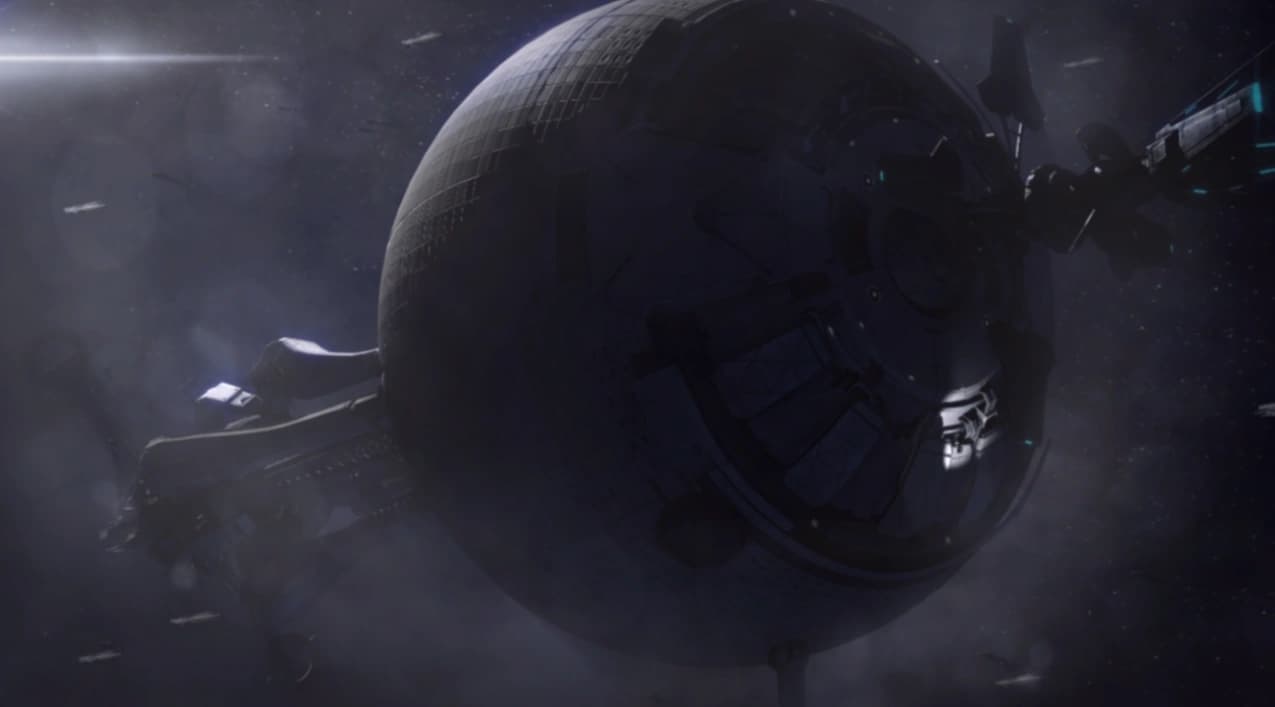
The Crucible was an ancient superweapon of unknown origin, refined across countless cycles by species hoping to stop the Reapers. Rediscovered during the Reaper invasion and built by a united galaxy, it became the last hope of organic life, completed only by joining it with the Citadel.
Element zero
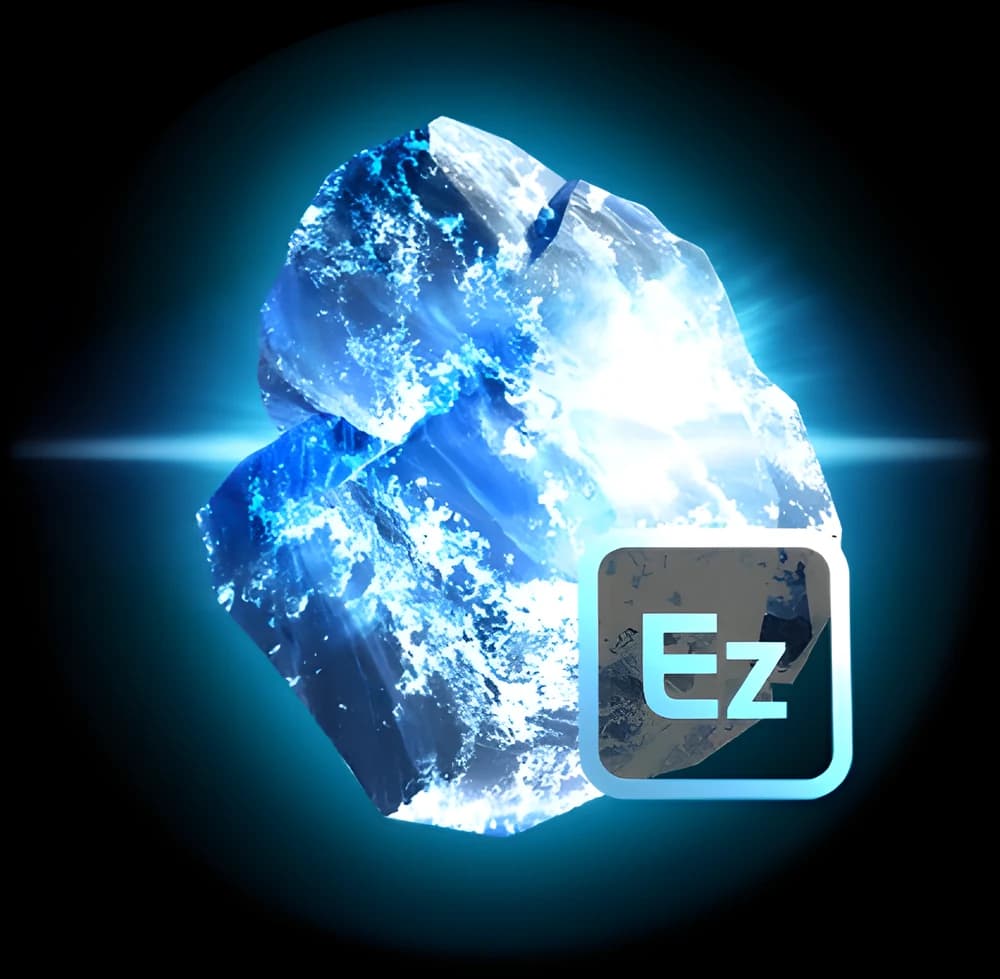
Element zero, nicknamed eezo, was a rare material that released dark energy when subjected to an electrical current, letting it raise or lower the mass of everything in the resulting field. It underpinned faster-than-light travel, artificial gravity, and the biotic abilities of living beings.
Reaper
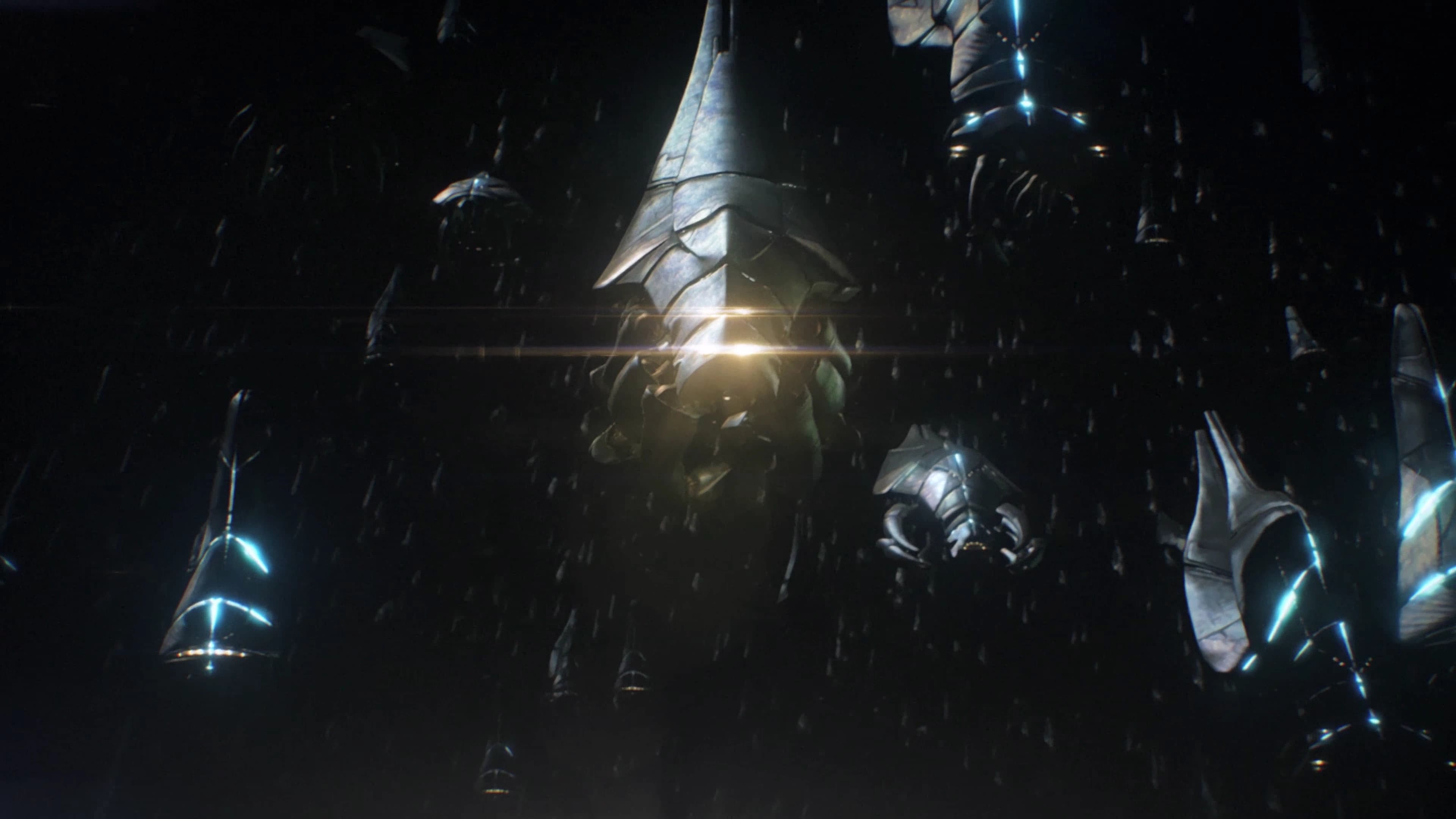
The Reapers were an ancient race of synthetic-organic starships that hibernated in dark space and returned once every fifty thousand years to harvest the galaxy's advanced life. They built the Citadel and the mass relay network to guide civilization down a predictable path, then reaped it to preserve organic life from synthetic destruction.
Sovereign: the Reaper vanguard the geth called Nazara
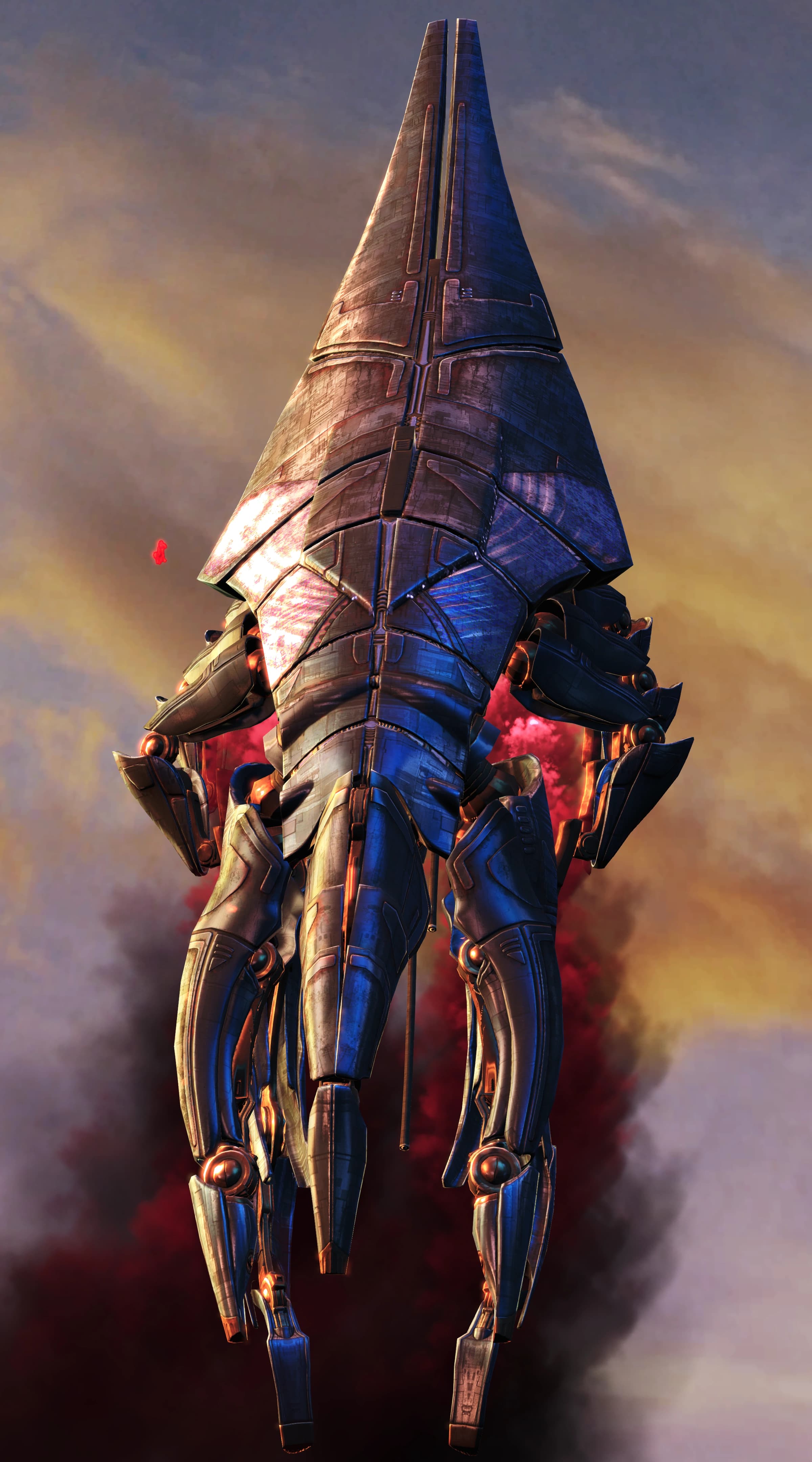
Sovereign, called Nazara by the geth, was the Reaper vanguard that posed as the flagship of the rogue Spectre Saren Arterius. It spent fifty thousand years waiting to summon its kind from dark space, and in 2183 it launched the assault on the Citadel that ended in its destruction.
Amanda Kenson: Scientist of the Bahak System
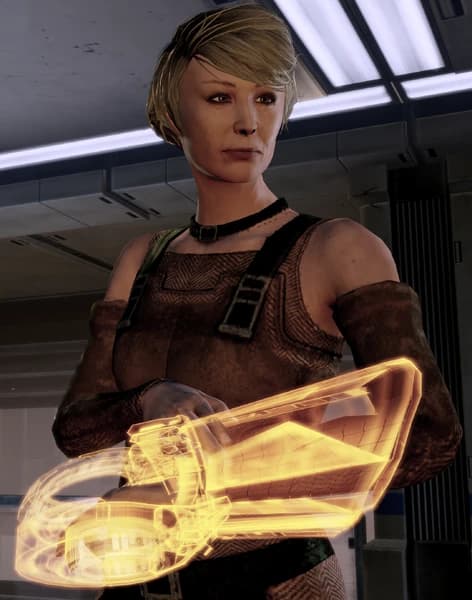
Doctor Amanda Kenson was a human scientist whose research suggested the mass relays predated the Protheans. Investigating evidence of an imminent Reaper invasion in a batarian system, she was indoctrinated by a Reaper artifact and turned against the very Commander Shepard sent to rescue her.

Citadel Council
The Citadel Council was the executive committee that governed Citadel space from the Citadel Tower, composed of representatives of the asari, salarians, and turians, and was the ultimate authority over Council law, interspecies disputes, and the covert Spectre agents.
Mentioned in20 entries
Alec Ryder: the first human Pathfinder in Mass Effect: Andromeda
Alec Ryder was an N7 veteran, AI researcher and the human Pathfinder of the Andromeda Initiative. He built SAM, brought his twins to Andromeda, and died on Habitat 7 in 2819, passing the role to one of them.
Alliance Navy: Humanity's Fleet
The Alliance Navy was the space combat branch of the Systems Alliance military, charged with defending Earth and its colonies. Numbering several thousand ships across multiple fleets, it was one of the greater naval forces in Citadel space and bore the brunt of the fighting during the Reaper War.
Amanda Kenson: Scientist of the Bahak System
Doctor Amanda Kenson was a human scientist whose research suggested the mass relays predated the Protheans. Investigating evidence of an imminent Reaper invasion in a batarian system, she was indoctrinated by a Reaper artifact and turned against the very Commander Shepard sent to rescue her.
Arcturus Station
Arcturus Station was a five kilometer space station that served as the military and political capital of the Systems Alliance from the First Contact War onward, guarding the mass relay to Earth. During the Reaper War it was abandoned and destroyed, becoming a grave for the 45,000 people aboard.
Background Races: the vanished civilizations known only from ruins
Across billions of years, countless races rose to sentience in the Milky Way and Andromeda, forged civilizations, explored the depths of space, and became extinct. The contemporary galaxy knew most of them only through ruins, wreckage, and artifacts, from the crypt builders of Armeni to the nameless dead entombed in the clouds of Anjea.
Citadel Fleet: the Council's defence force and what one battle cost it
The Citadel Fleet was the Council's main space defence force, mostly turian ships led by the asari dreadnought Destiny Ascension. Sovereign's attack in 2183 caught it scattered across the relays, and Shepard decides who survives.
Eden Prime
Eden Prime was one of the first human colonies founded beyond the Charon mass relay, an idyllic agrarian paradise whose Prothean ruins made it the opening battleground of the war against the Reapers.
Elcor
The elcor were a massive, four-legged Citadel species from the high-gravity world of Dekuuna, whose cautious psychology and ponderous, emotionless speech reflected an environment where a single fall could be fatal. Slow but immensely strong, they were nicknamed living tanks by their enemies.
Element zero
Element zero, nicknamed eezo, was a rare material that released dark energy when subjected to an electrical current, letting it raise or lower the mass of everything in the resulting field. It underpinned faster-than-light travel, artificial gravity, and the biotic abilities of living beings.
Elysium: the colony attacked in the Skyllian Blitz of 2176
Elysium was humanity's oldest colony in the Skyllian Verge, founded in 2160 in the Vetus system with 8.3 million people by the game's present. In 2176 a pirate and mercenary force under Elanos Haliat attacked it and was thrown off.
FTL travel
FTL travel was faster-than-light movement achieved without a mass relay, using a drive core to lower a starship's mass so it could exceed lightspeed. It let vessels cross local space at high speed but accumulated a dangerous static charge that had to be regularly discharged.
Mass Effect Story Explained: Plot Summary and Ending of the First Game
The plot of the first Mass Effect in order, from the geth attack on Eden Prime to the Battle of the Citadel. Who Saren is, what Sovereign wants, and what each ending choice changes.
+ 8 more
Get new articles in your inbox
No spam. New lore drops, canon conflicts, and deep dives only when they’re worth reading.
Some links on Lore Fortress are affiliate links. If you buy through them we earn a small commission at no extra cost to you.