Creep
the living substrate of the zerg
Creep was a living zerg superorganism, a viscous purple substance that nourished zerg structures and strains, bound entire colonies into a single organism, and could consume a whole planet within days if left unchecked.
Creep was a living zerg superorganism, a viscous purple substance, thick and slimy to the touch, that the Swarm used to nourish its structures, larvae, and other strains. It was psionically sensitive and could be influenced and controlled by psionic entities. More than a mere secretion, creep bound every colony located on it into a single living creature, and if left unchecked it could consume an entire planet within days. (StarCraft: Uprising; StarCraft: Shadow of the Xel'Naga; StarCraft: Frontline Volume 2)
Seeding and spread#
Creep could be deposited in a number of ways. Certain zerg structures, such as hatcheries, served as loci for its growth, and hive spores could be used in the initial stages of infestation. Post-Great War evolution gave zerg creatures the ability to spread creep themselves, overlords secreting it directly and other strains laying creep tumors. Once established, creep spread rapidly, and its proliferation could be observed in real time. If left unchecked it could consume an entire planet within days. (StarCraft manual; StarCraft: Uprising; StarCraft II: Wings of Liberty)
Biology#
Creep had a cellular structure and could be considered an organism in its own right, with zerg structures functioning as its organs. It sustained itself and the surrounding Swarm by processing minerals drawn from the ground through deep tendrils, and it could envelop and consume biological matter, including the corpses of the fallen. Ground strains moved faster over creep than over normal terrain. Creep could grow in anaerobic environments and over water, and it could even extend over hollows in the terrain, though attempting to cross such a hollow could cause it to tear and give way. (StarCraft: Uprising; StarCraft: Shadow of the Xel'Naga; StarCraft: Liberty's Crusade; StarCraft: Speed of Darkness; StarCraft: Frontline Volume 2; The Education of PFC Shane; StarCraft Field Manual; StarCraft II: Wings of Liberty)
Function and removal#
A zerg colony became a single living creature through the interconnectivity of creep. Most zerg structures were effectively giant organs that drew sustenance from it, a notable exception being the extractor, and the zerg that lived upon it took their nourishment from it as well. Deprived of creep, they resorted to consuming other organisms, even one another, to survive. The substance also carried a network of neural connections that alerted the nearby hive to incoming intruders. (StarCraft manual; StarCraft: Shadow of the Xel'Naga; StarCraft: Frontline Volume 2)
Creep could not stand extreme heat and would not grow in unsuitably hot places. It could be set alight by high explosive or incendiary ordnance, but it grew back fast enough that brute force rarely cleared it entirely, and reliable removal could only be guaranteed by destroying the structures that served as its growth loci. It was often hard to tell when creep was truly dead, and protoss glassing was used numerous times to eradicate planetary infestation entirely. (StarCraft: Uprising; StarCraft manual; StarCraft: Speed of Darkness; StarCraft Field Manual)
Terran and protoss experiments#
The Terran Confederacy conducted experiments with creep after discovering xenomorphs on a number of fringe worlds. In secret facilities such as the Fujita Facility on Vyctor 5 and an installation on Tarsonis, researchers found they could grow creep from spores and control its growth with heat, and using ghost subjects such as Sarah Kerrigan they found it could be controlled psionically. The Vyctor 5 and Tarsonis experiments were later destroyed by the Sons of Korhal. (StarCraft: Uprising)
In 2502, the protoss scientific organization PAX, the Protoss Advance/Experimental Facility, conducted its own experiments, infecting creep with a virus in the hope of destroying all creep and committing xenocide against the zerg. The mutated creep proved infectious, engulfing two zealots assigned to the facility and infesting one of them, named Ruom. It became a psionic predator able to impede the Khala and drive nearby Khalai to madness, and Ruom went on a rampage that killed the other protoss. The entire facility was frozen and abandoned, only to be discovered later by a terran military expedition, which found the mutated creep still alive. (StarCraft: Frontline Volume 2; StarCraft II: Heaven's Devils)
Frequently asked questions
- What is creep in StarCraft?
- Creep was a living zerg superorganism, a viscous purple substance, thick and slimy to the touch, that the Swarm used to nourish its structures, larvae, and other strains. It bound every colony located on it into a single living creature, and if left unchecked it could consume an entire planet within days.
- How does creep spread?
- Creep could be deposited by certain zerg structures such as hatcheries, by hive spores in the initial stages of infestation, and by later strains, with overlords secreting it directly and others laying creep tumors. Once established, creep spread rapidly and could consume an entire planet within days.
- What is creep's weakness?
- Creep could not stand extreme heat and would not grow in unsuitably hot places. It could be set alight by high explosive or incendiary ordnance, but its regenerative properties made complete extermination by brute force difficult, so reliable removal could only be guaranteed by destroying the structures that served as its growth loci.
- What experiments were done on creep?
- The Terran Confederacy experimented with creep at secret facilities including the Fujita Facility on Vyctor 5, finding it could be grown from spores and controlled psionically using ghost subjects such as Sarah Kerrigan. In 2502, the protoss organization PAX infected creep with a virus, producing a mutated, infectious strain that overran their facility.
- Who is Ruom?
- Ruom was a zealot who was infested when PAX's mutated creep engulfed two zealots at their facility. Ruom became a psionic predator able to impede the Khala and drive nearby Khalai to madness, and went on a rampage that killed the other protoss before the facility was frozen and abandoned.
Sources
- GameStarCraft II: Wings of Liberty, Blizzard Entertainment, 2010
- BookStarCraft manual, Peter Underwood, Bill Roper, Chris Metzen and Jeffrey Vaughn, Blizzard Entertainment, 1998
- BookStarCraft: Uprising, Micky Neilson, Pocket Star, 2000
- BookStarCraft: Liberty's Crusade, Jeff Grubb, Pocket Star, 2001
- BookStarCraft: Shadow of the Xel'Naga, Gabriel Mesta, Pocket Star, 2001
- BookStarCraft: Speed of Darkness, Tracy Hickman, Pocket Star, 2002
- ComicStarCraft: Frontline Volume 2, Simon Furman and others, Tokyopop, 2009
- BookStarCraft II: Heaven's Devils, William C. Dietz, Pocket Star, 2010
- BookStarCraft Field Manual, Rick Barba, Insight Editions, 2015
- BookThe Education of PFC Shane, Robert Brooks, Blizzard Entertainment short story, 2013
Spotted a factual error or a primary source we missed? Email a correction. Every flagged claim gets reviewed.
Followed from this entry

Zerg
The zerg are a ravenous collective of biologically advanced aliens who evolve by assimilating the essence of other species in pursuit of genetic perfection. Created by Amon's xel'naga on Zerus and bound to the Overmind, they grew into one of the three dominant powers of the galaxy.
2502: the year of quiet atrocities
2502 fell in the uneasy years between the Brood War and the Second Great War. The Terran Dominion hid a colonial massacre behind parade broadcasts, Emperor Mengsk buried the mother of his heir, a squad of outlaw commandos was sent to kill Jim Raynor, and secret programs built on stolen ghosts and captive protoss advanced in the dark.
Great War: protoss against zerg over Aiur
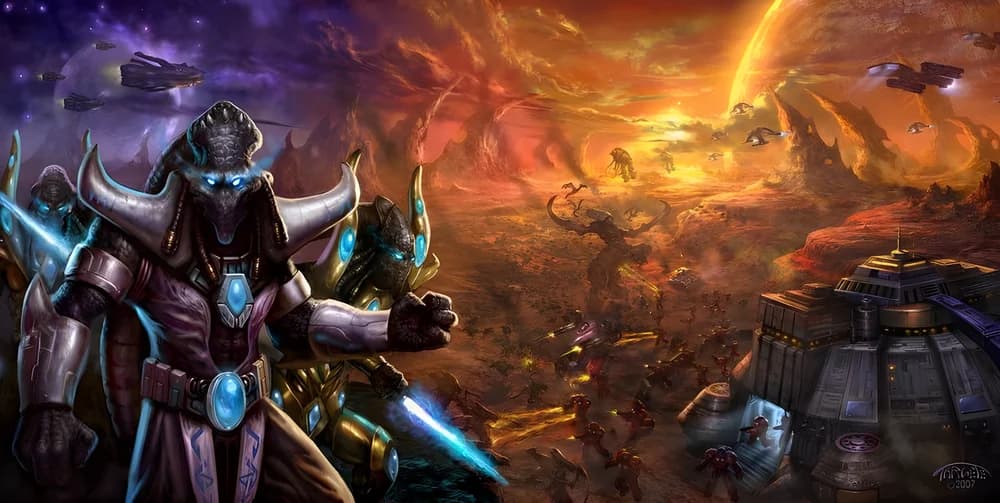
The Great War was the first open fight between protoss and zerg, with the terrans caught between them. It ended over Aiur with the Overmind destroyed.

Khalai: the protoss who kept the Khala
The Khala lifted the Aiur protoss out of the Aeon of Strife and built their Empire. They fled to Shakuras, then lost the Khala in the End War.
Protoss
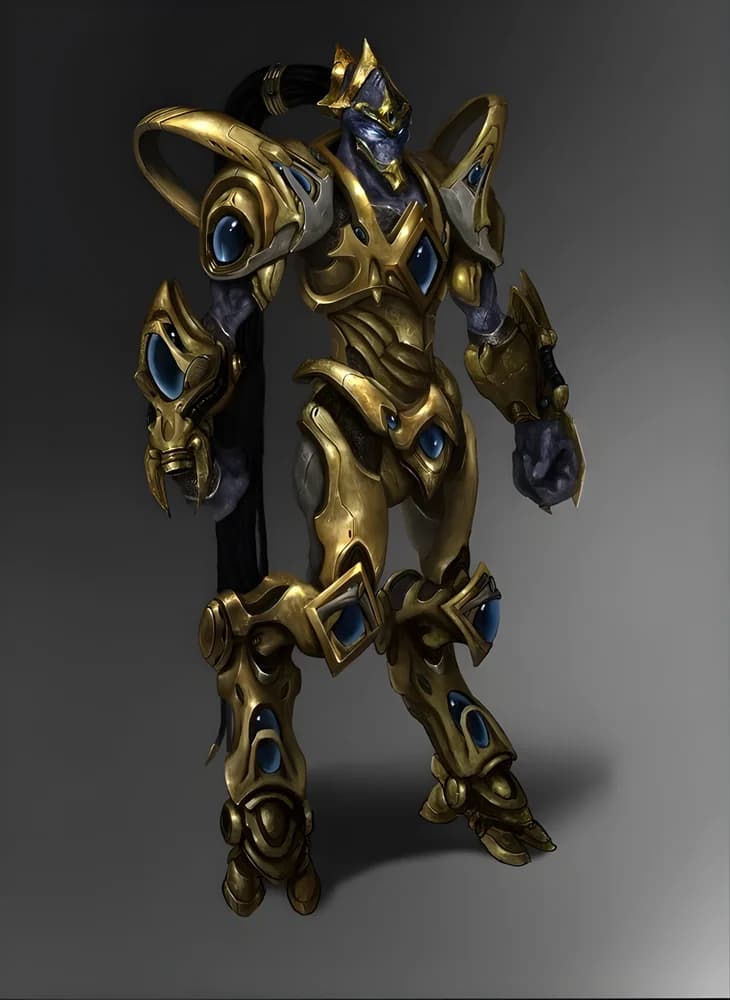
The protoss are an ancient, psionically gifted humanoid species native to Aiur, uplifted by the xel'naga and bound together by the Khala. Among the three dominant species of the galaxy, they are the most technologically advanced, and the most divided by their own history.

Sarah Kerrigan, the Queen of Blades
Sarah Kerrigan was a psychic terran who began as a Confederate ghost, rose to be second-in-command of the Sons of Korhal, and after Arcturus Mengsk abandoned her on Tarsonis was captured and infested by the Zerg Swarm to become the Queen of Blades.
Mentioned in13 entries
2499: the year the Great War began
2499 was the final year of peace in the Koprulu Sector and the first year of the Great War. It opened with quiet training rosters and covert cover ups, and it closed with two Confederate colonies burned from orbit, the zerg revealed to terran eyes, and rebellion spreading from Mar Sara to Antiga Prime.
2502: the year of quiet atrocities
2502 fell in the uneasy years between the Brood War and the Second Great War. The Terran Dominion hid a colonial massacre behind parade broadcasts, Emperor Mengsk buried the mother of his heir, a squad of outlaw commandos was sent to kill Jim Raynor, and secret programs built on stolen ghosts and captive protoss advanced in the dark.
Elms: mercenary marine and hidden psychic
Elms was a terran mercenary marine with a cybernetic arm and a psionic gift she kept hidden from those around her. Hired for a crooked salvage operation on Adena, she fought her way through a zerg ambush, exposed the officers who abandoned her, and killed them all rather than accept a leash from anyone.
Every Zerg Unit in StarCraft and StarCraft II, Explained
Every zerg strain from StarCraft, Brood War and the three StarCraft II campaigns, from the zergling to the leviathan. Each entry covers the species it came from, what it does for the Swarm and where it turns up in the story.
Evolution Chamber: crucible of zerg genetic advancement
The evolution chamber was a living zerg structure grown to test and refine the genetic code of the Swarm. Conceived under the Overmind's mandate against complacency, it hardened the strains of the zerg and passed each improvement outward through the hive cluster.
Feral Zerg
Feral zerg were zerg that had fallen outside the control of any higher entity, reverting to predatory instinct and attacking everything around them. Drawn to psionic emanations and able to survive without creep, they recurred across the Koprulu Sector wherever a cerebrate, broodmother, or the will of Kerrigan was lost.
Gystt
Gystt was a world purified by the protoss and long thought irreparable, until Overqueen Zagara restored it to life using the adostra. It became the site of the One-Day War and, afterward, Zagara's hive world.
Hatchery: foundational structure of every zerg colony
The hatchery was the living heart of every zerg colony, spreading creep, birthing larvae, and digesting minerals and vespene gas into nutrients for the Swarm. Grown from a single metamorphosed drone, it could mature into a lair and finally a hive, and the zerg defended it with fanatical zeal.
Hive: apex structure of the Zerg Swarm
The hive was the primary structure of the zerg and the final evolution of the hatchery, unlocking the last stages of the Swarm's development. Shielded by a dense exoskeleton and joined to the Overmind's full pool of knowledge, it gave the being that commanded it the power to loose the full fury of the zerg.
Overlord
The overlord is a Zerg flyer evolved from the assimilated Gargantis proximae, serving the Swarm as a coordinator of lesser strains, a long-range sensory scout, an unmatched psionic transmitter, and a deep-space transport.
Overseer
The overseer was a zerg strain evolved from the overlord, covered in highly evolved optical receptors that let it detect hidden and burrowed enemies. Through incorporated terran DNA it could also spawn changelings to infiltrate enemy forces.
Queen
The queen is a Zerg support strain derived from the Arachnis brood-keeper, bred to administrate hive clusters, oversee maturing broods, and serve as an infestation specialist. Two distinct forms exist across the history of the Swarm, the flying Great War queen and the ground-bound hive-master engineered after the Brood War.
+ 1 more
Get new articles in your inbox
No spam. New lore drops, canon conflicts, and deep dives only when they’re worth reading.
Some links on Lore Fortress are affiliate links. If you buy through them we earn a small commission at no extra cost to you.