Hierarchy: the twilight council of the Daelaam
The Hierarchy, also called the Twilight Council, was the governing body of the unified protoss on Shakuras and the successor of the fallen Conclave. Fractious and slow until Artanis agreed to lead it, the council steered the Daelaam through crisis after crisis until the destruction of Shakuras.
The Hierarchy, otherwise known as the Twilight Council, was the governing body of the Daelaam, the unified protoss nation that took shape on Shakuras after the fall of Aiur. Regarded as the successor of the Conclave that had ruled the old Protoss Empire, the council brought together representatives of the surviving Khalai tribes and the Nerazim under one roof for the first time in protoss history. It earned a reputation for being fractious and slow, and the body was nearly dysfunctional until Artanis, the only choice its members could agree upon, accepted the title of hierarch and became the supreme leader of the reunited protoss. (StarCraft: The Dark Templar Saga: Twilight; Artanis: Sacrifice)
A council born from ruin#
The Conclave, the body of Judicator elders that had governed the Protoss Empire for generations, was wiped out during the zerg invasion of Aiur. When the Khalai survivors fled through the warp gate to Shakuras and settled among the Nerazim they had once banished, a new government had to be built from the wreckage of the old, and the Hierarchy was regarded as the Conclave's successive body. Unlike its predecessor, which had been controlled by a single caste, the Hierarchy drew its members from across the surviving tribes and gave the dark templar a voice of their own. (StarCraft; StarCraft: Brood War; StarCraft II: Legacy of the Void)
The council met in the Citadel, a floating structure constructed by the Nerazim. Its known membership reflected the breadth of the refugee nation. Artanis represented the Akilae Tribe, Nahaan spoke for the Ara Tribe, though he rarely visited Shakuras, Admiral Urun sat for the Auriga Tribe, Tabrenus for the Furinax Tribe, and Zekrath for the Shelak Tribe. Mohandar, chosen to speak for the Nerazim after the death of Matriarch Raszagal and the self-imposed exile of Zeratul, held the dark templar seat, and Vorazun later succeeded him. (StarCraft: The Dark Templar Saga: Twilight; Artanis: Sacrifice; Children of the Void)
For all its inclusiveness, the body did not govern well. The Hierarchy became known for endless debate, reaching one impasse after another, and its paralysis threatened the survival of the fragile union it was meant to lead. (StarCraft: The Dark Templar Saga: Twilight; Artanis: Sacrifice)
The impasse and the rise of Artanis#
At one point in its early history the Hierarchy stood on the verge of collapse, and through it, the Daelaam itself. The question of the Great Fleet and the resources it demanded had once again deadlocked the chamber. In 2502 Zekrath declared that the body needed a leader. Both Nahaan and Urun put themselves forward for the position, and both were rebuked. Zekrath argued that the Hierarchy's leader had to be one who commanded the respect of both the Khalai and the Nerazim, someone like Artanis. Mohandar agreed, as did Tabrenus. (Artanis: Sacrifice)
Artanis himself refused. He had joined the council as the Akilae representative intending it to be a temporary duty, for his only aspiration was to be a warrior, not a politician, and he reaffirmed his plan to leave the body at the end of the next cycle. The other members voiced their support regardless, and Artanis was given a day to reconsider. Nahaan and Tabrenus threatened to quit the council altogether if he would not take the position. Mohandar told him plainly that desire and need did not always align, a truth the prelate said Tassadar had known well. (Artanis: Sacrifice)
In solitude Artanis reflected on his lost mentor and the events of the Great War. Selendis brought word that members of the Hierarchy were preparing to leave Shakuras, convinced he would decline, and Artanis feared that all would be lost if he did not accept. When the next day came, Tabrenus took the hierarch's initial silence as refusal and moved to depart at once. Instead Artanis announced that he would take up the mantle, and against his personal desires he became hierarch for the sake of his people. His ascension brought the stability the council had lacked, and work went ahead on the Golden Armada, with the reclamation of Aiur, the one shared interest of Khalai and Nerazim, as its purpose. (Artanis: Sacrifice; Children of the Void)
Judgment on the preserver#
In 2503 the Hierarchy convened to weigh the fate of Zamara, one of the last preservers, whose consciousness was trapped in the mind of the terran archaeologist Jake Ramsey and was slowly killing him. The terran mercenary Rosemary Dahl came before the council to demand a rescue, accompanied by Vartanil, a craftsman who had survived on Aiur and had once been drawn into the Tal'darim. Dahl had hoped for a private audience with Artanis, but the entire Hierarchy arranged to attend, and its members held sharply different opinions on what to do with the two petitioners. (StarCraft: The Dark Templar Saga: Twilight)
Executor Selendis championed Dahl's cause before her former teacher. Despite her bluntness, Dahl presented her case, and with Vartanil's support she convinced Artanis of the merits of the mission. Artanis and Selendis recounted their previous battles with the dark archon Ulrezaj, and the admission that no preservers remained on Shakuras hardened Dahl's belief that Ulrezaj had destroyed the rest. Mohandar revealed that Ramsey and Zamara would likely make for Alys'aril, a sacred and secret Nerazim shrine on the moon of Ehlna. He was loath to let any Khalai travel there, but Selendis persuaded him by proposing only a small expedition, which she volunteered to lead herself. Vartanil insisted on joining and was permitted to go. Weighing the views of the tribal leaders, Hierarch Artanis authorized the expedition. (StarCraft: The Dark Templar Saga: Twilight)
Khalai and Nerazim at the brink#
The stability Artanis brought could not erase the fault line running through the Daelaam. The Khalai poured themselves into the completion of the Golden Armada while the Nerazim watched their culture and sacred sites eroded on their own homeworld. Vorazun, daughter of Raszagal, emerged as the most outspoken critic of Artanis and of Mohandar, whom she considered a pawn of the Khalai, and her opposition blocked the mining of the Naszar region, ground the Nerazim held sacred. (Children of the Void)
The tension broke when a squadron of phoenixes preparing for the reclamation of Aiur collided with a Nerazim civilian transport, killing twenty seven Nerazim. Artanis forsook their funeral, and a Nerazim extremist named Taelus, inspired by Vorazun's ideals, seized the Citadel and demanded that the Khalai leave Shakuras. Vorazun and Mohandar entered the Citadel to negotiate, but Taelus refused every offer, wanting to ignite a conflict that would drive the Khalai from the planet. Seeing that stopping the extremists before Khalai forces stormed the Citadel was the only way to prevent open war, Vorazun moved to disable them without killing. The attempt nearly succeeded, until Taelus struck down Mohandar. Enraged, Vorazun killed her former pupil and carried his body out of the Citadel, telling her people of the future they had within the Daelaam and that they should not fear change. (Children of the Void)
Artanis oversaw Mohandar's funeral and swore to take a greater role in Nerazim traditions and culture. He supported Vorazun's bid to become Matriarch, and when it was accepted she took her seat on the Hierarchy. Vorazun promised a portion of her forces to the Golden Armada and the reclamation of Aiur, though she kept most of them behind to guard Shakuras. (Children of the Void)
The End War and the last council#
During the End War, the forces of Amon invaded Shakuras, and the campaign ended with the destruction of the planet itself. The Hierarchy as a seated council of tribes did not survive the loss of its world, though its two most prominent members, Artanis and Vorazun, lived through the cataclysm. The leadership of the Daelaam effectively passed to them, joined by Highlord Alarak as the de facto representative of the Tal'darim and Talandar as the de facto representative of the Purifiers, while Grand Preserver Rohana and Phase-smith Karax served as advisers to the hierarch. After the war Artanis retained his position as head of state, with Vorazun continuing to speak for the Nerazim, and the government that had once deadlocked in the Citadel over every question endured, in changed form, as the ruling voice of a people who had lost two homeworlds and refused to be broken by either. (StarCraft II: Legacy of the Void; StarCraft: Evolution)
Sources
- GameStarCraft, Blizzard Entertainment, 1998
- GameStarCraft: Brood War, Blizzard Entertainment, 1998
- GameStarCraft II: Legacy of the Void, Blizzard Entertainment, 2015
- BookStarCraft: The Dark Templar Saga: Twilight, Christie Golden, 2009
- BookStarCraft: Evolution, Timothy Zahn, 2016
- WebChildren of the Void, Matt Burns, Blizzard Entertainment short story, 2015
- ComicArtanis: Sacrifice, Matt Burns and James Waugh, Blizzard Entertainment, 2015
Spotted a factual error or a primary source we missed? Email a correction. Every flagged claim gets reviewed.
Followed from this entry

Conclave: the elders who exiled the Nerazim
A small body of Judicator elders ruled the Protoss Empire from Aiur. They banished the Dark Templar, enslaved the Purifiers and tried Tassadar.

Daelaam
The Daelaam was the unified protoss government that bound the Khalai, Nerazim, Purifiers, and some Tal'darim together after the fall of Aiur, led by Hierarch Artanis through the End War against Amon and the reclamation of their homeworld.

Golden Armada: the fleet Amon turned
Artanis built the greatest protoss fleet ever assembled in order to retake Aiur. Amon seized it through the Khala and aimed it at the Koprulu sector.

Great Fleet
The Great Fleet was the principal military space force of the protoss, the fleet that carried their power across the stars. Built around the carrier and tended by the Auriga Tribe, it was shattered in the fall of Aiur and rebuilt over the wars that followed.
Dark Templar (Nerazim)
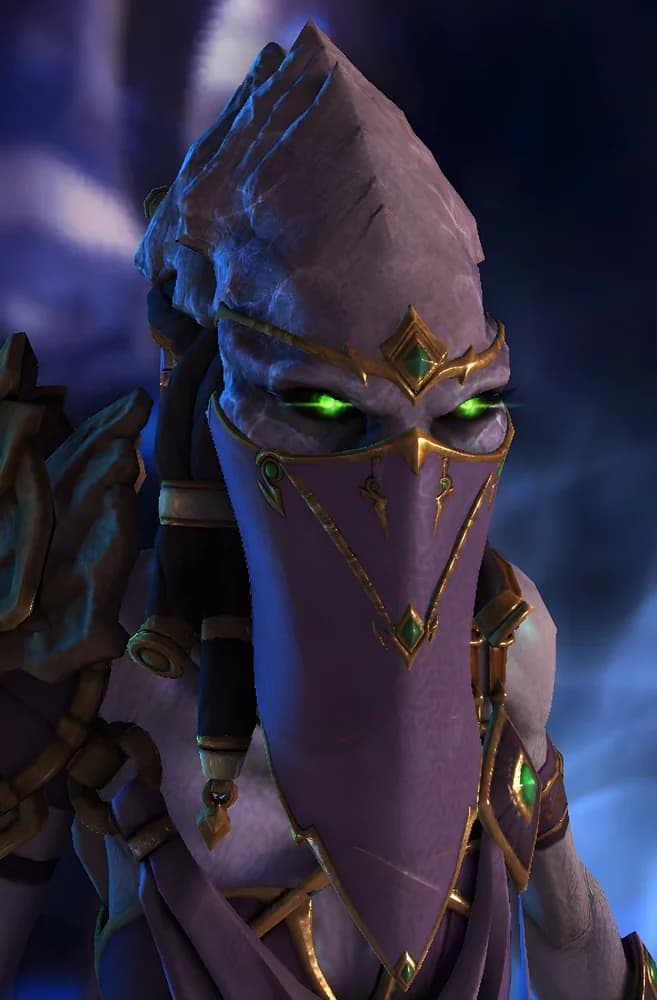
The Nerazim, known to outsiders as the Dark Templar, are the protoss tribes who shunned the Khala, severed their nerve cords, and drew their power from the Void instead. Banished from Aiur, they became masters of shadow and exile before reuniting with their kin under the Daelaam.
Protoss
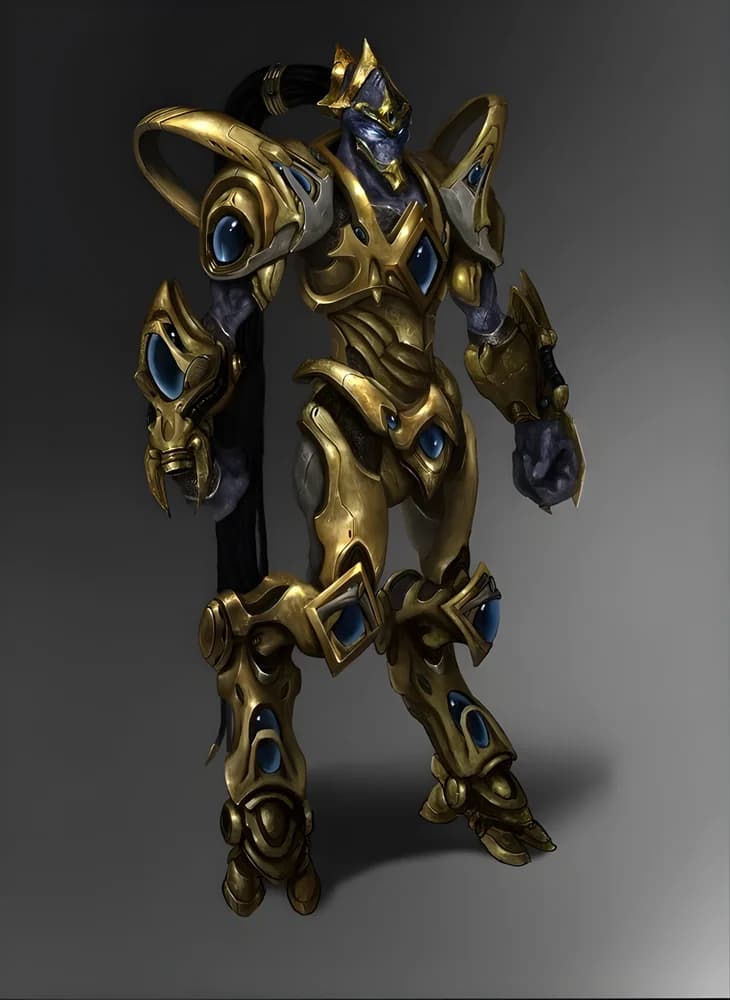
The protoss are an ancient, psionically gifted humanoid species native to Aiur, uplifted by the xel'naga and bound together by the Khala. Among the three dominant species of the galaxy, they are the most technologically advanced, and the most divided by their own history.
Mentioned in11 entries
2502: the year of quiet atrocities
2502 fell in the uneasy years between the Brood War and the Second Great War. The Terran Dominion hid a colonial massacre behind parade broadcasts, Emperor Mengsk buried the mother of his heir, a squad of outlaw commandos was sent to kill Jim Raynor, and secret programs built on stolen ghosts and captive protoss advanced in the dark.
Artanis
Artanis was the Hierarch of the Daelaam, a renowned warrior who rose from executor during the zerg invasion of Aiur to lead the reunited protoss. He forged the Khalai and Nerazim into one people, reclaimed Aiur, and led the alliance that banished Amon from the Khala.
Conclave: the elders who exiled the Nerazim
A small body of Judicator elders ruled the Protoss Empire from Aiur. They banished the Dark Templar, enslaved the Purifiers and tried Tassadar.
Dark Templar (Nerazim)
The Nerazim, known to outsiders as the Dark Templar, are the protoss tribes who shunned the Khala, severed their nerve cords, and drew their power from the Void instead. Banished from Aiur, they became masters of shadow and exile before reuniting with their kin under the Daelaam.
Judicator Caste
The Judicator Caste was a collection of protoss tribes who acted as the leaders and statesmen of their people, descended from the first tribes to join the Khala. Governed through the Judicator Assembly and the Conclave, they shaped protoss policy until the caste was shattered and finally dissolved.
Khalai: the protoss who kept the Khala
The Khala lifted the Aiur protoss out of the Aeon of Strife and built their Empire. They fled to Shakuras, then lost the Khala in the End War.
Mohandar
Mohandar was the aged leader of the Nerazim and a member of the protoss Hierarchy, a close ally of Matriarch Raszagal who guided Vorazun and held the dark templar within the Daelaam until his death at rebel hands.
Raszagal: the Matriarch Kerrigan enslaved
Adun saved her from execution on Aiur, and she led the Dark Templar for over a thousand years. Kerrigan seized her mind during the Brood War.
Selendis
Selendis is the protoss High Executor, a celebrated warrior who rose as the protege of Artanis. She served with the Golden Armada, fell briefly under Amon's thrall, and struggled to find purpose after the loss of the Khala.
Urun
Urun was a proud, traditionalist protoss of the Auriga Tribe and a member of the protoss Hierarchy who later commanded the carrier Saalok's Eye and died fighting the Niadra Brood on Adena.
Vorazun: Raszagal's daughter, Matriarch
She defended Shakuras, took the Nerazim matriarchy after Mohandar died, and became one of Artanis' closest advisors in the long war against Amon.
Get new articles in your inbox
No spam. New lore drops, canon conflicts, and deep dives only when they’re worth reading.
Some links on Lore Fortress are affiliate links. If you buy through them we earn a small commission at no extra cost to you.