Justicars: the asari order that answers only to the Code
Justicars were asari who gave up family, property and everything but weapons and armour to wander asari space enforcing a code of more than five thousand sutras. The Code admitted no moral grey and commonly prescribed death, which made justicars both revered and feared by the governments that tolerated them.
A justicar was an asari who had forsworn children, family and every worldly possession except her weapons and armour, and who had sworn herself instead to the Code of the Justicars. Members of this ancient order wandered the space of the Asari Republics righting wrongs as the Code defined them, answering to no government and to no court. They were few, because the training killed many who attempted it and because the life that followed was rarely easy, and their reputation ran far enough that pirates would abandon a planned raid on learning that one was present. The order was compared by Samara, one of the last of them, to the knights errant of an old human age and to the samurai of feudal Japan. (Mass Effect 2)
An order apart#
The justicars belonged to no ministry and reported to no magistrate. They operated inside asari space, correcting injustices by means that were often harsh and frequently fatal, and it was rare for one to travel beyond the borders of the Republics because her presence among other species risked a diplomatic incident. That reluctance was well founded. A code that recognised no ambiguity translated poorly among aliens who did not share asari morality and had never agreed to be judged by it. (Mass Effect 2)
Entry to the order cost everything a normal asari life contained. A justicar renounced the possibility of children and of family, which for a species whose lifespan ran to a millennium and whose culture was built around long relationships was a heavier renunciation than it might appear. She kept her weapons and her armour and nothing else. The training that followed carried a high mortality rate, and the survivors were correspondingly rare. (Mass Effect 2)
The Code#
The Justicar Code was the centre of a justicar's existence, a body of more than five thousand sutras describing every situation a justicar might conceivably face. Each justicar was required to know the whole of it by heart. Samara described justice, for her, as following the Code, nothing more and nothing less, while acknowledging that this was not as simple as it sounded and that many would criticise so uncompromising a doctrine. (Mass Effect 2)
The Code admitted no morally grey action. Every deed fell cleanly into right or wrong, and the remedy it commonly prescribed for wrongdoing was death. Officer Dara, an asari official working in Nos Astra on Illium, stated flatly that anyone attempting to bribe a justicar would be gunned down where they stood. The absolutism cut in the other direction as well, and Detective Anaya, who ran a precinct in the same city, held that a justicar would as readily give her life to defend one honest police officer as to fight an army of dishonest ones. (Mass Effect 2)
Samara admitted that the harshness of the Code made curiosity a liability. If she was going to be required to kill a murderer, she preferred not to learn anything about him that might redeem him in her eyes. The Code left no room to act on what she had learned, so learning it served only to make the killing harder. (Mass Effect 2)
The Oaths of Subsumation#
The oaths a justicar swore were called the Oaths of Subsumation. They pledged protection of the innocent, punishment of the guilty, and defence of common law and the norms of asari society. That last clause carried a consequence the Republics valued highly: a justicar would never overthrow a sitting government. However unjust an administration might be judged, the order preserved existing asari law rather than staging a coup, which meant that the deadliest independent agents in asari space were structurally incapable of becoming a political faction. (Mass Effect 2)
One oath stood apart. The Third Oath of Subsumation bound a justicar to the will of another with total loyalty, and while it held it overrode even the dictates of the Code. The binding was not permanent, and it was not safe for whoever invoked it. On release from the oath, a justicar was free to kill the one she had served if that service had forced her into acts she considered deeply dishonourable. (Mass Effect 2)
Fighters#
Justicars were formidable in almost every form of personal combat and were known to have destroyed entire bands of mercenaries and slavers single handed. At least one fought a Spectre to a draw. Their advantage came from time as much as talent. Over decades and in some cases centuries of dedicated training, a justicar refined the natural biotic aptitude of her species to a level of power and finesse that rivalled an asari matriarch. (Mass Effect 2)
The reputation that followed from this was practical rather than ceremonial. Aggressors who learned that a justicar was in the area called off planned raids rather than test her. Given the sacrifices involved, the skill and the rigid adherence to the Code, justicars were held in high regard across asari culture, and there were many stories and vids made of their exploits, though much of what those vids showed was exaggerated. (Mass Effect 2)
Justicars and the law#
Relations between the order and asari civil authority were uneasy. Police forces generally found a justicar's presence unnerving and yet let her work, out of respect for what she was. Officials at a higher level were less accommodating, and often saw justicars as threats to the peace rather than as its guardians, precisely because merciless absolutism led so easily to violent confrontation, above all with aliens who neither understood nor accepted asari morality. (Mass Effect 2)
The Code addressed the collision directly and briefly. A justicar was permitted to submit to detainment by lawful authorities for a single day. Once that day expired she was bound by the Code to resume her duties, whatever her captors intended, and the likely result was violence between the justicar and the people holding her. It was a rule that gave local police one day to solve their problem, and Anaya, ordered by superiors who feared a cross species incident to detain Samara on Illium, understood that the clock left her own life at risk. (Mass Effect 2)
The Ardat-Yakshi duty#
Among the burdens the Code laid on the order was its handling of the Ardat-Yakshi, asari whose condition made mating lethal to their partners. Those who could be safely sequestered were brought to monasteries, and the justicar Phora was known to have delivered several to the monastery on Lesuss by threatening and terrifying them into coming with her. Those who could not be sequestered were, by the Code's requirement, to be put to death. (Mass Effect 2; Mass Effect 3)
The order's most famous member found the limit of her own doctrine there. Samara's daughters carried the condition, and one of them, Morinth, had spent centuries embracing it. Faced at last on Lesuss with the obligation to execute her last surviving daughter, Falere, Samara attempted to take her own life instead. Whether the Code compelled such a suicide in cases where a justicar could not fulfil her duties was never established, and her attempt is not evidence that it did. (Mass Effect 2; Mass Effect 3)
The order in the Reaper War#
When the Reaper invasion reached asari space, some justicars broke their solitary habit and returned to Thessia to reinforce the defence of their homeworld. It was the kind of decision the Code could accommodate and the order could not afford. Their numbers had always been small, and estimates held that even if the Reaper War ended in victory the justicars might not exist afterwards at all. (Mass Effect 3)
The order was never entirely closed. Justicars could and did leave it, among them Tristana, who turned to work as a freelance assassin, and an asari duelist of the Andromeda Initiative, who later doubted her decision to travel to a new galaxy. But leaving was rare, the training killed many who tried to enter, and an order that never recruited in numbers had little to replace the losses of the war. (Mass Effect: Foundation; Mass Effect: Andromeda; Mass Effect 3)
Sources
- GameMass Effect 2, BioWare, 2010
- GameMass Effect 3, BioWare, 2012
- GameMass Effect: Andromeda, BioWare, 2017
- ComicMass Effect: Foundation, Dark Horse Comics, 2013 to 2014 (written by Mac Walters)
Spotted a factual error or a primary source we missed? Email a correction. Every flagged claim gets reviewed.
Followed from this entry

Asari
The asari, native to Thessia, were among the most influential species in the galaxy, renowned for their elegance, biotic talent, and millennium-long lifespans. A mono-gender people able to reproduce with a partner of any species, they founded the Citadel Council and stood at the heart of galactic society for two thousand years.

Biotics
Biotics was the ability of certain lifeforms to generate mass effect fields using element zero nodules grown through their bodies. Channelled through surgical implants and physical gestures, it let a wielder lift, hurl, and crush objects at a distance or raise protective barriers.
Reaper
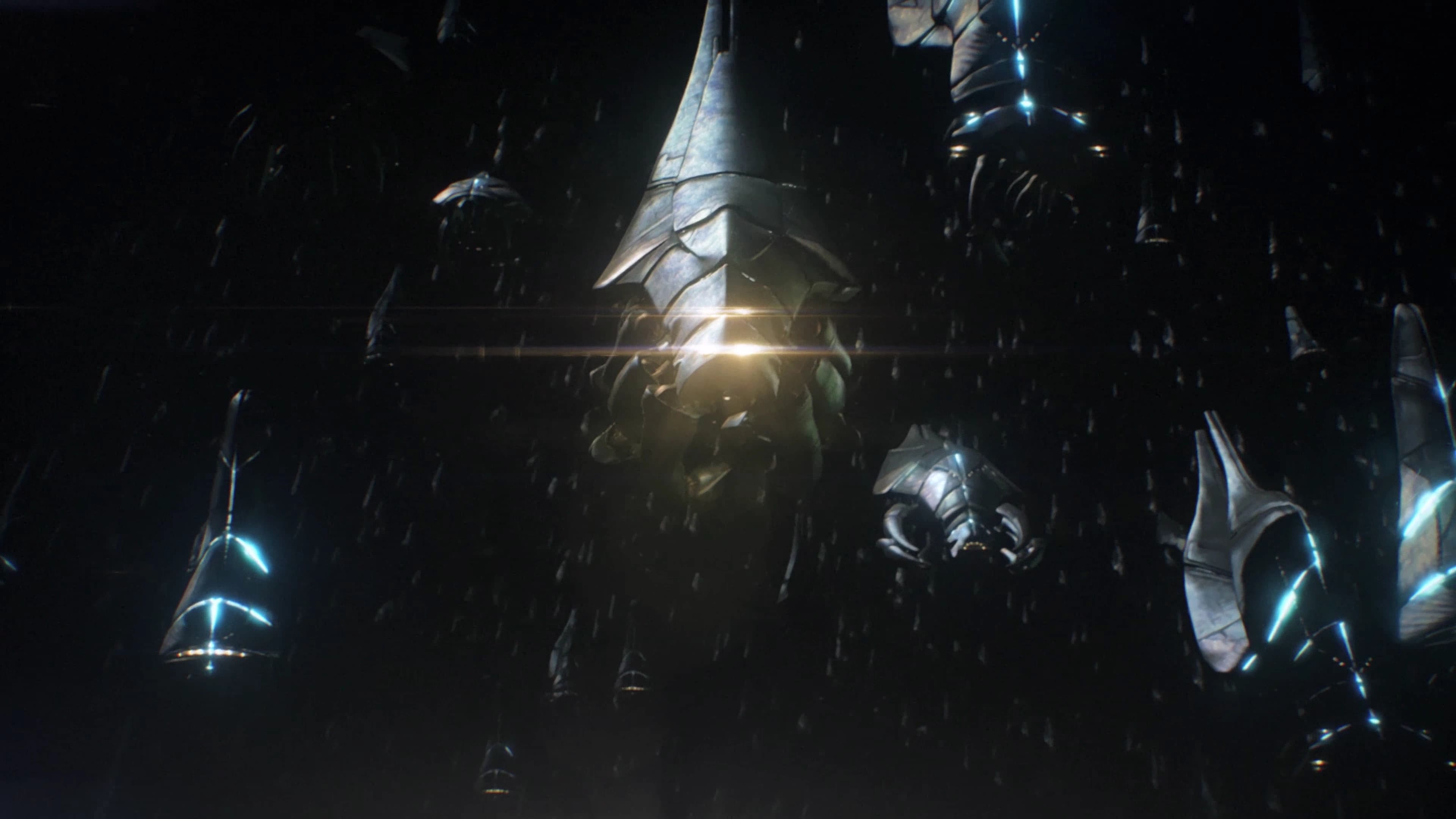
The Reapers were an ancient race of synthetic-organic starships that hibernated in dark space and returned once every fifty thousand years to harvest the galaxy's advanced life. They built the Citadel and the mass relay network to guide civilization down a predictable path, then reaped it to preserve organic life from synthetic destruction.

Asari Republics
The Asari Republics were the loose, consensus-driven government of the asari, the most influential species in the galaxy. As the first contemporary race to settle the Citadel, the asari were instrumental in founding the Citadel Council and remained at the heart of galactic society.

Illium
Illium was a hot garden world colonized by asari corporate interests as a trade hub between the Terminus Systems and the Asari Republics, where relaxed customs laws made almost any good available. During the Reaper War its wealthy, well armed leaders mounted a fierce defense that slowed the invaders.

Morinth
Morinth was an Ardat-Yakshi, an asari afflicted with a rare genetic disorder that killed her partners when she joined minds with them and made her stronger with each death. Addicted to the act, she fled asari justice for centuries while her own mother, the justicar Samara, hunted her across the stars.
Mentioned in3 entries
Every Mass Effect Romance Option, Game by Game
Every romance in Mass Effect, Mass Effect 2, Mass Effect 3 and Andromeda: who each character is, whether a male or female Shepard or Ryder can romance them, how the relationship plays out and what happens to it in the next game. Fates that depend on choices are given as choices.
Every Mass Effect Squadmate and Companion, Game by Game
Every squadmate in Mass Effect, Mass Effect 2, Mass Effect 3 and Andromeda, with their species, how they join, what their story is about and how they can die. Fates that depend on player choices are given as choices, because the series never picks one canon.
Samara
Samara was a nearly thousand-year-old asari justicar, a member of an ancient monastic order bound by a strict honor code, who hunted her own murderous daughter across the galaxy and lent her formidable biotics to Commander Shepard's cause.
Get new articles in your inbox
No spam. New lore drops, canon conflicts, and deep dives only when they’re worth reading.
Some links on Lore Fortress are affiliate links. If you buy through them we earn a small commission at no extra cost to you.