Alia's Temple: the fane of St. Alia of the Knife
Alia's Temple, also called Alia's Fane, was the colossal temple in Arrakeen dedicated to the worship of St. Alia of the Knife. Raised beside Paul's Keep as one of the wonders of the universe, it drew pilgrims from across the Imperium, hid dungeons beneath its maze of corridors, and became the stage for the fall of the Regent Alia Atreides.
Alia's Temple, also known as Alia's Fane, was a temple in Arrakeen on Arrakis, dedicated to the worship of St. Alia of the Knife. It rose on an escarpment near Paul's Keep, the citadel of the Emperor Paul Atreides, and was counted among the wonders of the universe. From a platform overlooking the city, Alia Atreides delivered a mass or evening rite to her Fremen followers, while pilgrims from across the Imperium crossed the last thousand metres of their journey to the temple on their knees. (Dune Messiah; Children of Dune; The Dune Encyclopedia)
Origins beside Paul's Keep#
In The Dune Encyclopedia's account, the temple belonged to the great rebuilding of Arrakeen that followed the victory of Muad'Dib over the Padishah Emperor. On an escarpment near to Paul's Keep, the Imperial fortress that Paul liked to think of as his sietch above the sand, there was established a fitting companion, Alia's Temple, built during the same twelve years of prodigious construction. Amid a capital of terraces like mesas, squares as large as cities, and orchards watered with an extravagance no other world could match, the fane of the Emperor's sister was itself one of the wonders of the universe. (The Dune Encyclopedia)
A persistent, if apocryphal, tradition among the Qizarate held that the work was completed in far less time than twelve years. In that account, recorded in the Yiam-el-Din, Muad'Dib surveyed the battle plain where the Sardaukar legions had been obliterated and declared that he would build his palace on the place of chaos and death, a great citadel to dwarf all other Imperial monuments. "And beside it will I build Alia's Temple," the tradition reported him saying, "and pilgrims will come from all over the universe to worship there." The city, he vowed, would rise in seven weeks according to the plan of the ancient scriptures, so that future ages would know him as the Dune Messiah, the Mahdi. The Qizarate traced the prophecy to the Orange Catholic Bible and read the seven weeks as a symbolic re-enactment of the seven days of Genesis. A stranger myth held that giant sandworms had bored through the rock to lay the foundations of the citadel, the work of an alliance between Muad'Dib and Shai-Hulud, the Grandfather of the Desert. Whatever the truth of such tales, the temple they explained stood in plain sight, and pilgrims did come from all over the universe. (The Dune Encyclopedia)
The exterior and the Great Square#
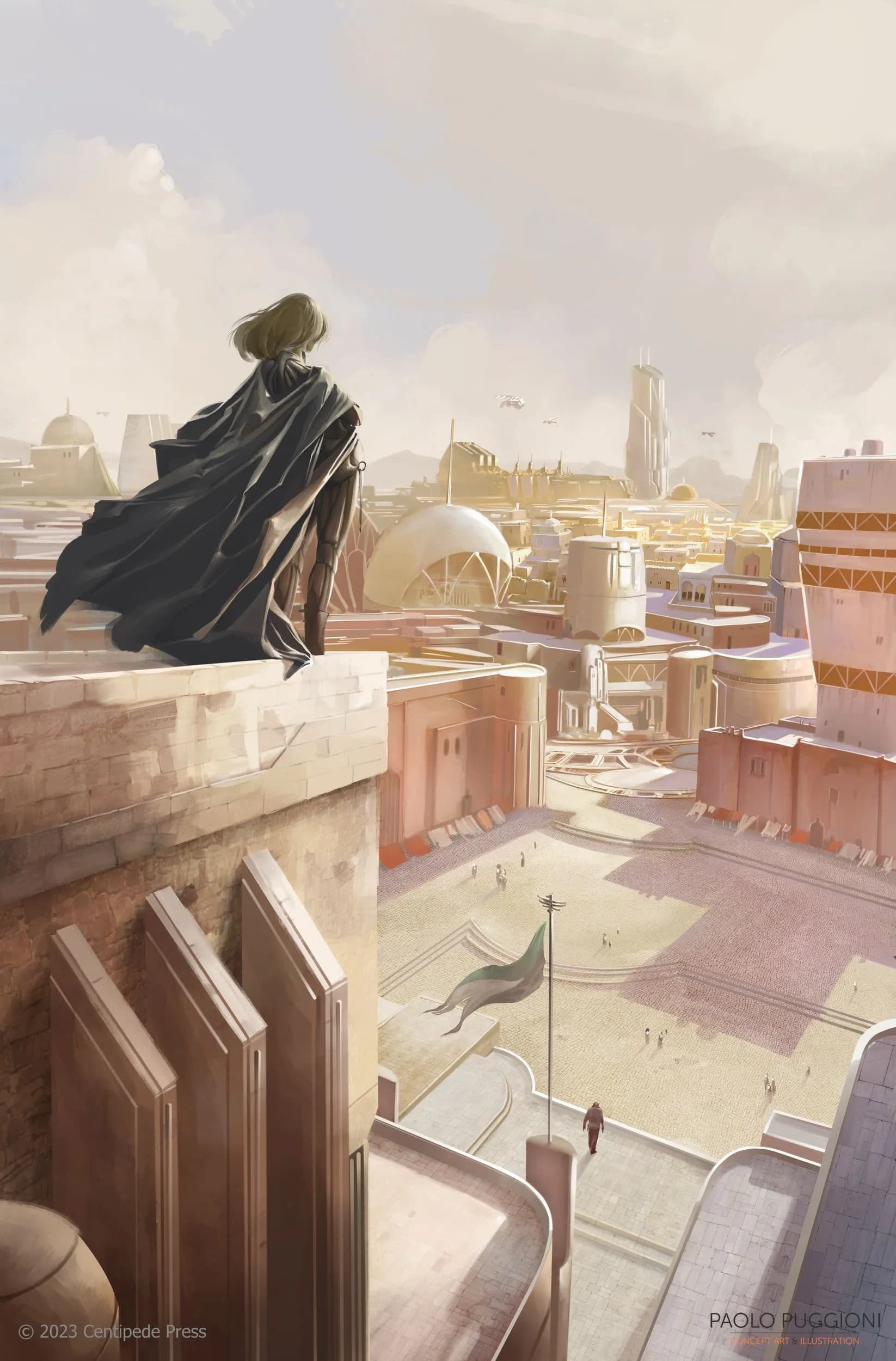
The temple presented a face built to overwhelm. Its sides ran two thousand metres, and its doors were larger than an entire ancient terran cathedral, proportions designed to reduce a pilgrim's soul to motedom before the visitor had set foot inside. The sides of the building were adorned with green and black banners, the colours of the Atreides. Above, the battlement was described as towering, and set into the structure was the gigantic Sun-Sweep Window, which incorporated every solar calendar known in history. (Children of Dune; The Dune Encyclopedia)
Stairs led up to the lower porch, which was often crowded with pilgrims and with the vendors who fed on their traffic. The temple fronted the Great Square of Arrakeen, and it was from a platform overlooking that square that Alia addressed the crowds below. The battlement concealed a hidden slit through which Alia could privately observe the square, watching the throngs of the faithful without being seen by them. (Dune Messiah; Children of Dune)
The Sacred Chambers#
The interior of the fane was known as the Sacred Chambers, and within it lay the Hall of Oracles, where Fremen worshippers often tracked in sand from the streets. The corridors of the temple ran in a maze that Duncan Idaho described as Sietch-like, a warren in stone that echoed the sietch communities of the deep desert. (Children of Dune)
The upper floors held living quarters. Alia's personal apartments were reached by a spiral staircase, and her room contained a bathtub, close by her training quarters, where the Regent maintained the blade skills that had made her name a byword. The temple also contained a Deathstill, the Fremen apparatus for reclaiming the water of the dead, a reminder that beneath the Imperial splendour the cult of St. Alia remained a desert faith. Below the temple lay dungeons, which in the final years of the Regency would receive prisoners whose names had once commanded the Imperium. (Children of Dune)
The cult of St. Alia of the Knife#
The temple existed to serve the veneration of Alia as St. Alia of the Knife, the sister of the Emperor who had killed the old Baron Harkonnen as a child. Alia often walked out on the platform overlooking Arrakeen to deliver a mass or an evening rite to her Fremen followers, and the ceremonies drew crowds that filled the Great Square. The pilgrimage itself was an act of submission. The final thousand metres of the approach to the temple was to be walked on the knees, so that every pilgrim arrived humbled before the doors that could have swallowed a cathedral. (Dune Messiah; Children of Dune)
The Preacher at the temple#
In the years of Alia's Regency the temple plaza became the stage for the fane's most dangerous critic. On the twenty-eighth day of mourning for the reportedly slain Leto II, The Preacher appeared in the plaza near the temple, his hand on the shoulder of his young guide Assan Tariq, and told the crowd that had fallen silent before him that he had come to preach in honour of Leto. Though his words were blatant heresy against the priesthood that ruled from the building above him, none moved to stop him as he departed the city. The blind wanderer, whom many suspected of being Muad'Dib himself, returned to Arrakeen again, and after he denounced her before the crowds he was at last stabbed to death on the temple steps by a priest. (Children of Dune)
Prison and downfall#
As the Regency of Alia curdled into tyranny, the dungeons beneath the temple filled. When the Naib Stilgar fled into the desert with the Princess Irulan and Ghanima Atreides, Alia's forces attacked his camp, captured them, and scattered his people. Stilgar carried one satisfaction with him into the dungeons beneath Alia's Temple, that he had killed the treacherous emissary Agarves, though he rightly guessed that Alia had chosen the man expecting exactly that fate for him. With Irulan and Stilgar imprisoned below her fane, Alia pressed Ghanima to accept the Corrino prince Farad'n. (Children of Dune)
Her forces, however, had been spread too thin. Leto II, protected and strengthened by the sandtrout skin he had taken in the desert, arrived at Alia's Temple and overcame his aunt's legendary prowess at hand to hand combat. Defeated, and possessed within by the ancestral persona of the Baron Harkonnen, Alia exerted the force of her own personality one final time. Rather than submit to a Fremen Trial of Possession, and over the protests of her inner voices, she flung herself from a high window to the courtyard below. It was recorded as her first independent act in years, performed before the eyes of her surviving family, and it ended the Regency in the shadow of the temple that had been raised to worship her. (Children of Dune)
Sources
- BookDune Messiah, Frank Herbert, G. P. Putnam's Sons, 1969
- BookChildren of Dune, Frank Herbert, G. P. Putnam's Sons, 1976
- BookThe Dune Encyclopedia, Willis E. McNelly (ed.), Berkley Books, 1984
Spotted a factual error or a primary source we missed? Email a correction. Every flagged claim gets reviewed.
Followed from this entry

Alia Atreides
Alia Atreides was the preborn daughter of Duke Leto Atreides and Lady Jessica, sister to Paul. Granted full ancestral memory in the womb, she ruled the Atreides Empire as Regent before succumbing to possession by her Harkonnen grandfather and taking her own life.
Arrakeen: the first city built on Arrakis
Sheltered by the Shield Wall near the northern pole, it held the Emperor's officials, House Atreides, then Muad'Dib's empire, then Leto II's festival city Onn.

Arrakis
Arrakis, known as Dune and later as Rakis, was a harsh desert world in the Canopus system and the only natural source of the spice melange. Home to the Fremen and the sandworms, it became the seat of the Atreides empire and the center of the known universe.
Duncan Idaho: reborn as ghola after ghola
Leto's Swordmaster died on Arrakis in the Desert War. The Tleilaxu brought him back again and again, serving the Atreides for five thousand years.

Ghanima Atreides
Ghanima Atreides was the pre-born daughter of Paul Muad'Dib and Chani, and the twin sister of the God Emperor Leto Atreides II. Married in name to her brother and consort to Farad'n Corrino, she seeded the Atreides, Harkonnen and Corrino bloodlines across the Empire.

House Atreides
House Atreides was a respected House Major of the Galactic Padishah Empire, ruled by a Duke and seated for twenty-six generations on the ocean world of Caladan. Through Paul Muad'Dib and his son Leto II, the Atreides line rose to rule the Known Universe before passing into a bloodline scattered across the millennia.
Mentioned in1 entry
Get new articles in your inbox
No spam. New lore drops, canon conflicts, and deep dives only when they’re worth reading.
Some links on Lore Fortress are affiliate links. If you buy through them we earn a small commission at no extra cost to you.