Cybernetics Core: forge that bound protoss spirits to steel
The cybernetics core was a protoss support structure famed for blending machinery with biological beings and psionics. Its essence translators bonded the spirits of fallen warriors to the exoskeletons of dragoons and other walkers, while its auto-fabricators and field systems gave protoss commanders the means to wage war against far larger armies.
The cybernetics core was a protoss support structure, and among the most storied buildings a protoss commander could raise in the field. Cybernetics cores were famed for their ability to blend machinery with biological beings and psionics, a union achieved through the advanced essence translators housed within their walls. It was here that the spirits of fallen protoss were bonded to the cold metal exoskeletons of the dragoons and other such walkers, and it was here that the auto-fabricators and materials needed to stage successful battlefield operations were kept ready. Wherever the Khalai made war, from the defense of Aiur to the far colonies, the cybernetics core followed as both armory and reliquary. (StarCraft manual; StarCraft Field Manual; StarCraft II: Legacy of the Void)
The essence translators#
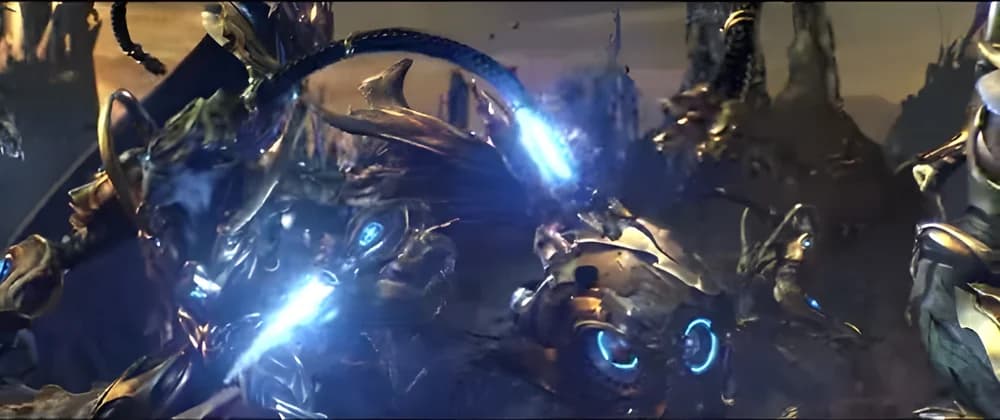
Within the cybernetics core were the necessary construction materials, automated factories, and the mysterious essence translators that gave the structure its reputation. The essence translators bonded the spirits of fallen protoss to the cold metal exoskeletons of the dragoons and other such walkers, preserving warriors whose bodies had been broken in battle and granting them a second life of service. The bond between spirit and machine was not immediate mastery. Eventually, by focusing through the Khala, the fallen warrior came to control the movements of the quadrupedal dragoon as naturally as if they still stood within their former bodies, the communal psionic link carrying the will of the pilot into limbs of metal. (StarCraft II: Legacy of the Void; StarCraft manual)
The most celebrated of those who passed through such a bonding was Fenix, the praetor whose body was recovered from Antioch after he fell to the zerg and implanted inside a dragoon exoskeleton, from which he greeted the executor on his return to Aiur. In him the promise of the essence translators was made plain: the machine did not erase the warrior, and those who had known Fenix in life knew him still within the walker. It was this fusion of flesh, machine, and psionic essence that made the cybernetics core famous among the structures of the protoss. (StarCraft)
Arsenal of the field encampment#
The essence translators were only part of the core's work. Cybernetics cores also provided protoss commanders with the necessary auto-fabricators and materials needed to stage successful battlefield operations, making the structure a practical foundation for any army in the field. The building itself was equipped with flux dissipators, photon stabilizer arrays, and phase alignment amplifiers, systems that gave protoss warriors a decided edge on the battlefield, where numbers were typically in the enemy's favor. A protoss host almost always fought outnumbered, and the core's machinery was one of the instruments that let quality answer quantity. (StarCraft Field Manual)
The core likewise opened the way to the more advanced arts of protoss war making. An encampment that had raised a cybernetics core could refine the weapons and armor of its aircraft within the structure, keeping the fleets that fought above the battle line as sharp as the warriors below it. The core's presence also widened what a settlement's gateways could call forth. With a cybernetics core standing, stalkers and sentries could be warped in to join the battle line, and the mothership core could be brought into the field. In the era of the Daelaam, commanders of every tradition raised the structure, and several among them, Karax, Vorazun, Alarak, and Fenix among their number, pursued the secrets of the warp gate through its systems. (StarCraft; StarCraft II: Wings of Liberty; StarCraft II: Heart of the Swarm; StarCraft II: Legacy of the Void; StarCraft II co-op missions)
Cores of the Tal'darim and the Ihan-rii#
The cybernetics core was not the possession of the Khalai alone. The Tal'darim utilized cybernetics cores in much the same way as the Khalai, binding biological beings to machinery within their walls, but they did so in an unimaginably painful way. Where the Khalai rite preserved a fallen warrior with reverence, the Tal'darim version reflected the harshness of a society built on ambition and suffering, and the union of flesh and steel it produced was bought in agony. (StarCraft II: Legacy of the Void)
Stranger still were the Ihan-rii. That enigmatic branch of the protoss utilized structures very similar to cybernetics cores in their settlements, identical enough in form to be recognized for what they were, yet these buildings produced a vastly different energy signature from the cores of the Khalai and Tal'darim. What the Ihan-rii worked within them, and how far their rites resembled the bondings of the essence translators, remained unknown. (StarCraft II: Legacy of the Void)
The core forge#
The most exalted form of the structure was the core forge, a protoss cybernetics core enhanced with xel'naga technology. In an alternate course of the End War, one in which the dark prelate Zeratul survived the war's opening stages, he utilized these structures against Amon's forces to support his war of resistance. The core forge did not depend on patient study as an ordinary core did. It was attuned to the relics of its makers, and as fragments of xel'naga artifacts were recovered, knowledge awakened within the forge of its own accord, each shard deepening the arts available to the host it served. In the forge, the cybernetics core came full circle: a structure built to join protoss spirit to protoss machine, raised at last to carry the science of the gods who had shaped the protoss themselves. (StarCraft II co-op missions)
Sources
- GameStarCraft, Blizzard Entertainment, 1998
- GameStarCraft II: Wings of Liberty, Blizzard Entertainment, 2010
- GameStarCraft II: Heart of the Swarm, Blizzard Entertainment, 2013
- GameStarCraft II: Legacy of the Void, Blizzard Entertainment, 2015
- BookStarCraft manual, Peter Underwood, Bill Roper, Chris Metzen and Jeffrey Vaughn, Blizzard Entertainment, 1998
- GameStarCraft II co-op missions, Blizzard Entertainment, 2015 onwards
- BookStarCraft Field Manual, Rick Barba, Insight Editions, 2015
Spotted a factual error or a primary source we missed? Email a correction. Every flagged claim gets reviewed.
Followed from this entry
Khala
The Khala was the communal psionic link and guiding philosophy of the Khalai protoss, founded by the mystic Khas to end the Aeon of Strife. It bound its adherents in shared emotion for over a thousand years until Amon corrupted it, forcing the protoss to sever it forever.

Mothership
The mothership was among the most powerful warships in the protoss arsenal, a vast support vessel that served as the flagship of the Golden Armada. Designed during the Golden Age of Expansion as a deep-space explorer, it was later armed and turned to war.

Aiur
Aiur was the homeworld of the protoss, a verdant world on the galactic fringe engineered by the Xel'Naga and seat of the Protoss Empire. It was overrun by the zerg in 2500 and reclaimed by the Daelaam after the defeat of Amon.

Alarak: the highlord who turned on Amon
Alarak won the Rak'Shir against Highlord Ma'lash and took the Tal'darim for himself. When Amon cast his people aside, he turned the death fleet on him.

Daelaam
The Daelaam was the unified protoss government that bound the Khalai, Nerazim, Purifiers, and some Tal'darim together after the fall of Aiur, led by Hierarch Artanis through the End War against Amon and the reclamation of their homeworld.

Dragoon
The dragoon is a protoss four-legged walker that gives a second life to Templar too gravely wounded to fight on foot. The crippled warrior is transplanted into the exoskeleton, where their psionic mastery directs its ranged phase disruptors.
Get new articles in your inbox
No spam. New lore drops, canon conflicts, and deep dives only when they’re worth reading.
Some links on Lore Fortress are affiliate links. If you buy through them we earn a small commission at no extra cost to you.