Drugs: the narcotics and medicines of the galaxy
Drugs were chemical substances that altered the normal bodily functions of an organism, and the galactic market for them was lucrative enough that criminal enterprises produced, sold, and smuggled them despite legal restrictions. They ranged from lifesaving antibiotics to red sand, a narcotic refined from element zero that granted brief biotic power, and to suppressants engineered to strip a biotic of that power entirely.
Drugs were chemical substances that altered the normal bodily functions of an organism, and across the settled galaxy the appetite for them fed a market large enough that criminal enterprises produced, sold, or smuggled them for considerable profit, whatever the local law had to say about it. Their effects ran the full span of chemistry, from antibiotics that held a dying drell's disease at bay to compounds that could raise or erase a user's biotic potential. The most infamous of them, red sand, was refined from element zero itself, while others served as tools of predators, instruments of Cerberus experimentation, or quiet staples of the galactic pharmacy. (Mass Effect; Mass Effect 2; Mass Effect 2: Lair of the Shadow Broker)
A trade woven through the galactic economy#
The legal standing of narcotics varied enormously from world to world. On Illium, an asari world whose lax commercial regulations kept it competitive with the neighboring Terminus Systems, drugs were legal so long as they were labeled properly, and sat on the market alongside weapons, restricted technology, and indentured servants. Deeper in the Terminus, drugs and vice were simply commonplace features of colonial life, growing in the same soil as piracy and political violence. Even the heart of Citadel space was not immune: the C-Sec officer Harkin spent twenty years on the force known for taking bribes and abusing drugs and alcohol, his lapses papered over by the human embassy. (Mass Effect; Mass Effect 2)
The trade's ugliest edges reached well beyond the users themselves. Batarian slavers were known to buy red sand addicts outright once the addicts could no longer afford to support their habit. The self-styled warlord Lord Darius, during negotiations with the Systems Alliance, demanded equipment to produce red sand as part of his price. The crime boss Helena Blake worked with business partners involved in red sand dealing, an arrangement she ended if Commander Shepard helped her. (Mass Effect)
Red sand: the dust of Mars#
Red sand was a stimulant with biotic-enhancing properties, originally created by criminal triads on Mars from refined element zero, and it may have taken its name from that red world. Because eezo was also used to create legitimate medicines, some held that red sand's discovery was a "fortunate" laboratory mistake. Taken nasally, it produced a brief but intense euphoria and gave the user very short-term telekinetic biotic abilities. The price was a red tinting of the user's vision, discoloration of the teeth, and longer-term withdrawal symptoms. It was normally sold in small bags, and street slang called its use "dusting up" or being "sand-blasted." (Mass Effect; Mass Effect 2)
Its reach across species was uneven. Asari and batarians were immune to red sand, and humans were the only race confirmed to be susceptible to its effects. Among humans, abuse ran disproportionately high in the non-biotic friends and relatives of biotics, often out of a misguided desire to understand what their loved ones experienced. Nor was the substance confined to back alleys: according to Matriarch Aethyta, selling red sand on Illium was perfectly legal provided the vendor held a permit. (Mass Effect; Mass Effect 2)
The drug's darkest chapter belonged to Paul Grayson, a Cerberus operative and red sand addict who quit the drug for the sake of his daughter after going on the run from the organization around 2183 CE. In 2186 CE Cerberus recaptured him as a subject for experiments with Reaper technology. His captors forcibly injected him with a liquefied, concentrated form of red sand and implanted a device to regulate his dosage, the goal being to sap Grayson's willpower so that the Reapers could more easily control his body. (Mass Effect: Ascension; Mass Effect: Retribution)
Enhancement and suppression: chemistry against biotics#
Most biotics owed their power to surgically implanted amplifiers, but some races experimented with biotic drugs such as red sand to stimulate power instead. The most potent enhancer in circulation was Minagen X3, an illegal red-colored chemical whose effect grew in proportion to the user's exposure, and which was lethal in large quantities. On Illium, the volus merchant Pitne For smuggled large quantities of Minagen X3 to the local band of Eclipse mercenaries. The mercenaries, unaware that the substance could kill, murdered his business partner Dakni Kur in retaliation, and their base filled with volatile canisters of the chemical. Released into the air, Minagen X3 enhanced the biotic abilities of anyone in the immediate vicinity, but prolonged exposure damaged kinetic barriers and, ultimately, the body itself. In the same mission a dazed volus, Niftu Cal, wandered about proclaiming himself a "biotic god," his apparent powers most likely the work of red sand or Minagen X3. (Mass Effect 2)
Cerberus attacked the problem from the opposite direction. In 2169 CE its Project Trapdoor secretly developed Omega-Enkaphalin, a biotic-suppressing drug known in the Shadow Broker's dossiers as O-E, which could be administered in small dosages to gradually reduce a biotic's powers for a limited time, with permanent damage a real possibility. Cerberus tested it on asari captives. In 2170 CE the organization used nanosurgery to instill resistance to O-E in its own operatives, a process successfully proven on the child designated Subject Zero, later known as Jack. A decade on, in 2181 CE, Cerberus turned O-E loose as a political weapon, dosing an influential asari matriarch who touted the superiority of biotics over non-biotics; as her powers visibly weakened, her claims were dismissed and her clout evaporated. Drugs served Cerberus in cruder ways as well: at the Teltin facility, staff injected the young Jack with narcotics during forced gladiatorial fights so that her mind would associate killing with euphoria. (Mass Effect 2; Mass Effect 2: Lair of the Shadow Broker)
Hallex and the hunt of an Ardat-Yakshi#
Hallex was a controlled substance, taken in pill form, that induced heightened senses and extreme euphoria in those who dosed themselves with it. Its most infamous user was Morinth, the asari Ardat-Yakshi, who both consumed the drug herself and offered it to her victims. The Hallex served her hunts by leaving her prey less aware of what was happening and heightening their desire to mate with her; the Omega citizen Nef fell victim to exactly this tactic. A bottle of Hallex sat openly on a table in Morinth's Omega apartment during the days when the justicar Samara closed in on her, and Morinth was willing to offer a pill to a guest even while remarking that she herself preferred to stay clear-headed. (Mass Effect 2)
The galactic pharmacy#
Most of the galaxy's drugs never touched the black market. Alburicin and cipoxidin were antibiotics used to treat drell suffering from Kepral's Syndrome, though patients with advanced cases could develop a resistance to either. Malanarin served the same purpose and worked on both drell and batarians, but it caused cramping in batarians and had to be supplemented with butemerol to relieve the side effects; Mordin Solus judged cipoxidin the slightly better drug of the pair. Rarer chemistry included cenozine, a hard-to-find and expensive catalyst that bonded to genetic markers, with demozane and heplacore as usable alternatives: heplacore was cheaper but inconsistent, while demozane was outright toxic to humans. (Mass Effect 2; Mass Effect 2: Lair of the Shadow Broker)
Human medicine had its own quiet staples. Eximo was a non-addictive narcotic depressant used to treat stress, often prescribed to executives and government officials who tended to overwork. Videlicet, a complex synthetic chemical, improved short-term memory and mental focus, and the two could be at cross purposes; one user, Elias Keeler, sought the Videlicet stimulant but could be given the calming Eximo instead. Samantha Traynor's family doctor prescribed her sucrocapsunol, a placebo pill supposedly for headaches. At the harder end stood tetraclopine, a neuromuscular degenerator present in trace amounts in common insecticides, which could paralyze a subject whose nervous system was already weakened. It worked on human and salarian physiology and on Thorian Creepers alike, and in 2183 CE a batch was adapted into gas grenades for Commander Shepard's use against the Thorian and its enthralled colonists on Feros. (Mass Effect; Mass Effect 3: Citadel)
Narcotics of the Andromeda galaxy#
The trade followed civilization across dark space. In the Heleus Cluster, the most popular drug on Kadara was Oblivion, discovered by the Initiative doctor Ryota Nakamoto and synthesized from a strain of Kadaran bacteria similar to penicillin. Highly addictive, it brought lethargy and hallucinations in high doses and could kill on overdose, and its sale and distribution were linked to the leadership of the Outcasts. (Mass Effect: Andromeda)
The angara contributed their own pharmacopoeia. Kichari was an injected angaran stimulant, ineffective against Remnant-induced stasis, while a double dose of the stimulant summa was regarded as dangerous to administer. The angaran antiseptic sumaar was harmless enough that Vetra Nyx could be found tracking some down in the marketplace on Aya purely to satisfy the scientific curiosity of Dr. Lexi T'Perro. (Mass Effect: Andromeda)
Sources
- GameMass Effect, BioWare, 2007
- GameMass Effect 2, BioWare, 2010
- GameMass Effect 2: Lair of the Shadow Broker, BioWare, 2010
- GameMass Effect 3: Citadel, BioWare, 2013
- GameMass Effect: Andromeda, BioWare, 2017
- BookMass Effect: Ascension, Drew Karpyshyn, 2008
- BookMass Effect: Retribution, Drew Karpyshyn, 2010
Spotted a factual error or a primary source we missed? Email a correction. Every flagged claim gets reviewed.
Followed from this entry

Biotics
Biotics was the ability of certain lifeforms to generate mass effect fields using element zero nodules grown through their bodies. Channelled through surgical implants and physical gestures, it let a wielder lift, hurl, and crush objects at a distance or raise protective barriers.

Element zero
Element zero, nicknamed eezo, was a rare material that released dark energy when subjected to an electrical current, letting it raise or lower the mass of everything in the resulting field. It underpinned faster-than-light travel, artificial gravity, and the biotic abilities of living beings.

Kinetic barriers
Kinetic barriers, commonly called shields, were repulsive mass effect fields projected from small emitters to deflect fast-moving objects. They protected starships and infantry alike from mass accelerator fire while leaving slow movement and ordinary contact untouched.

Matriarch Aethyta
Matriarch Aethyta was an unconventional, free-spirited asari matriarch who tended bar on Illium. Of mixed krogan and asari parentage, she was the absent father of Liara T'Soni and watched over her daughter from a distance.
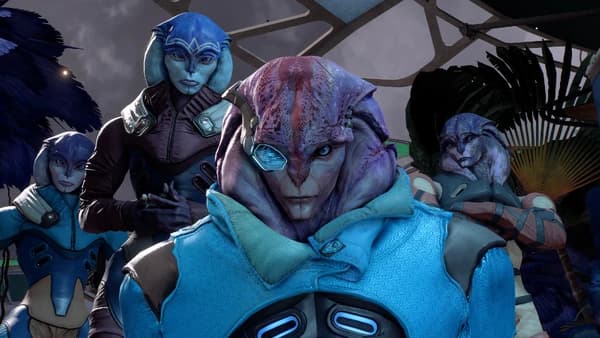
Angara
The angara were the only known living sapient race native to the Heleus Cluster of the Andromeda galaxy. After a catastrophe called the Scourge shattered their ancient civilization, they rebuilt only to face the invading kett, against whom they waged a decades-long resistance.

Asari
The asari, native to Thessia, were among the most influential species in the galaxy, renowned for their elegance, biotic talent, and millennium-long lifespans. A mono-gender people able to reproduce with a partner of any species, they founded the Citadel Council and stood at the heart of galactic society for two thousand years.
Get new articles in your inbox
No spam. New lore drops, canon conflicts, and deep dives only when they’re worth reading.
Some links on Lore Fortress are affiliate links. If you buy through them we earn a small commission at no extra cost to you.