Asgard
Realm of the Aesir
Asgard was the realm of the Aesir gods, perched in the crown of Yggdrasil and ruled by Odin from the hall of Gladsheim. Behind the great wall of Hrimthur it stood as a fortress against the prophesied doom of Ragnarok, until Kratos breached it and the realm fell.
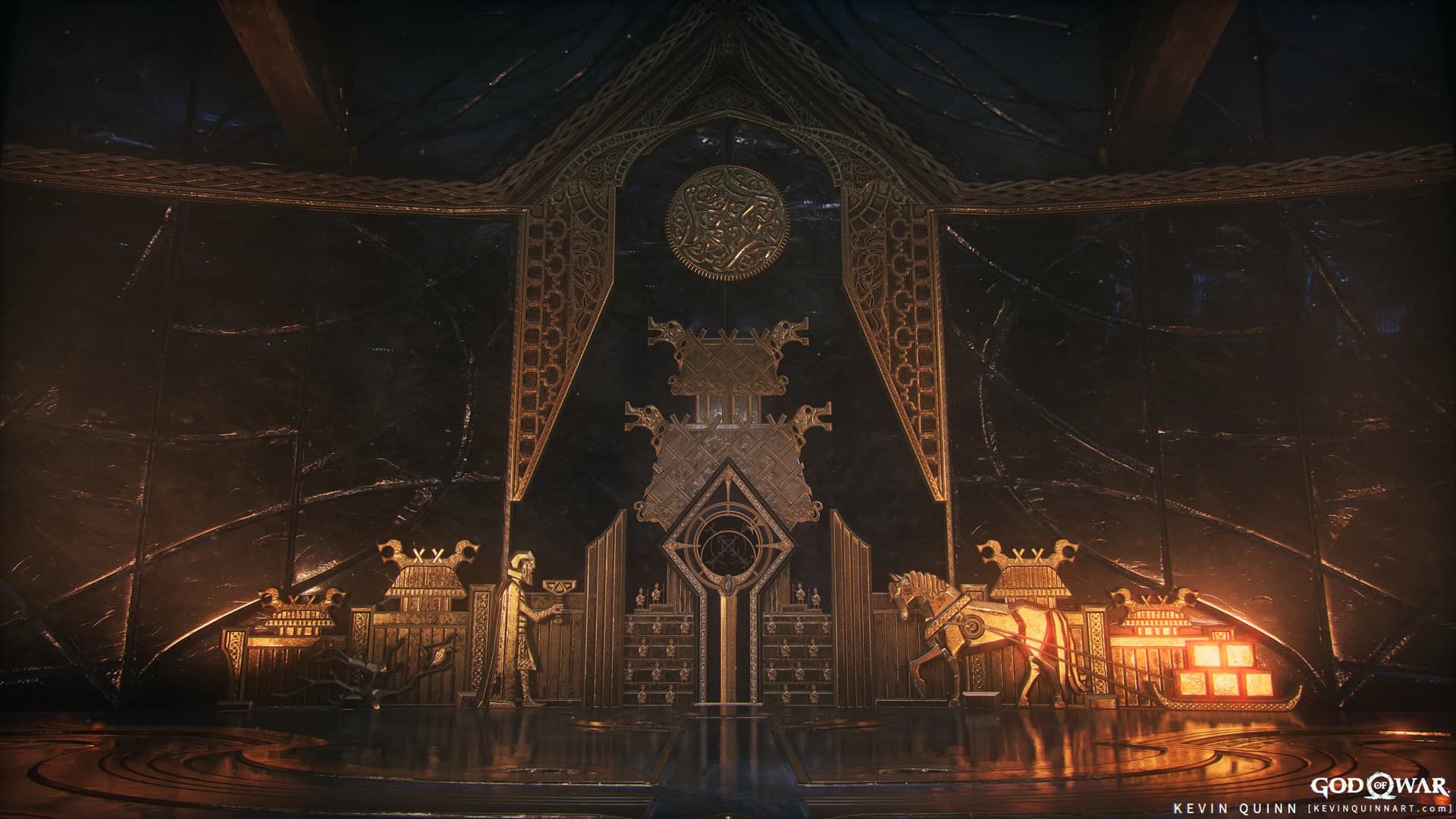
Asgard, known in Old Norse as Asgardr, was one of the Nine Realms of the World Tree and the home of the Aesir gods, from where they watched over the other eight realms. High in the crown of Yggdrasil, it was ruled since time immemorial by the All-Father Odin from his hall, and it was the final home of the bravest fallen warriors of Midgard, to which it remained connected by the burning rainbow bridge of the Bifrost. Traditionally associated with knowledge, war, and power, Asgard was nonetheless promised certain doom at the hands of the Jotnar at the time of Ragnarok, a fear that drove the Asgardians to turn their homeland into a fortress and to wage a ruthless campaign of conquest against the other realms. (God of War Ragnarök)
Government and the rule of Odin#
Though All-Father was a self-appointed title, Odin held enough charisma, authority, and power to rule both the Norse pantheon and the Nine Realms as a whole. He preferred to work behind the scenes, letting his henchmen do his bidding while he focused on gathering ever more knowledge. The burden of power and his fear of a prophesied demise made him increasingly greedy and paranoid, to the point where he did not hesitate to sacrifice even his closest followers. Prominent gods such as Tyr, Sif, and even Thor would ultimately turn on him, with dire consequences. (God of War Ragnarök)
Odin ruled through fear and information. With his ravens Huginn and Muninn as spies, he could be virtually everywhere at once and knew everything. He proved a pragmatic ruler when it suited him, ending the war with Vanaheim through his marriage to Freya and establishing total economic and political control over Svartalfheim with the help of Mimir, securing an endless supply of dwarven weapons and materials. Ultimately he ruled for the sake of his own power, not for his people or the realms. (God of War Ragnarök)
Military and the Einherjar#
The bulk of Asgard's army was the Einherjar, the fallen warriors of Midgard. After death in battle they were brought to Valhalla by the Valkyries, and upon receiving the All-Father's blessing they became bound to Odin and Asgard until Ragnarok. They did not spend their afterlife feasting; their purpose was to train endlessly in preparation for the final battle, instructed by the Valkyries in advanced combat and the use of the Bifrost. Their structure was rigidly hierarchical, each warrior specialized as a captain, archer, or thief. Their greatest strength was their ability to respawn in Valhalla whenever they were killed again, meaning Odin never ran out of reinforcements. Many Einherjar patrolled key areas throughout the Nine Realms. (God of War Ragnarök)
Geography and the wall of Hrimthur#
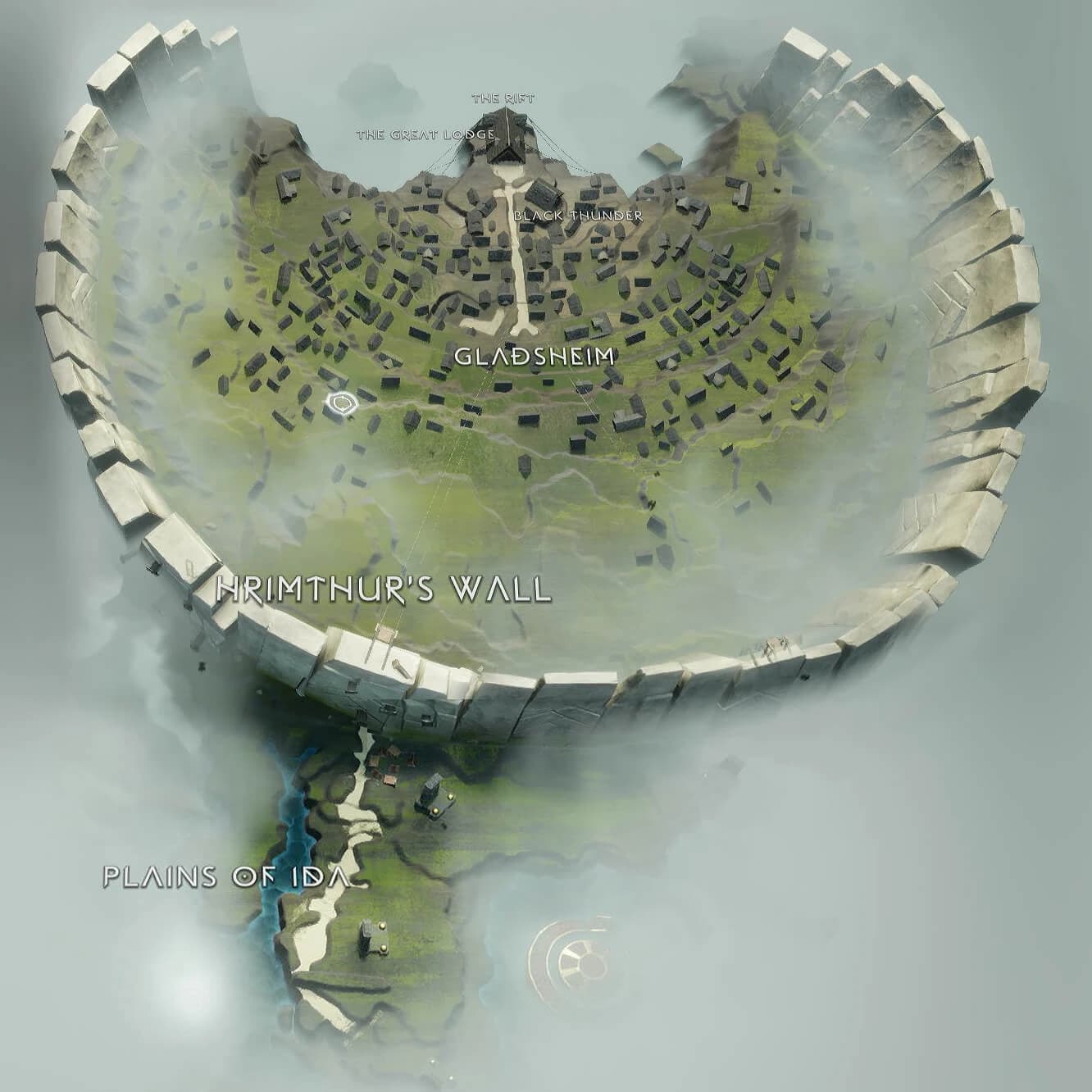
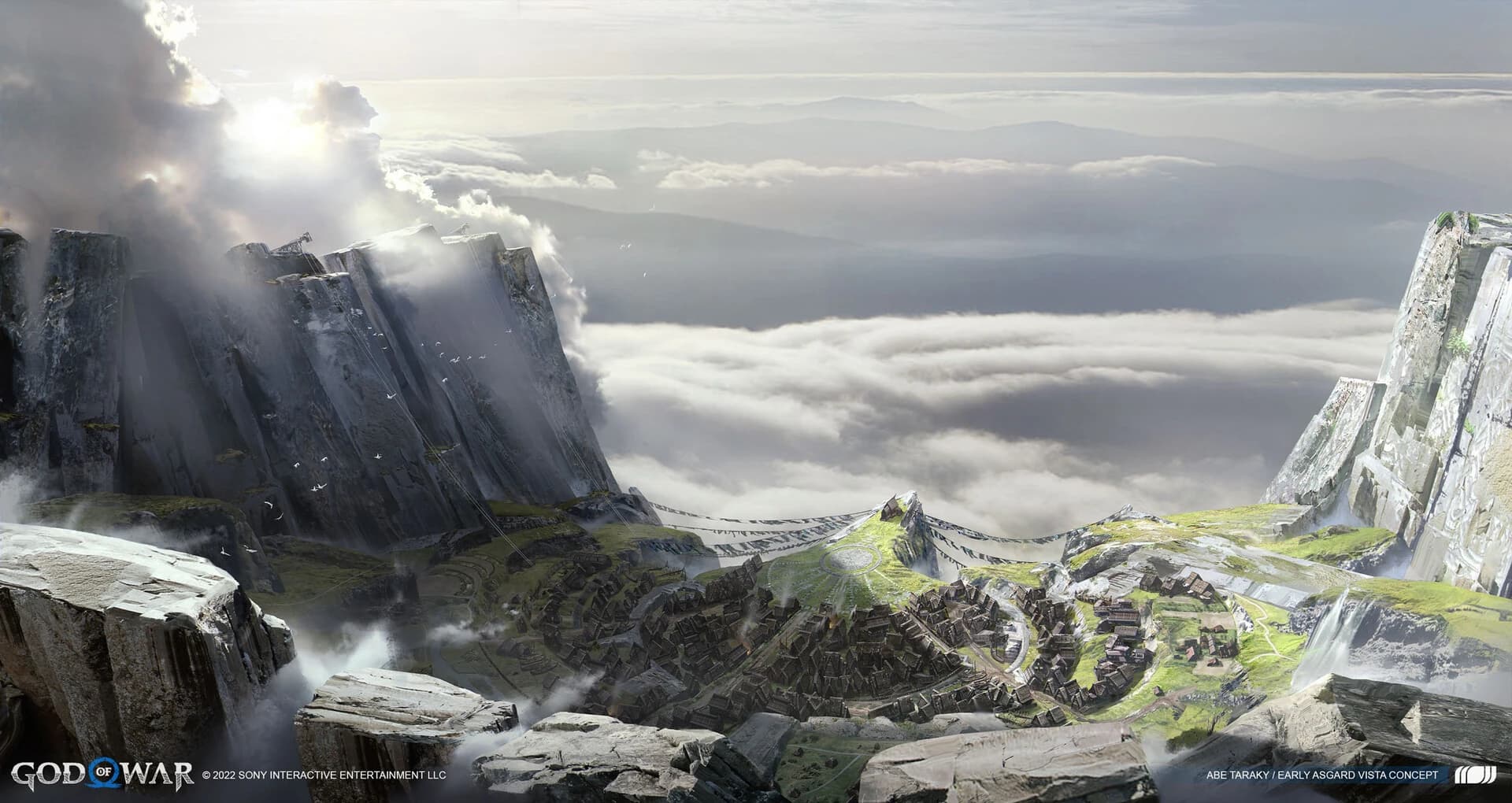
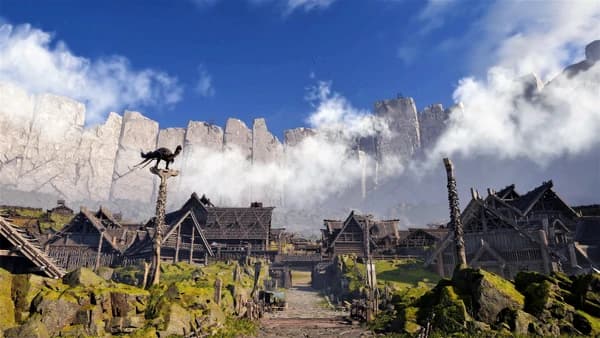
Asgard was a green and steep highland world surrounded by snow-capped mountains and crossed by vast expanses of water, with uninhabited plains called the Plains of Ida. Unaffected by the Fimbulwinter that ravaged Midgard, it was far safer and lusher than any of the other eight. The enormous wall dominated it, a raw rocky belt studded with giant rusted nails driven into the rock long ago by the giant Hrimthur. The wall protected the hall of Gladsheim and was considered impregnable, with a single hidden weakness known as Hrimthur's Flaw, concealed behind Asgard's Realm Tower. (God of War Ragnarök)
Within the wall lay Gladsheim, a settlement built in the Viking style rather than as a grand palace, which suited the humble image Odin had calculated for himself. The Great Lodge stood at the middle of it, home of the All-Father, his ravens, and the other Aesir, and beneath it lay the Rift, the source of Odin's obsession with knowledge. Nearby were the pub called Black Thunder, training grounds for the Einherjar, and the field of Vigridr, foretold to host the final battle. Many refugees from Midgard, seemingly brought there by Odin himself, had settled in the shadow of the wall, though Heimdall kept mortals out of the hall within. (God of War Ragnarök)
The mask and the invitation of Atreus#
While Kratos and Thor brawled on the frozen Lake of Nine, Odin invited Atreus into Asgard. Haunted by the prophecy of his father's death and frustrated by his inability to find answers, the young Jotunn eventually went, following Odin's raven Huginn. He was met first by Heimdall, the Bearer of Gjallarhorn, who toyed with him and read his mind before bringing him before the Great Lodge, where Thor and then Odin intervened. The All-Father adopted a benevolent manner, gave Atreus a room in Gladsheim, and presented him with what he called a major learning opportunity. (God of War Ragnarök)
Beneath the Great Lodge, in the Rift, a strange green light had appeared after Odin slew the first giant Ymir long ago. It shared a connection with a wooden mask whose pieces were scattered across the realms, inscribed in an ancient language Odin could not decipher. Believing Atreus gifted in forgotten tongues, Odin enlisted him to complete the mask, dangling the promise that it might reveal a way to save his father. The search took Atreus to Muspelheim, Helheim, and Niflheim, but the expeditions brought disaster, including the freeing of the great wolf Garm, and Atreus ultimately kept the completed mask for himself. (God of War Ragnarök)
Ragnarok and the fall of Asgard#
As Ragnarok approached, the Asgardians dug trenches and installed dwarven war machines around Hrimthur's Flaw, with the Einherjar under Queen Gna forming the bulk of the host and the Midgardian refugees pressed into piloting the machines. But it was not Heimdall who sounded Gjallarhorn as prophesied; it was Kratos, blowing the horn in Tyr's Temple. Odin's seal on the realms broke, and the armies of Alfheim, Helheim, and Vanaheim poured onto the plains of Asgard alongside Kratos, Atreus, Freya, Freyr, and the giants Fenrir, Angrboda, and Jormungandr. (God of War Ragnarök)
The wall was breached when Sindri exploited Hrimthur's Flaw and Atreus shot it open. In the devastated Gladsheim, Kratos spared Thor after defeating him a second time, and in fury at his son's disobedience Odin impaled Thor with his spear. Kratos, Atreus, and Freya then faced the All-Father himself, who proved a phenomenally deadly foe until their combined strength brought him to his knees. Atreus captured Odin's soul in a marble, but the vengeful dwarf Sindri shattered the stone, killing Odin for good in retribution for the death of his brother Brok. (God of War Ragnarök)
Aftermath#
Asgard's fate was sealed when Surtr, transformed into the primordial Ragnarok, shattered the wall and plunged his sword into Asgard's crust, killing himself and Freyr in a cataclysmic explosion. It imploded, the only one of the Nine that did not survive. Its destruction shook Yggdrasil to its roots, and its burning remains, the Remnants of Asgard, fell across the other eight realms. Odin's death and the ruin that followed broke the power of the Aesir, freeing the other realms after centuries of domination. The Valkyrie Queen Gna claimed leadership over the Remnants, while the surviving Asgardians who rejected Odin's ways followed Sif to a new home in Vanaheim. (God of War Ragnarök)
Frequently asked questions
- What is Asgard in God of War?
- Asgard was one of the Nine Realms of the World Tree and the home of the Aesir gods, high in the crown of Yggdrasil. Ruled by the All-Father Odin from his hall, it was the final home of the bravest fallen warriors of Midgard, connected to that realm by the rainbow bridge of the Bifrost.
- Who ruled Asgard?
- Asgard was ruled by Odin, the All-Father, a self-appointed title he held through charisma, authority, and power. He governed through fear and information, using his ravens Huginn and Muninn as spies so he could know everything, and ultimately ruled for the sake of his own power rather than for his people or the realms.
- What was the wall of Hrimthur in Asgard?
- The wall was Asgard's most striking feature, a raw rocky belt studded with giant rusted nails driven into the rock by the giant Hrimthur. It protected the hall of Gladsheim and was considered impregnable, with a single hidden weakness known as Hrimthur's Flaw, concealed behind Asgard's Realm Tower.
- Why did the Aesir conquer the Nine Realms?
- Asgard was promised certain doom at the hands of the Jotnar at the time of Ragnarok, and that fear drove the Aesir to turn their homeland into a fortress and wage a ruthless campaign of conquest. They even fought a centuries-long war against the Vanir of Vanaheim that ended only in a marriage between Odin and Freya.
- How was Asgard destroyed?
- When Kratos sounded Gjallarhorn in Tyr's Temple, the armies of the realms poured onto the plains of Asgard, the wall was breached, and Thor and Odin were killed. The fire giant Surtr, transformed into the primordial Ragnarok, shattered the wall and plunged his sword into Asgard's crust, imploding Asgard, the only one of the Nine Realms that did not survive.
Gallery
Images via God of War Wiki
Sources
- GameGod of War Ragnarök, Santa Monica Studio, 2022
Spotted a factual error or a primary source we missed? Email a correction. Every flagged claim gets reviewed.
Followed from this entry
Alfheim: the elves' war over the Light
Light and Dark Elves fought for centuries over the Light of Alfheim, the source that powers the Bifrost. It changed hands more than two hundred times.
Gladsheim: the hall of Odin
Gladsheim was the great hall and central settlement of Asgard, the heart of Odin's power. Sheltered behind the wall of Hrimthur, it was the seat of the Aesir and the place where Odin met his end during Ragnarok.
Helheim: the frozen hell even Odin feared
Those who died of age, disease or crime were sent to Helheim, a dark and unyielding cold where no fire burned. Even Odin could not last there long.
Lake of Nine
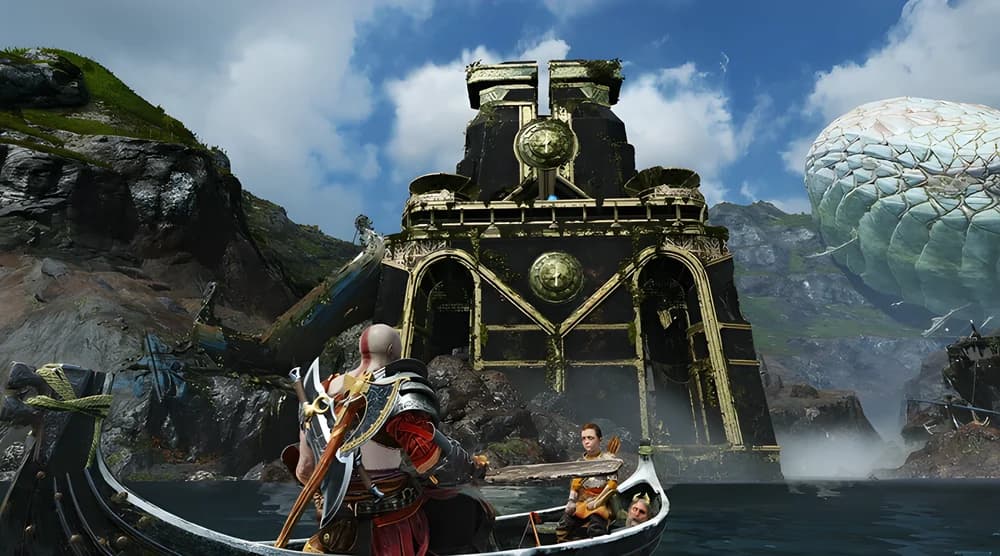
The Lake of Nine was the great central lake of Midgard, ringed by the towers of the Nine Realms and crossed by the World Serpent. It served as the hub from which Kratos and Atreus reached the far regions of the realm.
Midgard: Kratos' home, shaped from Ymir
Odin shaped Midgard from the body of the giant Ymir. Kratos settled there after leaving Greece, and Fimbulwinter later froze the Lake of Nine.
Muspelheim: the fire that would burn Asgard
Home of the Fire Giants and the source of all heat in the Nine Realms. Surtr was prophesied to burn Asgard down, and Kratos went there to ask him.
Mentioned in116 entries
Aesir Prison Wreckage: Odin's fallen prison in Niflheim
The Aesir Prison Wreckage was a region of Niflheim formed after Ragnarok, when an entire prison of Asgard crashed whole into the ice east of the Raven Tree. Within its cells Kratos and Freya found the true Tyr, whom Odin had hidden away, along with the tuning fork Sindri used to trigger Hrimthur's Flaw.
Aesir Royal Family: the Ruling Dynasty of Asgard
The Aesir Royal Family was the ruling dynasty of gods who reigned from Asgard over the Nine Realms. Descended from the first god Buri and led by Odin the Allfather, the line counted Odin's brothers Vili and Ve and his sons Thor, Tyr, Heimdall, and Baldur among its most prominent members.
Aesir-Vanir War
The Aesir-Vanir War was the long and brutal conflict between the two tribes of Norse gods, fought ages before Kratos came to the Northlands. It ended in an uneasy peace sealed by the marriage of Odin and Freya, only for Odin's treachery to reignite it.
Angrboda: the last giantess of Ironwood
Angrboda grew up almost alone in Ironwood, painting the prophecy of Ragnarok. She gave Atreus the soul marbles of the lost Giants and made him their keeper.
Atreus (Loki): Kratos's Son and the Truth of His Name
Atreus was the son of Kratos and the Jotunn Faye, born in Midgard and given the hidden name Loki. Across two great journeys he grew from a sickly boy into the prophesied champion of the Giants, the god of mischief whose fate was bound to Ragnarok.
Baldur: the god who could feel nothing
Freya's spell made Baldur invulnerable but stripped every sensation from him, and a century of numbness drove him mad. Kratos killed him beside Thamur's corpse.
Baldur's Curse: the spell of invulnerability
Baldur's curse was a spell of protection that Freya wove around her son to cheat a prophecy of his pointless death. It made Baldur impervious to every wound, whether dealt by weapon or sorcery, but it stripped him of all physical sensation, drove him into madness, and left mistletoe as its single fatal flaw.
Beyla
Beyla was a Dark Elf warrior of Alfheim and the wife of the Light Elf Byggvir. Having fled the endless war over the Light, the two joined Freyr's resistance in Vanaheim, where Beyla stood among the allies who aided Kratos against the forces of Asgard.
Birgir
Birgir was a Midgardian warrior and former Traveler who discovered that the Path he served was a lie of Odin, and forsook his brethren to fight for the Vanir. Branded a heretic, he became a loyal ally of Freyr in the resistance against Asgard.
Bragi
Bragi was one of the Aesir of Asgard, the god of poetry in Norse myth and husband of Idunn. He never appears in the games, but Mimir names him among the drunken Aesir who jeered as Freyr burned, the insult that helped start the First Great War.
Brok: the Huldra brother Odin murdered
Brok forged Mjolnir and the Leviathan Axe with his brother Sindri. Killed once and revived with an incomplete soul, he was stabbed by Odin disguised as Tyr.
Byggvir: the Light Elf of Freyr's resistance
Byggvir was a Light Elf of Alfheim who was imprisoned for seeking the forbidden history of his people and fell in love with his fellow captive, the Dark Elf warrior Beyla. The two abandoned the elven war over the Light and joined Freyr's resistance in Vanaheim, where Byggvir fought beside Kratos in the war against Asgard and survived it.
+ 104 more
Get new articles in your inbox
No spam. New lore drops, canon conflicts, and deep dives only when they’re worth reading.
Some links on Lore Fortress are affiliate links. If you buy through them we earn a small commission at no extra cost to you.