Why Do People In Star Wars Use Blasters Instead Of Guns?
Blasters won on logistics and stopping power. A single small gas canister feeds hundreds of shots, ammunition is cheap and light to carry, and bullets simply were not powerful enough. Even low grade armour that blasters cut through would reliably stop a slug.
Logistics and stopping power. One small plasma cartridge can give a blaster rifle over 500 shots, which makes blaster ammunition far lighter to carry than physical rounds, a serious advantage across a long war. The bigger problem was power. Bullets just were not powerful enough. Armour that a blaster bolt went straight through would comfortably stop most slugs. (Ultimate Star Wars; The Star Wars Sourcebook)
Conventional guns do exist, and they have a name#
The galaxy did not forget how to make a rifle. Conventional firearms are called slugthrowers, and the physical round they fire is a slug. They show up constantly once you start looking. (Aftermath: Life Debt; Obi-Wan and Anakin)
The reference material is full of them: cycler rifles, scatterguns, autopistols, needlers, Verpine shatter rifles and shatter pistols, sharpshooter's rifles, rotary cannons. On Brentaal IV, an inventor named Andel Tanner was said to have made a pair of slugthrower pistols more than 6,000 years before the Galactic Civil War, and they were still prized enough to be stolen from the musician Fitz Roi. (The Star Wars Sourcebook; Star Wars Adventure Journal 4)
They were in service in the modern era too. General Grievous, back when he was the Kaleesh warrior Sheelal, specialised in a slugthrower rifle during the Huk War and introduced his comrade Kummar to the Czerka Outland rifle. In the months before the Battle of Jakku, the bounty hunter Jas Emari carried a custom slugthrower rifle. (Unknown Soldier: The Story of General Grievous; Aftermath: Life Debt)
So the question is not whether the technology exists. It is why nobody built armies around it. (The Star Wars Sourcebook)
The Jedi problem cuts both ways#
There is a well-known argument that slugthrowers should have been standard issue against Force users. Point a lightsaber at an incoming slug and the metal melts on contact, and the molten result keeps going, straight into the face of the Jedi doing the deflecting. A lightsaber is superb at redirecting an energy bolt and much worse at stopping a lump of metal that behaves like a liquid the moment it touches the blade. Not every slug gets through, mind: skilled Jedi parry them without trouble. (Obi-Wan and Anakin; The High Republic: Light of the Jedi)
That is genuinely a better anti-Jedi weapon in the right moment. It is also a niche one. (Obi-Wan and Anakin)
Armies do not equip for the rare case. In a galaxy-scale war, the overwhelming majority of what a trooper shoots at is another trooper, a droid or a vehicle. Optimising every infantry weapon in the Galactic Republic around the handful of enemies who carry lightsabers would be a strange trade, and it would cost you on every other axis. That is our reading rather than anything a character says, but it follows from the rest. (The Star Wars Sourcebook)
Ammunition is the real argument#
Blasters convert a gas into a bolt. Tibanna is the famous variety, harvested from Bespin, but eleton, orveth, sig and skevon all served as blaster gas as well. That gas is compressed into a canister and fed through the weapon, and some blasters could get over 500 shots out of a single relatively small one. (Rogue One: The Ultimate Visual Guide; Ultimate Star Wars)
Now think about supplying an army with the equivalent in slugs. Five hundred rounds is weight, bulk and a manufacturing chain, per soldier, per resupply, across thousands of worlds. A canister and a power pack is a fraction of that. (Ultimate Star Wars)
Then there is cost. Lighter, simpler ammunition is cheaper to move, and in a long, drawn-out conflict that difference compounds. The Clone Wars ran for three years across the whole galaxy. The Galactic Civil War ran longer. Whoever is arming those fronts is thinking about cost per shot, not about the one Jedi in a hundred thousand engagements. (Revenge of the Sith; Return of the Jedi)
Bullets could not get through#
The decisive factor is the simplest one. Armour that could not stop a direct blaster hit was extremely effective against most slugs. Canon shows it too: on Haruun Kal, the natives' crude slugthrowers were useless against stormtrooper armour. (The Star Wars Sourcebook; From a Certain Point of View: The Empire Strikes Back, "The Final Order")
That single fact ends the debate. If a cheap set of plates on an average soldier reliably defeats a slug, then a slugthrower is not a weapon you can build an infantry doctrine around, no matter how well it works against a lightsaber. Meanwhile the blaster bolt goes through that same armour. (The Star Wars Sourcebook)
You can see the same logic playing out one tier up, with materials rather than armour grades. Cortosis was prized precisely because it could withstand energy weapons like blaster bolts and lightsabers, which made cortosis armour a genuine threat to the Jedi. Nobody needed an equivalent counter-slug material, because slugs were already being stopped by ordinary kit. (Thrawn: Alliances; The Star Wars Sourcebook)
Where slugthrowers survived#
They stuck around in the places where their weaknesses did not matter and their strengths did. (The Star Wars Sourcebook)
Bounty hunters, criminals and specialists kept using them. Palm shooters, needlers and shatter pistols are concealment weapons, and a slugthrower has no bolt to give away your firing position. Hunting rifles stayed slugthrowers on plenty of worlds. Verpine shatter weapons in particular had a reputation that had nothing to do with anti-Jedi work. (The Star Wars Sourcebook)
The pattern is exactly what you would expect from the economics. Blasters won the mass market because they were cheap, light on logistics and effective against armour. Slugthrowers persisted as a specialist tool for people who needed a specific advantage and were happy to pay for it. Legends even argues the blaster made slugthrowers more useful, since people stopped wearing heavy armour that could not stop bolts anyway. (The Star Wars Sourcebook)
The Jedi were never the design brief#
One last thing worth straightening out, because it is the source of most of the confusion. (The Star Wars Sourcebook)
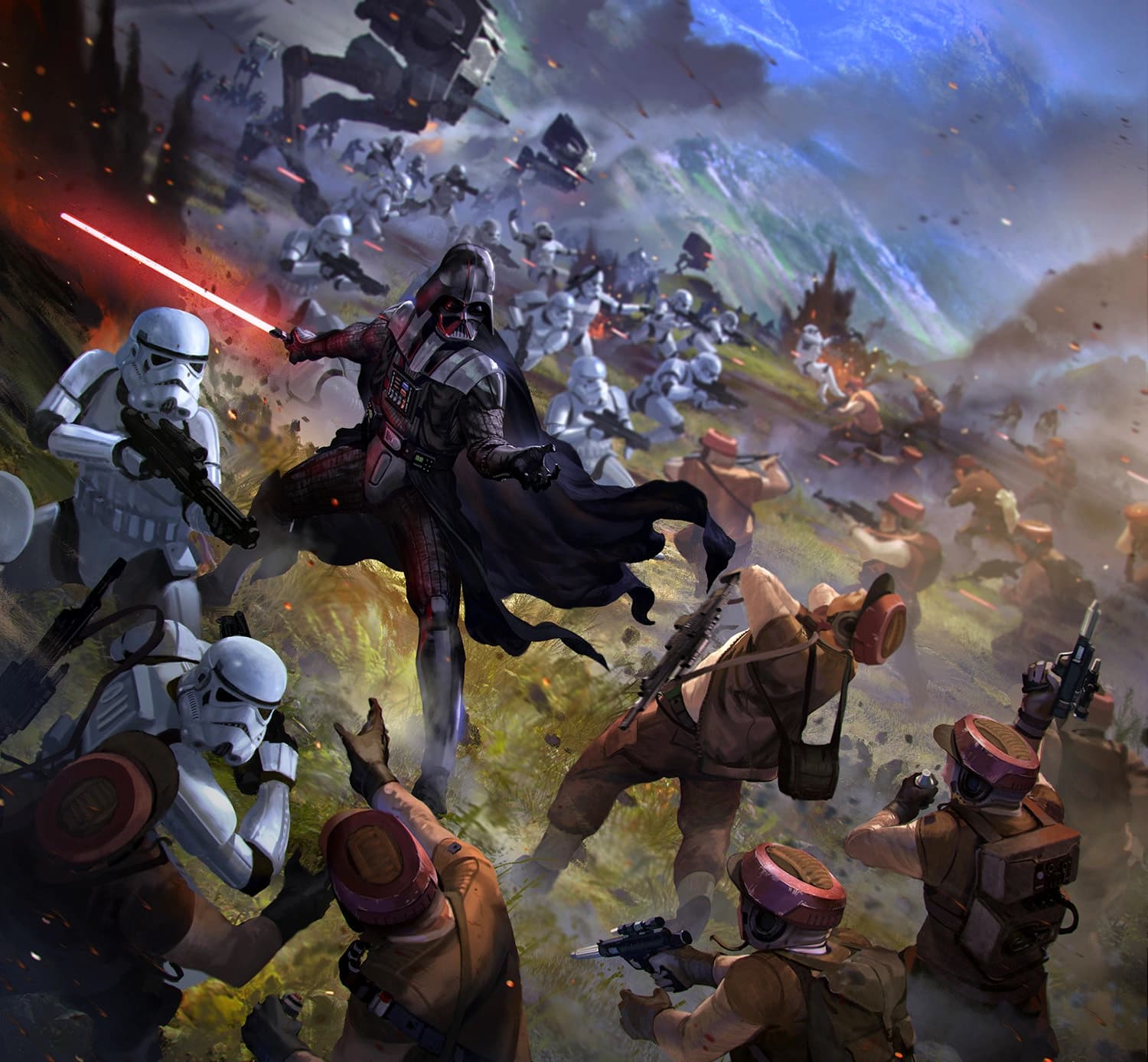
People frame this as a puzzle: the galaxy had a Jedi-killing weapon and refused to use it. But nobody in the Galactic Republic or the Galactic Empire was designing their standard infantry weapon around Jedi. Blasters were the dominant weapon for thousands of years before the Clone Wars, long before any war where killing Jedi at scale was the objective, and they stayed dominant after the Order was gone. (A New Hope; Revenge of the Sith; The High Republic: Light of the Jedi)
The Empire, which genuinely did hunt Force users, did not switch its stormtroopers to slugthrowers either. It sent Inquisitors with lightsabers of their own, because the answer to a Jedi was never small arms. It was another Force user, or overwhelming numbers, or an orbital bombardment. (Star Wars Rebels, "Rise of the Old Masters"; Revenge of the Sith)
Where anti-Jedi thinking did show up, it went into materials rather than ammunition. Cortosis armour and cortosis-clad battle droids were the actual attempt to solve the lightsaber problem, and the Confederacy tried exactly that during the Clone Wars. A slug that melts into a Jedi's face is a neat trick, but it only works once per Jedi and only if the Jedi tries to block it. (Thrawn: Alliances; Obi-Wan and Anakin)
Blasters are what an interstellar civilisation arms its armies with. Slugthrowers are what you bring when you have one specific problem and one chance to solve it. (The Star Wars Sourcebook; Obi-Wan and Anakin)
Frequently asked questions
- What is a slugthrower in Star Wars?
- A slugthrower is the galaxy's name for a conventional firearm, one that fires a physical projectile called a slug rather than an energy bolt. Cycler rifles, scatterguns and Verpine shatter rifles all fall under the category.
- Are slugthrowers better than blasters against Jedi?
- In one narrow sense, yes. A slug that meets a lightsaber blade melts, and the molten metal keeps travelling into the person holding the saber. Deflecting a bullet does not work the way deflecting a bolt does.
- How many shots does a blaster get from one gas canister?
- Some blasters could fire over 500 bolts from a single relatively small canister of blaster gas. That kind of ammunition density is close to impossible to match with physical rounds.
- Did anyone in Star Wars still use conventional guns?
- Yes. Slugthrowers turn up throughout the galaxy, from Grievous making his name with a slugthrower rifle in the Huk War to Jas Emari carrying a custom slugthrower rifle in the months before the Battle of Jakku.
Sources
- VideoA New Hope, Lucasfilm, 1977
- VideoReturn of the Jedi, Lucasfilm, 1983
- VideoRevenge of the Sith, Lucasfilm, 2005
- VideoRise of the Old Masters, Star Wars Rebels, season 1 episode 4, 2014
- BookAftermath: Life Debt, Chuck Wendig, 2016
- BookThe High Republic: Light of the Jedi, Charles Soule, 2021
- BookThrawn: Alliances, Timothy Zahn, 2018
- BookThe Final Order, From a Certain Point of View: The Empire Strikes Back, 2020
- ComicObi-Wan and Anakin, Charles Soule, Marvel, 2016
- BookUnknown Soldier: The Story of General Grievous, Star Wars Insider 86, 2006
- BookThe Star Wars Sourcebook, West End Games, 1987
- BookStar Wars Adventure Journal 4, West End Games, 1994
- BookUltimate Star Wars, Adam Bray, Cole Horton and Tricia Barr, DK, 2015
- BookRogue One: The Ultimate Visual Guide, Pablo Hidalgo, DK, 2016
Spotted a factual error or a primary source we missed? Email a correction. Every flagged claim gets reviewed.
Followed from this entry

Clone Wars
The Clone Wars was a galaxy-spanning conflict fought from 22 to 19 BBY between the Galactic Republic and the breakaway Confederacy of Independent Systems. Secretly engineered on both sides by the Sith, it ended with the Jedi purged and the Republic reformed into the Galactic Empire.

Confederacy of Independent Systems
The Confederacy of Independent Systems was the secessionist government of star systems that broke away from the Galactic Republic, sparking the Clone Wars. Led publicly by Count Dooku and backed by corporate powers, it was secretly controlled by Darth Sidious.
Galactic Civil War
The Galactic Civil War was the conflict in which the Alliance to Restore the Republic waged rebellion against the Galactic Empire. It ended with the Empire's defeat and the founding of the New Republic following the Battle of Endor.

Galactic Empire
The Galactic Empire was the fascist regime that replaced the Galactic Republic when Sheev Palpatine, secretly the Sith Lord Darth Sidious, proclaimed himself Emperor. It ruled the galaxy through fear, military power, and the hunt for the Jedi until its defeat at Endor and final collapse at Jakku.

Galactic Republic
The Galactic Republic was the democratic government that ruled much of the galaxy for over a thousand generations from its capital on Coruscant, served by the Jedi Order. After the Clone Wars it was reorganized by Palpatine into the Galactic Empire.

General Grievous
Grievous was a Kaleesh warlord rebuilt into a cyborg who served as Supreme Martial Commander of the Separatist Droid Armies during the Clone Wars. A feared Jedi hunter who collected the lightsabers of his victims, he led the Confederacy's forces until his death at the hands of Obi-Wan Kenobi.
Mentioned in1 entry
Get new articles in your inbox
No spam. New lore drops, canon conflicts, and deep dives only when they’re worth reading.
Some links on Lore Fortress are affiliate links. If you buy through them we earn a small commission at no extra cost to you.