Why Was It So Difficult For Non-Force Sensitives To Use A Lightsaber?
The blade has no mass but the weapon still fights you. Energy pouring through the kyber crystal creates a gyroscopic effect that makes a lightsaber pull and wobble in the hand. The Force lets a wielder feel the crystal's rhythm and cancel it out. Without that, you are wrestling the thing.
Because the weapon physically fights the person holding it. A lightsaber blade has no mass, but the way it works produces a gyroscopic effect that makes the blade pull against the hand. A Force user, attuned to the crystal inside, copes with that far more easily. Everyone else is wrestling a weapon that will not sit still. (Star Wars: The Complete Visual Dictionary, New Edition; Ultimate Star Wars)
What the weapon is actually doing#
A lightsaber looks like the simplest thing in the galaxy. Hilt, button, blade. It is not. (Star Wars: The Complete Visual Dictionary, New Edition)
Inside the hilt sits a power cell and a kyber crystal that has been attuned to the Force by its wielder. The crystal amplifies the energy from the cell to create the plasma beam, and it holds that beam inside a blade-shaped containment field. The blade that comes out has no mass at all. But the whole system runs on principles of controlled electromagnetic arc-wave energy, and that process creates a gyroscopic effect. (Star Wars: The Complete Visual Dictionary, New Edition; Ultimate Star Wars)
Anyone who has tried to turn a spinning bicycle wheel by its axle knows what that means in practice. The thing resists being moved off its axis, and it resists in a direction you did not ask for. (Star Wars: The Complete Visual Dictionary, New Edition)
The gyroscopic problem#
The difficulty is not the blade. It is the balance. (Star Wars: The Complete Visual Dictionary, New Edition)
Because there is no weight at the far end of the blade, none of a fighter's normal instincts help. A vibroblade or a sword tells you where its tip is through its own inertia. A lightsaber gives you nothing except the hilt in your fist and a gyroscopic force that shifts as you move, and the wielder ends up compensating for something they cannot feel properly. Legends puts it bluntly: the weightless blade and strong gyroscopic effect made the weapon extremely difficult, and dangerous, for the untrained. (Star Wars: The Complete Visual Dictionary, New Edition; Jedi vs. Sith: The Essential Guide to the Force)
For a Force user this is a solved problem before it is a problem. Kyber crystals are strange objects. They exhibit a kind of collective consciousness verging on sentience, and they can communicate non-verbally with living beings. A Jedi's crystal is bonded to its wielder, and the weapon is greatly enhanced in the hands of someone using the Force, so a Force user is working with the weapon rather than against it. That is a large part of why the Jedi treated mastering the lightsaber as a statement about skill and training rather than a formality. (Ahsoka; Ultimate Star Wars; Star Wars: The Complete Visual Dictionary, New Edition)
The people who managed it anyway#
The rule is not absolute, which is the interesting part. (Star Wars Rebels, "Trials of the Darksaber")
Cad Bane is the obvious short-term example. He specialised in fighting Jedi, duelled Obi-Wan Kenobi and Anakin Skywalker among others, and used a wide spread of weapons to hold his own. He never made a lightsaber his weapon, but one in his hands for a brief window is perfectly plausible. Sustaining it for a career is a different question. (The Clone Wars, "Hostage Crisis"; "Crisis on Naboo")
Sabine Wren is the long-term example. She found the Darksaber on Dathomir while the crew were hunting Maul, wanted nothing to do with it at first, and was talked into wielding it by Kanan Jarrus and Fenn Rau so she could unite the Mandalorians behind the rebellion. She got there through training, not talent, with little natural feel for the Force. She later became an apprentice of Ahsoka Tano on the same terms, and struggled at first to sense the Force at all. (Star Wars Rebels, "Visions and Voices"; "Trials of the Darksaber"; Ahsoka, "Part One: Master and Apprentice")
Din Djarin took the same weapon later and had the same problem. A Mandalorian with exceptional combat training and a lifetime of fighting behind him still had to learn the Darksaber from scratch, and the Armorer warned him that it would fight back if he struggled against it. (The Book of Boba Fett, "Chapter 5: Return of the Mandalorian")
Three routes around it#
There is more than one way through the gyroscopic problem, and only one of them involves being born lucky. (Star Wars: The Complete Visual Dictionary, New Edition)
The first is the Force, which is the standard answer and the reason the weapon is associated with Jedi and Sith in the first place. The second is sheer volume of training, which is Sabine's route and Din's route: enough repetition that the compensations become automatic even without any feel for the crystal. (Star Wars Rebels, "Trials of the Darksaber"; The Book of Boba Fett, "Chapter 5: Return of the Mandalorian")
The third is cybernetics, and General Grievous is the case study. He had no Force sensitivity whatsoever. What he had was a body rebuilt around the job and personal tuition from Count Dooku, and he went on to become one of the most prolific Jedi killers of the Clone Wars, collecting his victims' weapons as trophies. Implants can hold a blade steady in ways flesh cannot. (Revenge of the Sith; The Clone Wars, "Lair of Grievous")
Why almost nobody bothered#
Given all that, the galaxy's default choice makes sense. (Star Wars: The Complete Visual Dictionary, New Edition)
If you cannot touch the Force, a blaster gives you immediate reliable results and a vibroblade gives you a melee weapon that behaves the way a melee weapon should. A lightsaber gives you years of frustration first, and at the end of it you are still not as good as a Padawan. The weapon is not rare because the parts are hard to find. It is rare because for most of the galaxy it is simply the wrong tool. (Star Wars: The Complete Visual Dictionary, New Edition; Jedi vs. Sith: The Essential Guide to the Force)
Frequently asked questions
- Can a non-Force-sensitive use a lightsaber at all?
- Yes, for a while. Plenty of skilled fighters have picked one up and used it effectively in a short engagement. The difficulty is sustaining it, because the gyroscopic pull works against the wielder every second the blade is lit.
- What causes the gyroscopic effect?
- Lightsabers run on principles of controlled electromagnetic arc-wave energy, with the kyber crystal amplifying the power cell's output into a contained plasma blade. That process produces a gyroscopic effect, which is what makes the weapon awkward to handle despite the blade weighing nothing.
- How did Sabine Wren manage the Darksaber?
- Training, and a lot of it. Kanan Jarrus taught her, and she had little natural feel for the Force at the time. She learned to work with the weapon rather than through it.
- Why do most people in the galaxy carry blasters instead?
- Because a blaster does not argue with you. For anyone without the Force, a blaster or a vibroblade delivers reliable results immediately, while a lightsaber demands years of work before it stops being a liability.
Sources
- VideoRevenge of the Sith, Lucasfilm, 2005
- VideoLair of Grievous, The Clone Wars, season 1 episode 10, 2008
- VideoHostage Crisis, The Clone Wars, season 1 episode 22, 2009
- VideoCrisis on Naboo, The Clone Wars, season 4 episode 18, 2012
- VideoVisions and Voices, Star Wars Rebels, season 3 episode 11, 2017
- VideoTrials of the Darksaber, Star Wars Rebels, season 3 episode 15, 2017
- VideoChapter 5: Return of the Mandalorian, The Book of Boba Fett, season 1 episode 5, 2022
- VideoPart One: Master and Apprentice, Ahsoka, season 1 episode 1, 2023
- BookAhsoka, E. K. Johnston, 2016
- BookStar Wars: The Complete Visual Dictionary, New Edition, Pablo Hidalgo and others, DK, 2018
- BookUltimate Star Wars, Adam Bray, Cole Horton and Tricia Barr, DK, 2015
- BookJedi vs. Sith: The Essential Guide to the Force, Ryder Windham, 2007
Spotted a factual error or a primary source we missed? Email a correction. Every flagged claim gets reviewed.
Followed from this entry

Ahsoka Tano
Ahsoka Tano was a Togruta Force-user, Anakin Skywalker's Padawan during the Clone Wars who left the Jedi Order after being wrongly accused of treason. She survived Order 66, became the rebel agent Fulcrum, and outlived the Empire.

Cad Bane
Cad Bane was a Duros bounty hunter considered the best in the galaxy after the death of Jango Fett. A specialist in fighting Jedi, he worked repeatedly for Darth Sidious and was finally killed by his old apprentice, Boba Fett.

Clone Wars
The Clone Wars was a galaxy-spanning conflict fought from 22 to 19 BBY between the Galactic Republic and the breakaway Confederacy of Independent Systems. Secretly engineered on both sides by the Sith, it ended with the Jedi purged and the Republic reformed into the Galactic Empire.

Din Djarin
Din Djarin was a Mandalorian warrior and bounty hunter known across the Outer Rim simply as the Mandalorian. Hired to retrieve a Force-sensitive child, he instead became the foundling Grogu's protector and adoptive father.

General Grievous
Grievous was a Kaleesh warlord rebuilt into a cyborg who served as Supreme Martial Commander of the Separatist Droid Armies during the Clone Wars. A feared Jedi hunter who collected the lightsabers of his victims, he led the Confederacy's forces until his death at the hands of Obi-Wan Kenobi.
Jedi Order
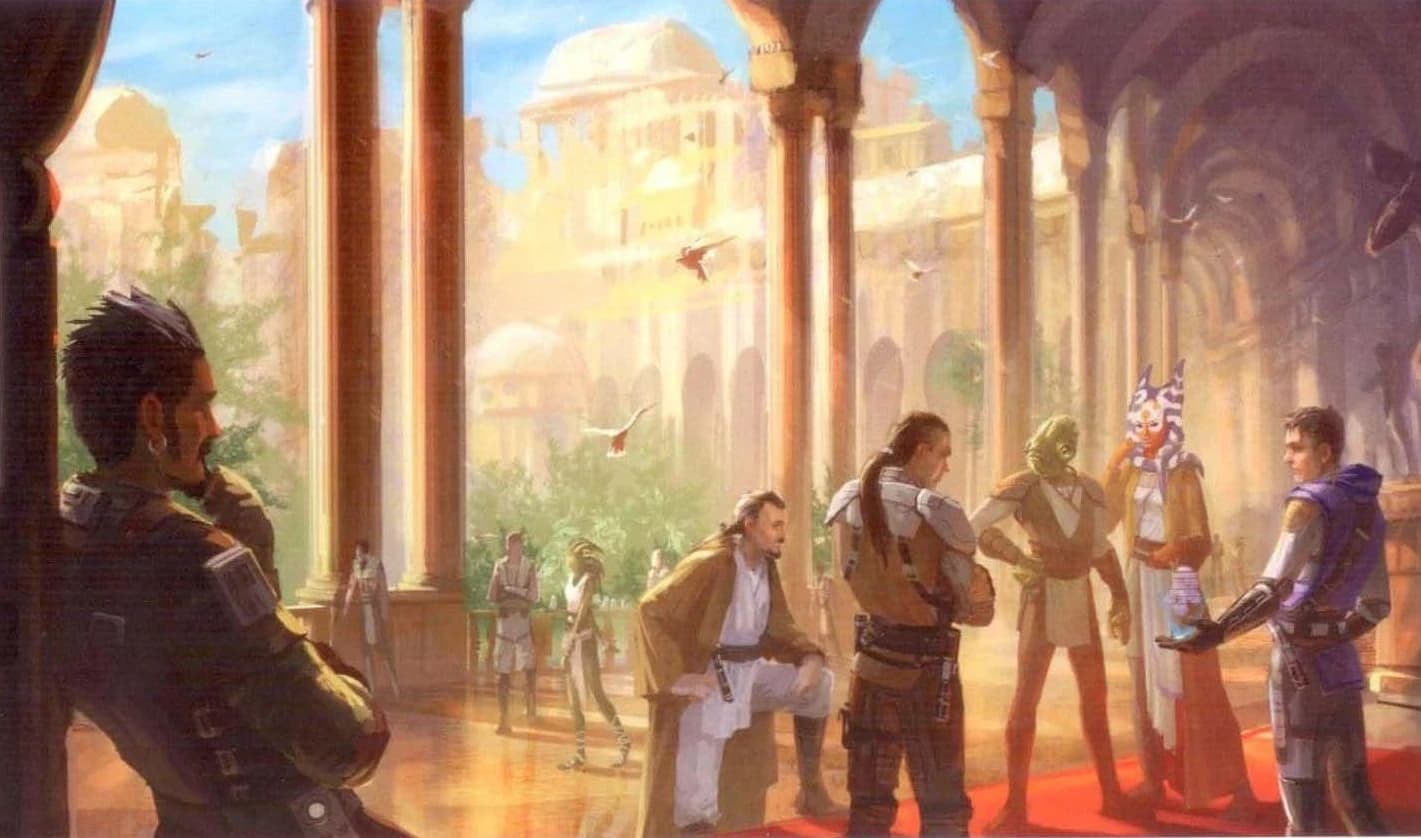
The Jedi Order was a monastic, nontheistic religious order devoted to the light side of the Force, serving for over a thousand generations as the guardians of peace and justice in the Galactic Republic. Nearly annihilated by Order 66, the Order endured through scattered survivors and was rebuilt, however briefly, by Luke Skywalker.
Get new articles in your inbox
No spam. New lore drops, canon conflicts, and deep dives only when they’re worth reading.
Some links on Lore Fortress are affiliate links. If you buy through them we earn a small commission at no extra cost to you.