Spice blow: the explosion that turns sand into melange
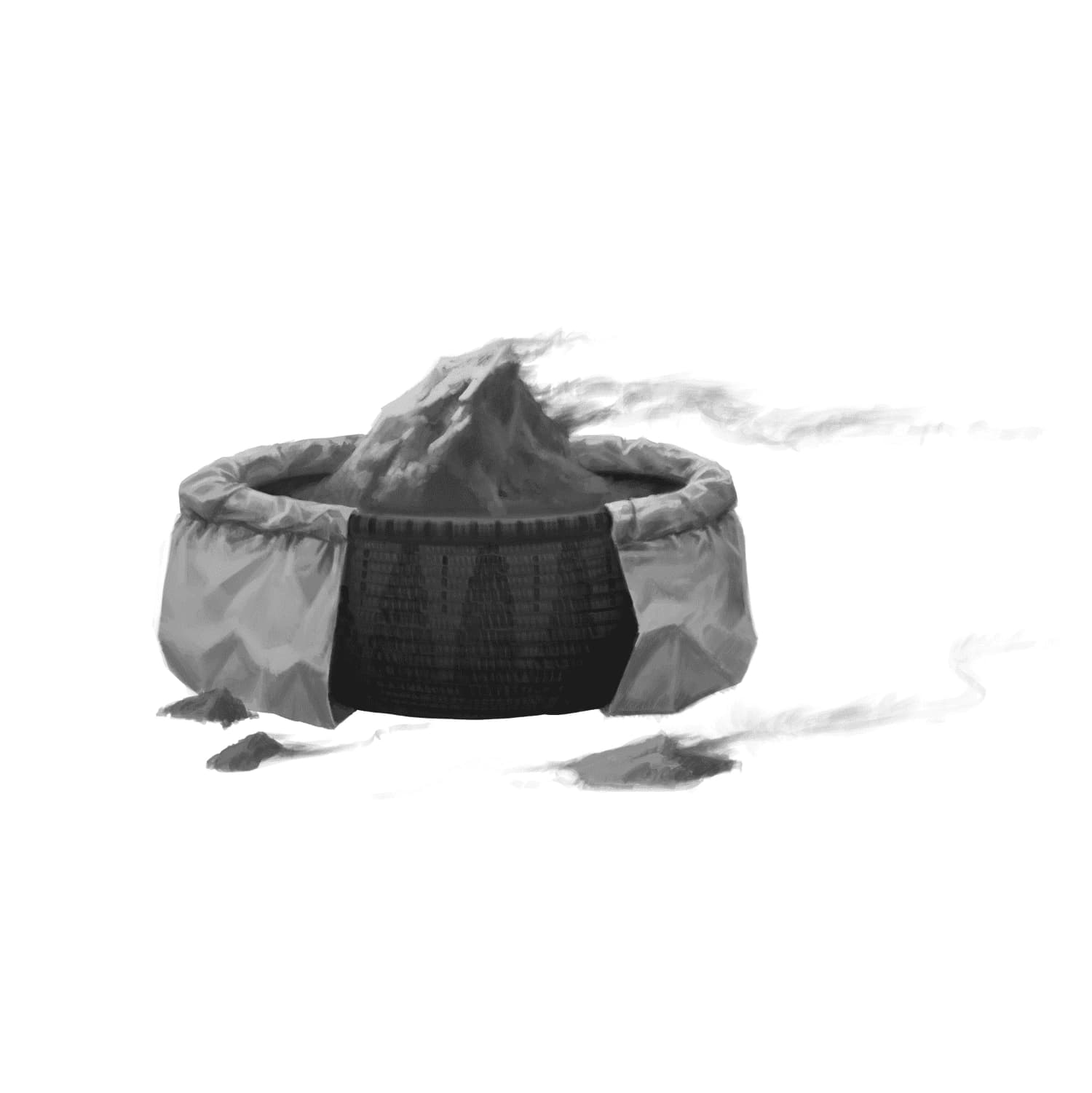
A spice blow was the violent final stage of the melange cycle on Arrakis, in which a carbon dioxide bubble built up inside a pre-spice mass and heaved the whole deposit to the surface in an eruption of dust and raw spice. Every Fremen knew the sound of one, every sandworm was drawn to it, and Liet-Kynes died inside one.
A spice blow, also written spiceblow, was the event on Arrakis in which a mass of pre-spice material deep beneath the desert reached its critical point and burst upward through the sand, throwing an enormous quantity of raw melange onto the surface. It was the last step of a cycle that began with the sandtrout and passed through the young sandworms the Fremen called little makers, and it was the reason the spice that held the Imperium together could be gathered at all. It was also lethal. Liet-Kynes was swallowed by one after the fall of House Atreides, and thousands of years later a blow beneath a shanty town on Rakis orphaned Sheeana Brugh. (Dune; Dune (appendix); Heretics of Dune)
The mass beneath the sand#
Everything in the spice cycle began with water, which on Arrakis was the one substance the desert could not tolerate. Sandtrout, the leathery flatworm stage of the sandworm's life, converged on any store of water deep beneath the surface and sealed it away. Where their excretions mixed with that water, a wild organic growth arose. This was the pre-spice mass, fungusoid in nature, and it developed far below the dunes out of anyone's sight. (Dune (appendix))
The organism responsible for feeding the growth was the little maker, the young sandworm. As the mass took up more water and more organic matter from the sandtrout around it, it swelled and gathered pressure. There came a point at which it passed into a stage of wild growth, and from there the outcome was fixed. The mass could not stay where it was. (Dune (appendix))
The bubble and the eruption#
At the critical stage a gigantic bubble of carbon dioxide formed deep in the sand at the centre of the mass. Pressure did the rest. The bubble heaved upward, forcing the whole deposit toward the surface, and broke through in a massive explosion with a whirlpool of dust spinning in the middle of it. The eruption traded places between two worlds: whatever had formed in the depths came up, and whatever had been lying on the surface went down. (Dune; Dune (appendix))
What came up was not yet spice. The raw material of the pre-spice mass became melange only after the blow, transformed by exposure to the sun and the air of Arrakis. That is why the spice could be taken in open sand by machine at all. The planet manufactured it deep, delivered it to the surface in a single violent movement, and then cured it in the heat. (Dune (appendix))
Reading a blow#
For the Fremen the blow was an event with a signature. Every Fremen knew the sound of one and could distinguish it immediately from the noise of worms or any other desert life, which meant that a sietch could tell from a distance whether the desert had just produced wealth or was about to produce death. Sound was the earliest warning available in open sand. (Dune)
Sight came next. A dark patch on the sand at range might be a spiceblow, and a crew that saw one would signal a hovering ornithopter across to investigate before committing anything larger. Spice mining depended on exactly this kind of reconnaissance. Spotters ranged ahead of the working ground, and when they read the cresting ripples of wormsign they reported to the carryalls so that a spice harvester could be lifted clear before the worm arrived. A fresh blow site was the richest ground a crew could find and the shortest-lived, because the thing that made it valuable also announced it to the one creature guaranteed to come. (Dune)
What the worms do#
Sandworms were drawn to spice blows and could not resist them. On Rakis, in the age long after the Scattering, every child knew that Shaitan would come to a blow, and the knowledge was elementary enough that it needed no explaining to anyone raised on the sand. (Heretics of Dune)
The attraction closed the cycle. Sandtrout massing on water produced the pre-spice mass, the mass blew, the worms came, and when the worms in their turn died they released sandtrout back into the sand so that the whole sequence could begin again. Nothing in the process was designed for human convenience. The Fremen and the mining crews simply learned to work inside a violent natural rhythm, taking what they could between the eruption and the arrival of the maker. (Dune (appendix); Children of Dune; God Emperor of Dune)
The death of Liet-Kynes#
The planetologist Liet-Kynes had spent his life reading the desert, and the desert killed him with the one process he understood better than any living person. After the fall of House Atreides on Arrakis, he was taken as an accomplice of the Duke and the Fremen and abandoned in open sand without water and without a stillsuit. (Dune)
He came to rest above a pre-spice mass that had reached its critical point. Heat exhaustion, dehydration and delirium had already taken him past the point where escape was possible, and in his last hours he heard his father reciting the whole body of his teaching on ecology. Then the bubble lifted him, broke, and the dust whirlpool dragged him down into cool darkness. The coolness and the moisture came as relief for a moment. It occurred to Kynes at the end that his father and all the other scientists had been wrong, and that the most persistent principles of the universe were accident and error. His dream of a green Arrakis lived on among the Fremen, and his daughter Chani became Paul's beloved. (Dune)
Sheeana and the village on the blow#
Millennia later the same mechanism produced a different kind of consequence. A shanty town on the outskirts of Keen, on the world by then called Rakis, had been sited disastrously on top of a pre-spice deposit. When the hoard far beneath came to fruition and expanded in an explosion of melange, the worms came as they always came, and consumed what was left of the settlement. (Heretics of Dune)
An eight year old girl named Sheeana watched from a distance while her parents and neighbours died. She then walked up to the worm that had orphaned her, and it did not kill her. It obeyed her. That single fact carried her to the priesthood at Keen and eventually into the Bene Gesserit, who used her ability to coax a worm aboard a ship before Rakis was burned, and so carried the spice cycle to Chapterhouse where sandtrout began turning a green world into desert. The blow that destroyed her village was, in the long account, the event that preserved the melange cycle after the planet that invented it was gone. (Heretics of Dune; Chapterhouse: Dune)
Sources
- BookDune, Frank Herbert, 1965
- BookDune (appendix), Frank Herbert, 1965; the appendices and Terminology of the Imperium printed with Dune
- BookChildren of Dune, Frank Herbert, 1976
- BookGod Emperor of Dune, Frank Herbert, 1981
- BookHeretics of Dune, Frank Herbert, 1984
- BookChapterhouse: Dune, Frank Herbert, 1985
Spotted a factual error or a primary source we missed? Email a correction. Every flagged claim gets reviewed.
Followed from this entry
Melange
Melange, commonly called simply the spice, was a naturally produced awareness spectrum narcotic found only on Arrakis. It was the foundation of commerce, longevity, and interstellar travel across the Imperium, the single resource capable of creating or destroying an empire.
The Scattering
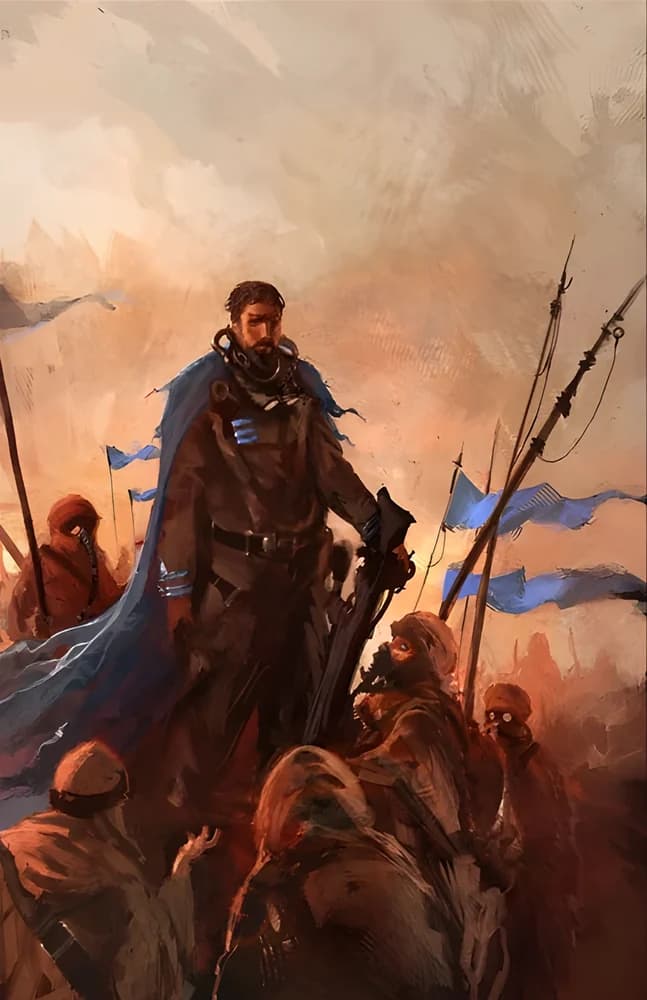
The Scattering was the great dispersal of humanity into uncharted space that followed the death of the God Emperor Leto II. Driven by famine and the collapse of his empire, countless humans fled the Old Imperium forever, fulfilling the design of the Golden Path.
Spice harvester
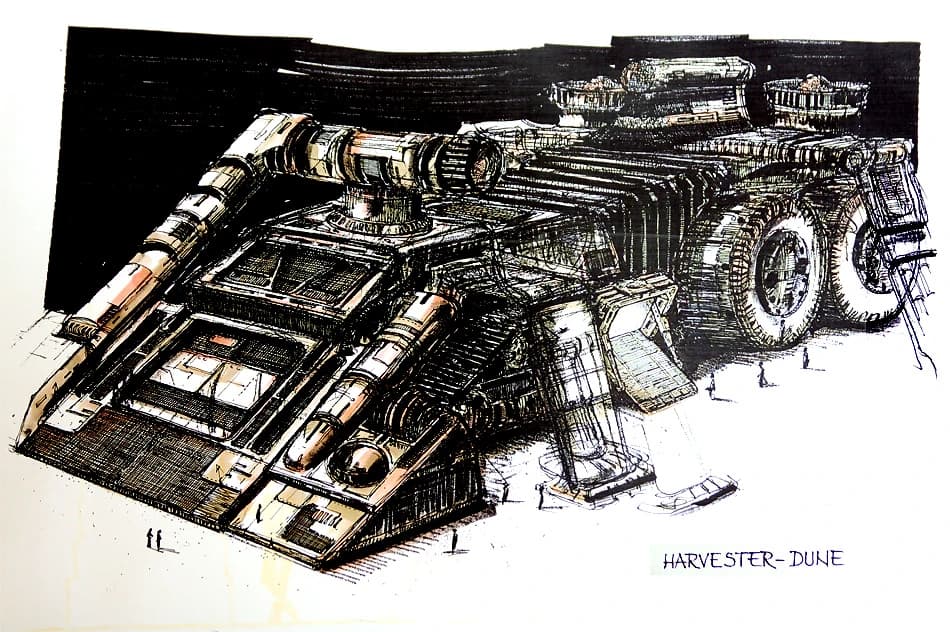
The spice harvester, also called a crawler, was a vast mobile factory used on Arrakis to mine and process melange from the desert sand. Dropped onto spice fields by carryalls and watched over by spotter thopters, harvesters worked under constant threat of the sandworms drawn by their rhythmic noise.
Arrakis
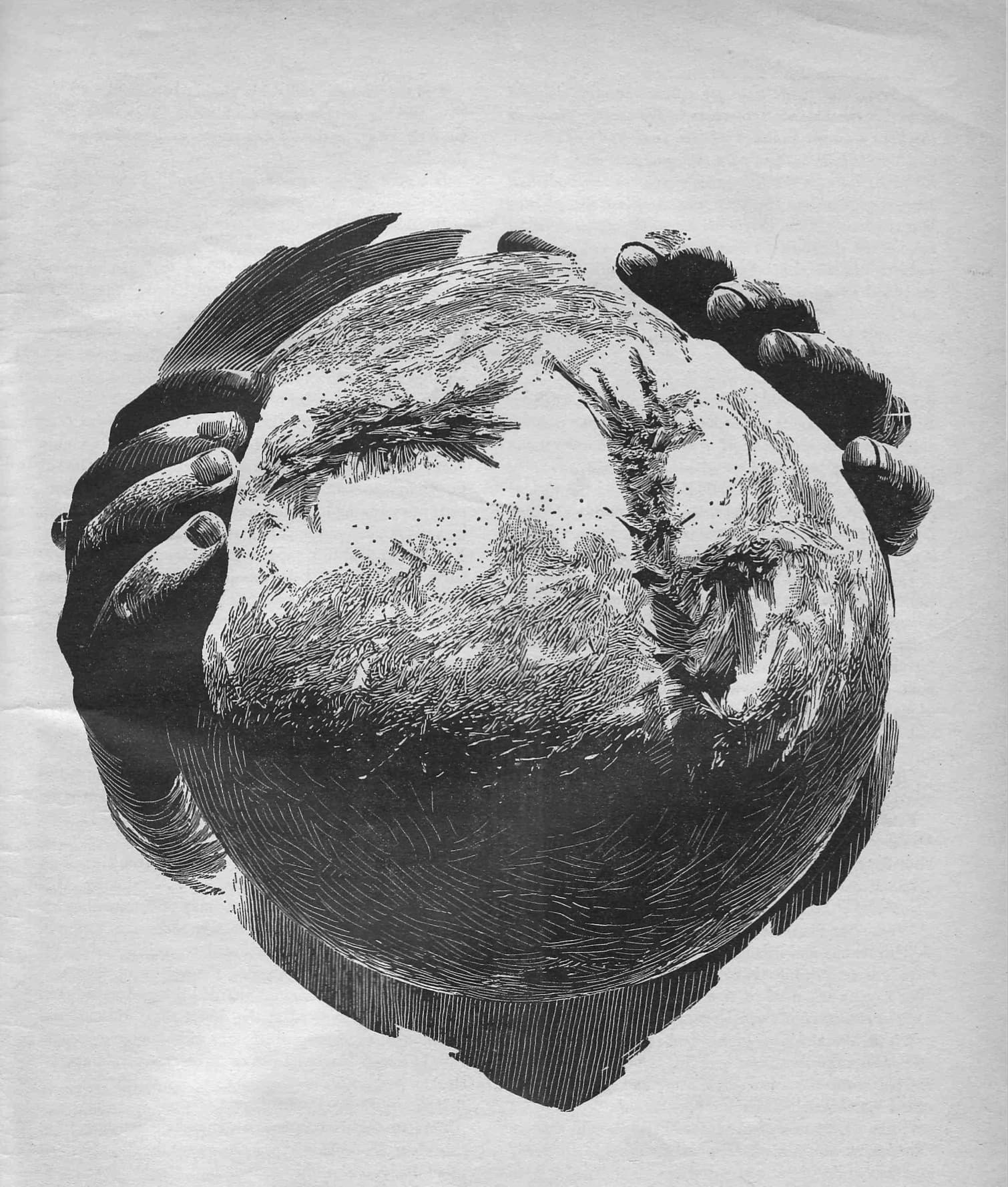
Arrakis, known as Dune and later as Rakis, was a harsh desert world in the Canopus system and the only natural source of the spice melange. Home to the Fremen and the sandworms, it became the seat of the Atreides empire and the center of the known universe.

Bene Gesserit
The Bene Gesserit were an ancient order of women who wielded power from the shadows of the Imperium through a millennia-long breeding program, mastery of body and mind, and the religious engineering of the Missionaria Protectiva. Their goal was the Kwisatz Haderach, and through him the guidance of humanity.
Carryall: the lifter of the spice harvest
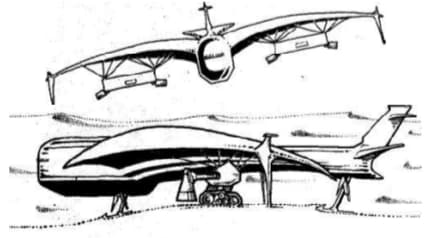
The carryall was a large winged aircraft used by spice mining teams on Arrakis. It ferried harvesters across the sand and, above all, lifted them clear when a sandworm came, making it indispensable to spice production.
Mentioned in2 entries
Dune Ending Explained: the Book's Plot Summary and Final Chapter
The whole plot of Frank Herbert's Dune in order, from the gom jabbar on Caladan to the duel with Feyd-Rautha in Arrakeen, then a plain explanation of the final chapter, what Paul wins, what he can no longer stop, and where the rest of the series goes from there.
Dune: Part One Ending Explained
The whole story of Denis Villeneuve's Dune: Part One in order, from the Emperor's gift of Arrakis to the duel with Jamis in the deep desert, then a plain explanation of the ending and the main ways the film differs from Frank Herbert's novel.
Get new articles in your inbox
No spam. New lore drops, canon conflicts, and deep dives only when they’re worth reading.
Some links on Lore Fortress are affiliate links. If you buy through them we earn a small commission at no extra cost to you.